
Choosing the wrong tanker equipment for your liquid bulk shipment doesn't just create a logistics inconvenience, it can contaminate your product, create a safety hazard, trigger a DOT violation, or all three simultaneously. Understanding the equipment options and matching them correctly to your product is one of the most critical decisions in chemical shipping.
This guide breaks down the tanker equipment used in liquid bulk transport by tank material, configuration, loading and unloading system, and DOT specification, so you can match the right trailer to your product the first time. Get the match wrong and the cost lands on your product, your schedule, or your compliance record, sometimes all three.
For more on liquid bulk freight, see our complete guide to liquid bulk freight.
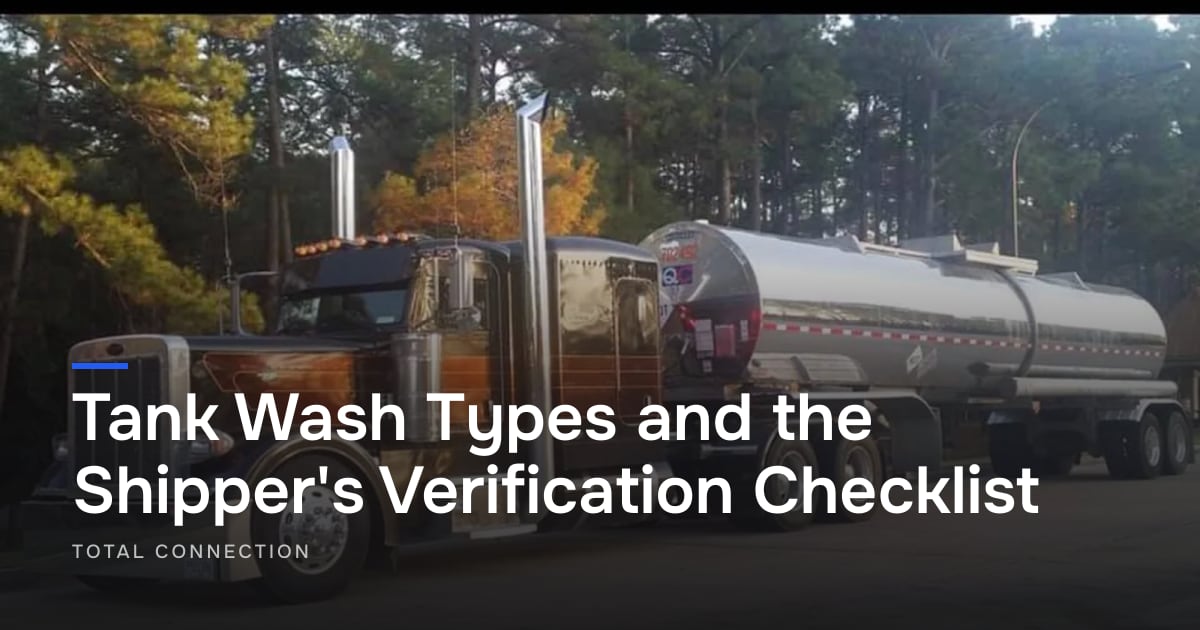
Tanker trailer types by material
Stainless steel tankers
The most versatile and most common tanker type for chemical freight. Stainless steel resists corrosion from most chemicals, cleans thoroughly, and maintains product purity. Available in several alloy grades, 304, 316, and 316L being the most common for chemical service. 316 stainless offers higher nickel content and better resistance to chloride corrosion than 304.
Aluminum tankers
Lighter than stainless steel, allowing more payload per trip before hitting DOT weight limits. Commonly used for petroleum products, some food-grade liquids, and non-corrosive chemicals. Not suitable for strong acids, strong alkalis, or chlorinated chemicals that attack aluminum.
Rubber-lined tankers
Stainless steel or carbon steel tanks lined with butyl rubber or other elastomeric materials. Used for corrosive chemicals, acids, caustic solutions, and other products that would attack bare metal. The rubber lining provides a chemical barrier between the product and the tank shell.
FRP (fiberglass reinforced plastic) tankers
Used for corrosive chemicals and some food-grade products. FRP tanks are lightweight, corrosion-resistant, and don't react with most chemicals. However, they're more fragile than metal tanks and can be damaged by impact.
| Tank material | Best for | Avoid |
|---|---|---|
| Stainless steel (304, 316, 316L) | Most chemicals, food-grade, high-purity products | Little it cannot handle; carries a cost premium |
| Aluminum | Petroleum products, non-corrosive chemicals, some food-grade | Strong acids, strong alkalis, chlorinated chemicals |
| Rubber-lined steel | Acids, caustics, and other corrosives | Solvents that attack the elastomer lining |
| FRP (fiberglass) | Corrosives and some food-grade products | High-impact service and high-temperature loads |
Tank configurations
Single compartment vs. multi-compartment
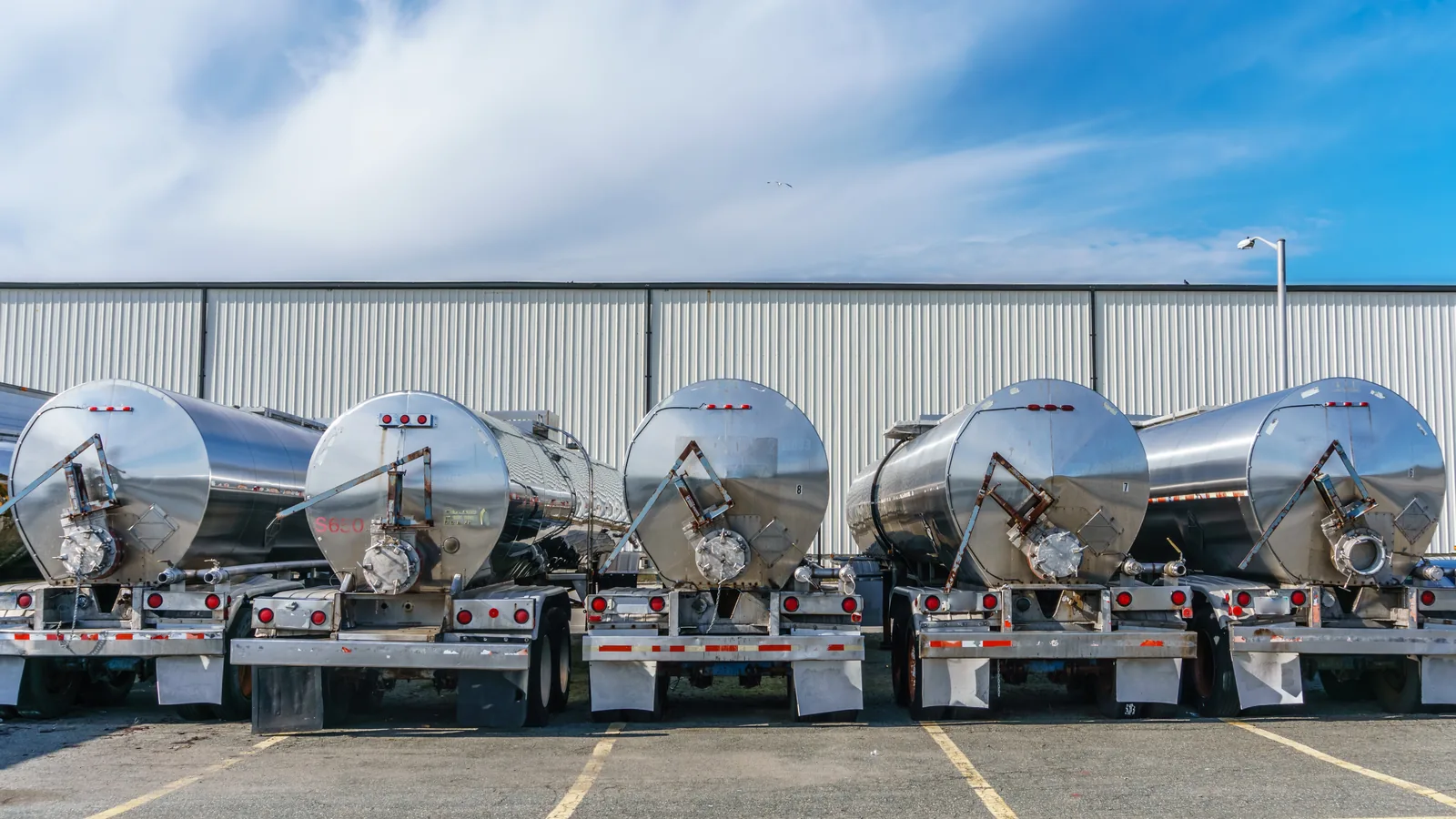
Single compartment tanks carry one product per load. Multi-compartment tanks, with 2, 3, 4, or even 5 separate compartments, can carry different products simultaneously. Each compartment has its own loading dome and unloading valve. Multi-compartment tanks are cost-effective for smaller volume shipments but add complexity to tank wash management.
Insulated vs. non-insulated (skin tanks)
Insulated tanks have a layer of fiberglass between the inner tank and outer shell, creating a thermos effect that maintains product temperature during transit. Non-insulated tanks (skin tanks) have no insulation, the product temperature changes with ambient conditions. Most chemical tankers are insulated due to the temperature sensitivity of many chemical products.
Heated vs. non-heated
In-transit heat systems use engine antifreeze circulated through coils in the tank floor to maintain product temperature. Dedicated heated tankers have independent diesel-fired heating systems for higher temperature requirements. Non-heated tankers rely on insulation alone.
Loading and unloading systems
Top loading vs. bottom loading
Top loading uses the manhole dome at the top of the tank. Bottom loading uses valves underneath the trailer. Bottom loading reduces vapor emissions and is required for some volatile chemicals. See our full guide on liquid bulk tanker loading and unloading procedures for the operational details.
Pump-off vs. air-blown unloading
Pump-off uses a pump to move product from the tank to the receiving facility's storage. Air-blown unloading uses compressed air to push product out of the tank. The choice depends on the product, flammable liquids should not be unloaded with compressed air due to static electricity risk. Corrosive liquids should not be pumped through metal pumps.
Center unload vs. rear unload
Center unload tanks have a sump and valve in the middle of the tank floor. Rear unload tanks have the valve at the rear. The choice depends on the receiving facility's configuration and unloading infrastructure.
DOT specification tanks
Three DOT and MC tank specifications cover most liquid bulk freight, and the product dictates which one is legal to use:
- DOT 407: the standard non-pressure spec for most chemical tanker trailers, with a maximum capacity around 7,000 gallons. It carries the majority of liquid bulk chemical freight.
- DOT 412: a corrosive-service spec for strong acids and caustics, built to higher construction standards than the 407 with additional safety features.
- MC 331: a pressure spec for compressed and liquefied gases such as anhydrous ammonia and propane, which must move under pressure.
Intermodal equipment: ISO tanks and flexitanks
Not all liquid bulk moves in a highway tanker. For international and rail moves, two intermodal options matter. An ISO tank is a stainless steel pressure vessel built into a 20-foot frame that transfers between truck chassis, rail, and ocean vessel without decanting the product, which makes it the default for export chemicals and many hazmat lanes. A flexitank is a single-use bladder that converts a standard 20-foot dry container into bulk liquid capacity of roughly 6,300 to 6,600 gallons, suited to non-hazardous food-grade and industrial liquids where a lower cost per shipment outweighs the lack of reuse. Choosing between them comes down to hazmat classification, volume, and whether the lane is domestic or export. See our guide to ISO tank container shipping for the details.
How to choose the right equipment
Equipment selection starts with four questions:
- What is the chemical product, and what does its SDS say about material compatibility?
- What are the temperature requirements: does the product need to be heated, insulated, or shipped ambient?
- What are the loading and unloading requirements at both origin and destination?
- What hazmat classification applies, and what DOT tank specification does it require?
Your liquid bulk freight broker should be able to answer all four questions and match you with a carrier who has the right equipment. If they can't, or if they need you to specify the equipment, they're not a liquid bulk specialist.
Common equipment selection mistakes
The same equipment errors show up again and again in chemical freight, and each one is avoidable:
- Specifying aluminum for a corrosive product to save weight, then watching it pit the tank and contaminate the load.
- Booking a non-insulated skin tank for a temperature-sensitive product that crystallizes before it reaches the receiver.
- Overlooking that the receiver requires bottom unloading or a specific dry-disconnect fitting, which strands the truck at the dock.
- Treating a DOT 407 and a DOT 412 as interchangeable, when strong acids and caustics legally require the 412 specification.
How Total Connection matches equipment to your product
Equipment matching is a core competency at Total Connection. When you tell us what you're shipping, we already know what tank material, configuration, insulation, and heating requirements your product needs. We verify equipment specifications with the carrier before dispatch, not after the truck arrives at your facility with the wrong setup.
The same desk that specs your tanker also coordinates the drayage, the inland truckload, the warehousing, and the export ocean leg, so one team owns the equipment decision and everything downstream of it.
Call 732-817-0401 or request a quote. Tell us the product and we'll tell you the equipment.
Frequently Asked Questions
What is the most common tanker type for chemical shipping?
Stainless steel DOT 407 tankers are the most widely used for liquid bulk chemical freight. They hold approximately 6,000-7,000 gallons and are compatible with the broadest range of chemical products.
How do I know which tanker type my product needs?
Start with your product's SDS, it specifies material compatibility requirements. Your liquid bulk broker should match the tank material, insulation, heating, and configuration to your product's specific requirements. At Total Connection, equipment matching is a standard part of every quote.
What's the difference between DOT 407 and DOT 412 tankers?
DOT 407 is the standard specification for most non-pressure chemical tankers. DOT 412 is a higher-specification design for corrosive service, strong acids and caustics, with additional construction standards and safety features.
Can one tanker carry multiple chemicals?
Multi-compartment tankers can carry different products in separate compartments simultaneously. Each compartment has its own loading and unloading system. However, multi-compartment shipping adds complexity to tank wash management and product segregation.
Does Total Connection verify equipment before dispatch?
Yes. We confirm the tank material, DOT specification, configuration, insulation, and heating capability with the carrier before the truck is dispatched to your facility. Equipment verification is standard on every shipment.