
An ISO tank container is a stainless steel pressure vessel, typically 316L grade, mounted inside a standard 20-foot ISO container frame, holding 21,000 to 26,000 liters (roughly 5,500 to 6,800 US gallons) of liquid bulk product. The frame is what makes it intermodal: the same tank moves between ocean vessels, rail cars, and truck chassis without ever transferring the cargo. For chemical shippers moving hazmat, food-grade liquids, or sensitive specialty chemicals across borders, ISO tanks are the standard answer when drums don't scale and dedicated tankers don't fit ocean economics.
This guide covers what ISO tanks are, how capacity actually works (it's not the headline number), the T-code classification system that controls which products you're allowed to load, hazmat and food-grade requirements, how ISO tanks compare to flexitanks and drums, and what to look for when sourcing tank capacity through a freight forwarder or NVOCC.
For more on container ocean freight for chemical shippers, see our complete guide to container ocean freight for chemical shippers.
What Is an ISO Tank Container?
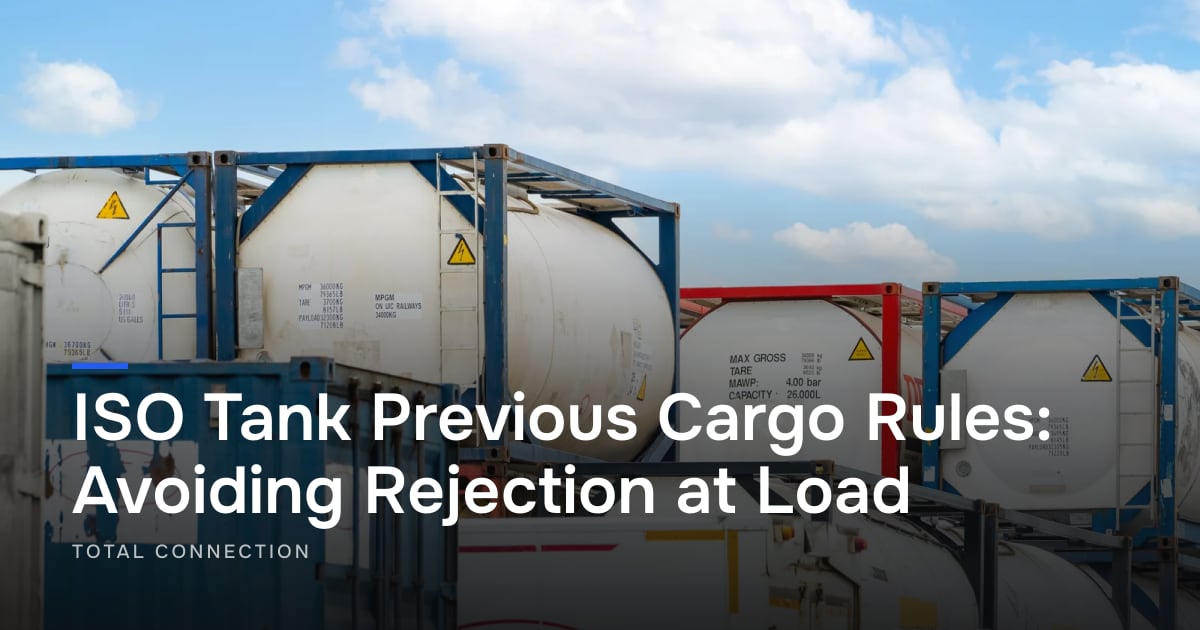
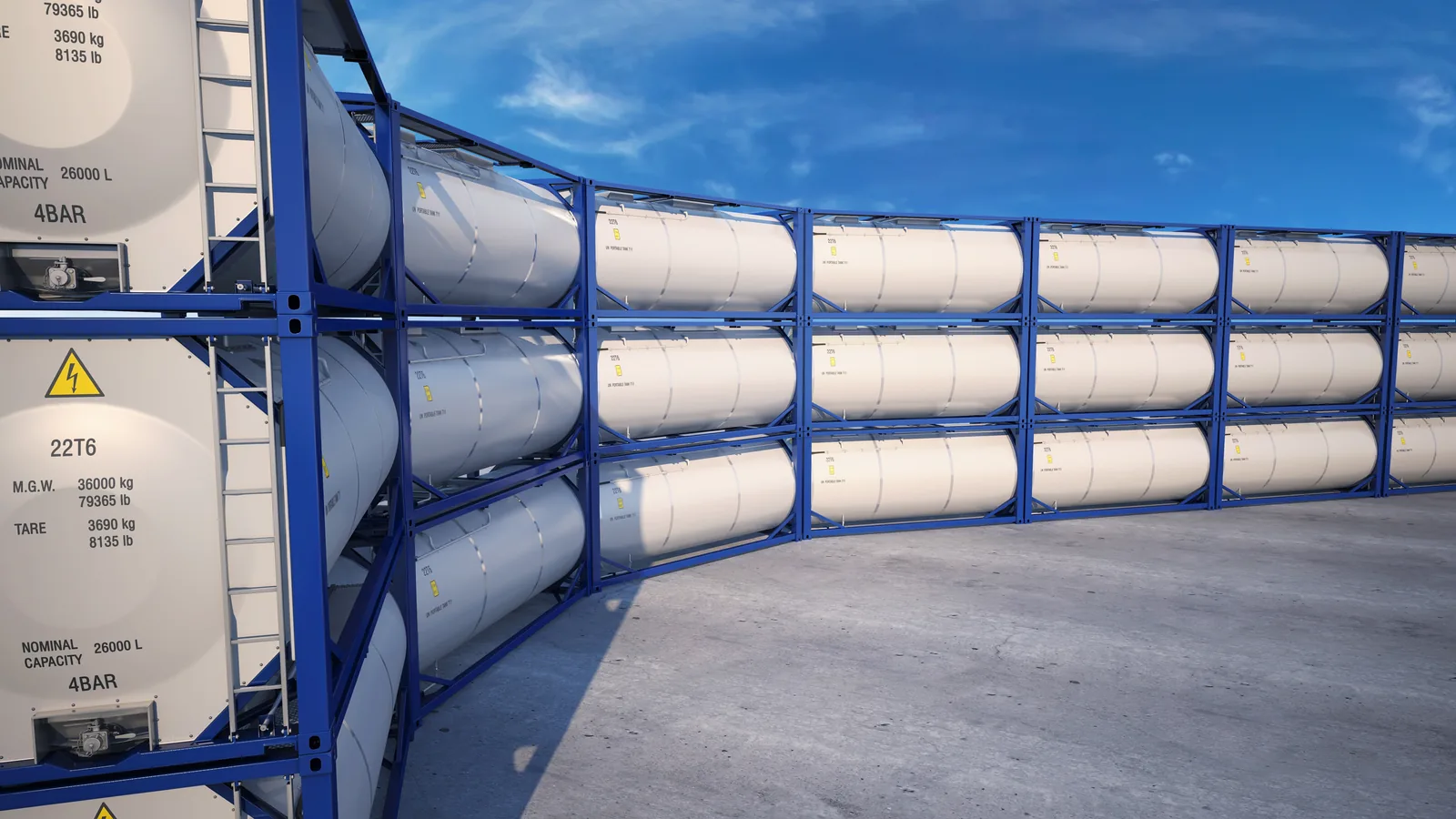
An ISO tank, formally called an IMO portable tank or UN portable tank in regulatory contexts, is a cylindrical stainless steel vessel built inside an ISO 1496-3 frame. The frame matches the corner-fitting positions and overall dimensions of a standard 20-foot dry container, which is why it slots into the same vessel cell positions, rail platforms, and chassis the rest of intermodal infrastructure is built around.
The tank itself is double-shell construction: an inner pressure vessel (almost always 316L stainless steel for chemical service) wrapped in an insulation layer and an outer protective skin. Most tanks are baffled internally to reduce surge during transit. Manways for inspection, top- and bottom-discharge valves, pressure relief, and steam or electric heating coils are standard equipment on most units, though specifications vary by build year and intended product range.
The point of the design is to handle one specific category of cargo: liquid bulk products that need to move internationally, in volumes too large for drums or IBCs but too small to justify a dedicated tanker move. A single 26,000-liter ISO tank carries roughly the equivalent of one US over-the-road tanker truckload, but with the option of putting it on a ship without ever transferring the cargo.
ISO Tank Capacity, Dimensions, and Specifications
Standard external dimensions follow the 20-foot ISO container envelope:
- Length: 6,058 mm (19 ft 10 in)
- Width: 2,438 mm (8 ft)
- Height: 2,591 mm (8 ft 6 in)
- Tare weight: typically 3,400-4,200 kg (7,500-9,300 lb) depending on insulation, coils, and lining
- Maximum gross weight: 36,000 kg (79,400 lb), limited by intermodal handling standards, not the tank itself
Internal volume runs from 14,000 liters on smaller specialty tanks (used for high-density chemicals where weight maxes out before volume) up to 26,000 liters on standard high-capacity units. The most common range for general chemical service is 21,000 to 25,000 liters.
Two numbers matter more than the headline capacity:
- Net payload, the gross weight ceiling minus the tare weight. On a 4,000 kg tare unit, that's 32,000 kg of cargo capacity. For a chemical with a specific gravity of 1.3, that ceiling fills roughly 24,600 liters, meaning a 26,000-liter tank shell isn't fully usable.
- Fill ratio limits, for hazmat and pressurized cargo, regulations cap the maximum fill percentage (often 80-95%) to allow for thermal expansion in transit. Run the math against your product's expansion coefficient before booking.
T-Codes and ISO Tank Classifications
The T-code system, defined in the IMDG Code and UN Model Regulations, classifies ISO tanks by maximum allowable working pressure, minimum shell thickness, and acceptable cargo categories. T-codes run from T1 through T22 for standard portable tanks, with extended designations T50 and T75 for specific gas service.
The practical range for chemical and liquid bulk shippers is T1 through T22:
- T1-T10: low- to medium-pressure tanks for non-hazmat and lower-hazard liquids
- T11-T14: the workhorse range, covers most flammable liquids, toxic materials, and corrosive chemicals routed in intermodal freight
- T15-T22: higher-pressure construction for highly toxic, reactive, or pyrophoric materials
The T-code your product requires isn't a judgment call. The Safety Data Sheet for any UN-numbered hazmat product contains a portable tank instruction (e.g., "T11" or "T14") in the transportation section. That instruction sets the minimum tank specification you can legally use. A carrier offering you a T11 when your SDS calls for T14 isn't offering a discount, they're offering a compliance violation.
What ISO Tanks Carry: Hazmat, Food-Grade, and Specialty Chemicals
ISO tanks move four broad cargo categories:
- Hazardous chemicals, flammable liquids (Class 3), corrosives (Class 8), toxic and infectious materials (Class 6), oxidizers (Class 5), and certain miscellaneous dangerous goods (Class 9). Examples include solvents, acids, caustics, peroxides, and reactive intermediates.
- Food-grade liquids, edible oils, fats, juices, wine, dairy ingredients, sweeteners, and food additives. Requires kosher- or food-grade-certified tank wash with verified prior product history.
- Pharmaceutical intermediates and bulk APIs, held to even tighter contamination tolerances than food-grade, often with documented cleaning validation under cGMP standards.
- Non-hazardous specialty chemicals, surfactants, plasticizers, polyols, glycols, and other industrial chemistry that doesn't trip a hazmat classification but still benefits from the contamination control of a dedicated stainless tank.
The cleaning certificate from the previous load is the single most important document in food-grade or pharmaceutical ISO tank service. The tank's prior product history determines whether your cargo can load. Asking for the cert at the terminal is too late, it's a pre-booking question.
ISO Tank vs Flexitank vs Drum: Choosing the Right Container
For international liquid bulk moves under 26,000 liters, the three real options are ISO tanks, flexitanks, and drums (or IBCs). Each has a defined operating envelope:
FactorISO TankFlexitankDrum / IBCCapacity21,000-26,000 L14,000-24,000 L200 L (drum) / 1,000 L (IBC)Hazmat capableYes (T-code dependent)NoYes (UN-rated packaging)ReusableYes (15+ year service life)No (single use)Drums limited; IBCs reusablePer-trip costHigher (lease + repositioning)Lower (single-use polyethylene)Highest per liter shippedBest forHazmat, food-grade, high-purityNon-hazmat, single-direction lanesSmall volumes, mixed shipmentsLoading equipmentTop or bottom valve, dedicated hookupPump-fill through container doorManual or palletized
The decision usually comes down to three questions: is the product hazmat, is the volume above 14,000 liters, and is the lane bidirectional or one-way? If hazmat or high purity matters, ISO tank. If non-hazmat and one-way, flexitank often wins on cost. Below 5,000 liters, drums or IBCs are usually the cleaner choice.
Loading, Unloading, and Tank Wash Requirements
Loading and unloading are the highest-risk phases of any liquid bulk move. ISO tank loading is typically top-load through a manway with grounding to control static, or bottom-load through a discharge valve with pressure transfer. Compatibility between the loading rack and the tank's fittings, not just product compatibility, needs to be confirmed before the truck arrives.
Tank wash between loads is mandatory for food-grade, pharmaceutical, and any sensitive chemical service. A proper tank wash includes:
- Pre-wash residual product removal and disposal under the appropriate waste stream
- Caustic or acid wash depending on the prior product chemistry
- Hot water rinse and steam sanitization where required
- Visual and instrumented inspection of the interior shell
- Issuance of a cleaning certificate documenting prior product, wash chemistry, and inspection results
For kosher service, the wash must be performed at a kosher-certified facility under rabbinical supervision, with a separate kosher cleaning certificate issued and signed at the time of inspection.
Regulatory Requirements for ISO Tank Shipping
ISO tank shipments touch multiple regulatory regimes depending on origin, destination, and modal segments:
- IMDG Code (International Maritime Dangerous Goods), governs ocean transit of hazmat in ISO tanks. Defines portable tank instructions, packaging, marking, placarding, and stowage rules.
- DOT 49 CFR Parts 171-180, governs domestic US transport. PHMSA enforces. Hazmat shipments require trained, certified personnel, proper shipping papers, and emergency response information.
- ADR / RID, European road and rail equivalents to DOT, applicable on European inland legs.
- IATA Dangerous Goods Regulations, air freight (rare for ISO tank cargo but possible for partial container ocean moves with air-leg handoffs).
- FDA and USDA, for food-grade and pharmaceutical cargo entering the US, prior notice and facility registration apply.
Inspection and recertification cycles are typically 2.5 years for the periodic test and 5 years for the major hydrostatic test. A tank approaching expiration shouldn't be booked for transit that ends after the recertification date, recertification has to happen on a tank that's empty and out of service.
How to Choose an ISO Tank Provider
The freight forwarder or NVOCC handling your ISO tank move controls equipment sourcing, hazmat documentation, port handling, drayage, and delivery coordination. The questions worth asking before booking:
- What T-code is the proposed equipment, and does it meet the SDS portable tank instruction for my product?
- What was the last product carried, and can I see the cleaning certificate?
- When is the next periodic inspection due, and will my transit complete before that date?
- Does the tank have functional heating coils if my product needs temperature maintenance?
- Where is the tank depot, and what's the reposition distance to my load point?
- Are you the licensed party of record for the hazmat documentation, or is that being subcontracted?
A provider that can't answer those six questions in the first conversation isn't equipped to manage hazmat liquid bulk freight. Total Connection has been moving ISO tanks for chemical shippers for 30 years under our NVOCC license (#026203NF), with full hazmat documentation, equipment sourcing through an established carrier network, and door-to-door coordination on international moves.
Compare ISO tank service to other liquid bulk options in our guide to liquid bulk transport equipment, or learn what a chemical freight broker actually does in our breakdown of liquid bulk freight brokerage. To request an ISO tank quote on a specific lane and commodity, contact our liquid bulk team or our ocean freight desk for international moves.
Frequently Asked Questions
How much does an ISO tank hold?
21,000-26,000 liters (5,500-6,800 US gallons) depending on design. Fill limits of 80-95% apply based on product expansion characteristics and hazmat classification.
Can ISO tanks carry hazardous materials?
Yes. ISO tanks are designed and certified for hazmat transport under international regulations (IMDG Code, ADR/RID). They're the standard method for international hazmat liquid bulk shipping.
What's the difference between an ISO tank and a flexitank?
ISO tanks are reusable stainless steel containers that handle hazmat and most chemicals. Flexitanks are single-use polyethylene liners placed inside standard dry containers, cheaper per trip but limited to non-hazmat, non-aggressive products.
Does Total Connection handle ISO tank shipping?
Yes. As a licensed NVOCC, we manage ISO tank ocean freight globally including tank sourcing, booking, hazmat documentation, drayage, and delivery coordination.