
LA/Long Beach chemical drayage is the overland movement of containerized chemical freight between the San Pedro Bay port complex and receivers, transload facilities, chemical plants, and distribution centers across Southern California and the broader West Coast supply chain. The San Pedro Bay ports handle roughly 40% of all U.S. containerized imports, and chemical freight including solvents, specialty chemicals, agrochemicals, and industrial materials makes up a significant portion of that volume.
Drayage at LA/Long Beach differs from other major U.S. ports in several important ways. California Air Resources Board (CARB) regulations impose strict truck emission standards that affect which carriers can legally operate here. PierPASS and PortCheck appointment requirements add a scheduling layer that catches unprepared shippers. The sheer scale of the port complex means chassis shortages and gate delays are persistent problems that require proactive planning, not reactive fixes.
For a foundational overview of how container drayage works from port gate to delivery point, see our container drayage guide for chemical shippers.
Port of Los Angeles vs. Port of Long Beach: What Chemical Shippers Need to Know
The San Pedro Bay port complex refers to two legally and operationally separate ports sharing a common waterway:
- Port of Los Angeles (POLA): Operated by the City of Los Angeles, POLA is the busiest container port in the United States by TEU volume. Major terminals include APM Terminals (Pier 400), TraPac, Everport Terminal Services, and China Shipping Terminal. POLA processes approximately 10-11 million TEUs annually in peak years and uses PierPASS for truck appointment scheduling at most terminals.
- Port of Long Beach (POLB): Operated by the City of Long Beach, POLB is the second-busiest U.S. container port. Major terminals include Long Beach Container Terminal (LBCT), Pacific Container Terminals (PCT), and SSA Marine. POLB runs the Pier B on-dock rail facility, which matters for chemical shippers moving freight inland by rail after transloading. POLB has migrated to PortCheck for truck appointment management.
Chemical shippers typically do not choose which port their cargo arrives at. The ocean carrier and vessel rotation determine terminal assignment. What matters for drayage planning is knowing your specific terminal before your carrier tries to book an appointment, since the two ports have separate operating systems, appointment portals, and gate hours. Assuming the rules at one port apply to the other is a common coordination failure that delays drayage and burns free time.
CARB Truck Regulations: The West Coast Difference for Chemical Drayage
California Air Resources Board regulations are the defining operational difference between drayage at LA/Long Beach and every other major U.S. port. These rules restrict which trucks can access port terminals, and they are enforced at the gate:
| CARB Requirement | Current Standard | Implication for Chemical Drayage |
|---|---|---|
| Drayage Truck Registry | All trucks must be registered with CARB before accessing port terminals | Carriers operating at LA/LB must maintain current CARB registration; unregistered trucks are turned away at the gate without recourse |
| Engine model year | Trucks must meet 2010 or newer engine emission standards (or equivalent verified emission levels) | Pre-2010 engine trucks are prohibited from drayage at LA/LB terminals; this eliminates a significant portion of older carrier fleets from the eligible pool |
| Advanced Clean Fleets rule | CARB is phasing in zero-emission drayage truck requirements over coming years | Carrier fleets are actively transitioning to electric trucks; range and payload considerations for chemical loads require verification with your carrier |
| Idling restrictions | 5-minute idling limit statewide with limited exceptions | Affects staging at tank farms, transload facilities, and receiver yards; some facilities have shore power hookups to maintain temperature without idling |
For chemical shippers, the bottom line on CARB is this: your broker must use only carriers registered in the CARB Drayage Truck Registry with compliant equipment. A non-compliant truck turned away at the gate means you are paying per-diem charges while scrambling for a replacement carrier. This is a completely avoidable problem with the right broker.
Equipment and Hazmat Compliance for Chemical Drayage at LA/Long Beach
Equipment and compliance requirements for chemical container drayage at LA/Long Beach follow federal DOT/PHMSA standards, with CARB compliance added as a California-specific layer:
- Hazmat endorsement (H) and tank endorsement (N or X): Required per 49 CFR Parts 171-173 for any driver hauling hazardous materials by motor vehicle. ISO tank drayage requires both the H and N endorsements, or the combined X endorsement. These endorsements require TSA security threat assessments and are separate from general CDL licensing.
- TWIC card: The Transportation Worker Identification Credential is required for access to all federal marine terminals at POLA and POLB. TWIC and CARB registration are separate credentials; both are required and both must be current.
- Chassis compatibility: ISO tanks require dedicated tank chassis with appropriate tie-down hardware. Standard 20-foot and 40-foot containers carrying drummed or IBC-packaged chemicals use conventional chassis. California's 80,000-lb GVW limit applies to all trucks on state highways; overweight loads require state permits.
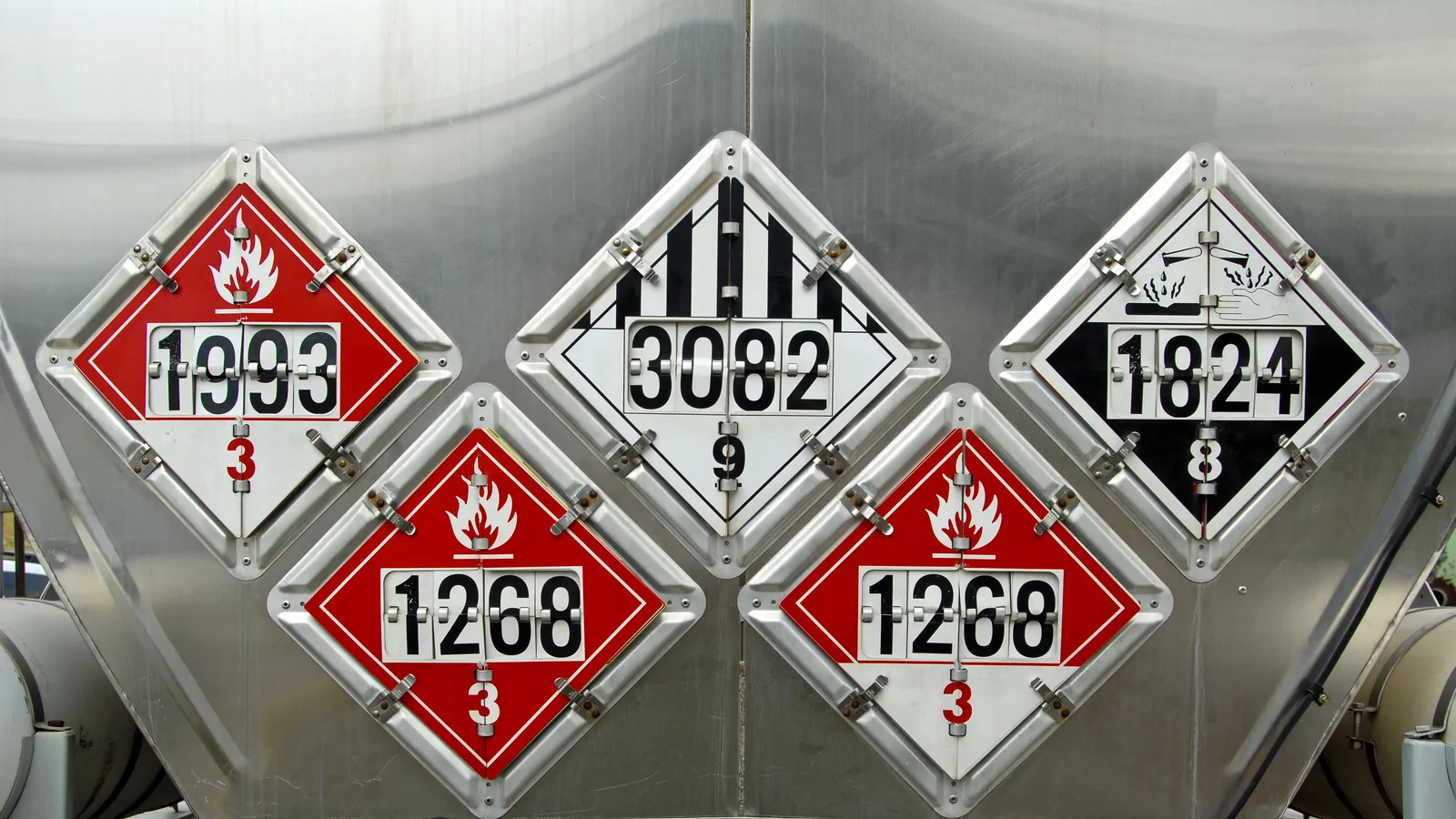
- Placarding per 49 CFR 172.500: Class 3 flammable liquids require red FLAMMABLE placards on all four sides. Class 8 corrosives (acids, caustics) require white CORROSIVE placards. Class 5.1 oxidizers require yellow OXIDIZER placards. Class 2.2 non-flammable compressed gases require green NON-FLAMMABLE GAS placards. The carrier is responsible for correct placarding before the truck moves on public roads.
- CHP enforcement: California Highway Patrol runs weight stations and hazmat compliance inspections on CA-710 (Long Beach Freeway) and I-110, the primary drayage corridors from the port. Drivers with documentation deficiencies, expired endorsements, or non-compliant vehicles face citations and potential out-of-service orders that halt the move entirely.
Chemical shippers importing multiple commodity types or working with complex hazard classes benefit from working with a liquid bulk and chemical freight broker who understands the full compliance stack, from ocean documentation through port drayage and over-the-road delivery.
LA/Long Beach Drayage Challenges for Chemical Shippers
The San Pedro Bay complex is the largest port environment in the Western Hemisphere by container volume. That scale creates specific operational challenges that chemical shippers encounter regularly:
- Chassis availability: LA/Long Beach has persistent chassis supply constraints, particularly for specialized equipment. Chemical ISO tank drayage requires tank-specific chassis with appropriate tie-down configurations, which are significantly less available in the general pool than standard container chassis. Booking specialized chassis requires advance coordination, not a same-day call.
- Appointment systems at two separate ports: POLA terminals use PierPASS; POLB terminals use PortCheck. Both require advance registration and slot booking. During high-volume periods, appointment slots for hazmat containers may involve additional clearance steps at specific terminals. Missing the appointment window before the last free day triggers per-diem charges that accumulate quickly across a multi-container shipment.
- Gate processing time: Even with a valid appointment, gate processing at high-volume terminals like APM Terminals Pier 400 and LBCT can run 45 to 90 minutes during peak periods. This matters for driver hours-of-service compliance, particularly for hazmat loads where documentation review adds time at the gate.
- CA-710 and I-110 truck corridors: These are the primary drayage routes from the port complex to inland distribution areas. CHP weight stations and inspection surges are common on both corridors. Carriers who know these routes also know the routing alternatives for specific hazmat classes where the direct route would trigger a restriction.
- Receiver facility requirements: Chemical plants and distribution centers in the Inland Empire (Riverside, San Bernardino counties), the LA Basin, and the Central Valley typically require advance SDS submission, pre-notification of hazmat delivery, and compliance with designated unloading areas. A carrier making a first delivery to your facility without this pre-coordination adds significant time and risk to the move.
Transload and Inland Distribution Options from LA/Long Beach
Chemical importers who cannot direct-deliver from the port have several transload and inland distribution options in the LA/LB market:
- ICTF (Intermodal Container Transfer Facility): Located in Dominguez, ICTF is a Union Pacific on-dock rail facility that allows containers to transfer from vessel to rail without requiring a street dray move. Chemical importers shipping to Midwest or Gulf Coast destinations can reduce trucking costs significantly through on-dock rail when their commodity and schedule allow it.
- Carson and Wilmington transload facilities: Multiple transload and warehouse facilities in the Carson and Wilmington areas, typically 5 to 15 miles from the port gates, handle drummed chemicals, IBC pallets, and ISO tank content transfers. These facilities are suitable for importers who need to repackage or break bulk before inland distribution.
- Inland Empire warehousing and transload: The Inland Empire (Riverside and San Bernardino counties) is Southern California's primary distribution hub, located 50 to 80 miles from the port complex. Several chemical-capable facilities here offer liquid storage, tank transloading, and rail siding access for onward distribution across the West.
- Pier B on-dock rail (POLB): The Port of Long Beach's Pier B on-dock rail facility connects directly to BNSF and Union Pacific mainlines. For shippers moving chemical freight to Phoenix, Las Vegas, Denver, or further east, Pier B rail can reduce the cost and driver-hour demand of an extended over-the-road move.
The right transload strategy depends on commodity, volume, delivery schedule, and inland destination. For shippers with recurring lanes from LA/Long Beach, mapping the transload market before a shipment arrives rather than after is the difference between a controlled cost and an emergency improvisation.
How Total Connection Handles LA/Long Beach Chemical Drayage
Total Connection has coordinated chemical freight logistics since 1995. We hold OTI/NVOCC license #026203NF and FMCSA MC #280101. Our carrier network in the LA/Long Beach market includes dray operators on the CARB Drayage Truck Registry with compliant equipment, current TWIC credentials, appropriate CDL endorsements for hazmat and tank operations, and direct experience with both PierPASS and PortCheck appointment systems.
For every LA/Long Beach dray move, we verify: CARB registration and truck compliance for the specific carrier and vehicle, hazmat classification and correct placard requirements, appointment slot availability against your last free day, chassis type and availability (including tank chassis for ISO tank moves), and delivery facility requirements including SDS pre-submission and hazmat receiving window restrictions.
We carry $5 million in general liability coverage, five times the industry-standard $1 million. On the West Coast, where a chemical incident on a heavily trafficked corridor generates significant cleanup liability and regulatory exposure, that coverage differential is real risk management for both shipper and broker.
If you have chemical containers moving through LA or Long Beach, request a drayage quote from Total Connection. Provide the commodity, UN number, terminal, and delivery point, and we will give you a direct answer on carrier options, cost, and timing.
Frequently Asked Questions
What is LA/Long Beach chemical drayage?
LA/Long Beach chemical drayage is the truck movement of containerized chemical freight between marine terminals at the San Pedro Bay port complex (Port of Los Angeles and Port of Long Beach) and chemical receivers, transload facilities, or warehouses across Southern California. This covers both import and export moves.
What makes LA/Long Beach drayage different from other ports?
California Air Resources Board (CARB) regulations require strict truck emission standards that limit which carriers can operate legally at these ports. PierPASS appointment systems and PortCheck requirements add scheduling complexity. The port's scale creates persistent chassis shortages and gate congestion that require proactive planning.
Do I need a CARB-compliant drayage carrier for LA/Long Beach?
Yes. Only trucks meeting CARB emission standards can legally perform drayage at California ports. Your drayage provider must use CARB-compliant equipment or face enforcement actions and delays. Total Connection pre-qualifies all LA/Long Beach drayage carriers for CARB compliance.
How long does LA/Long Beach chemical drayage take?
Same-day delivery is possible for local Southern California receivers when containers are available at the terminal. Longer distances to inland distribution centers or transload facilities typically run 1-2 days depending on traffic, terminal congestion, and chassis availability. Per-diem clock timing is critical for cost management.
Does Total Connection handle LA/Long Beach chemical drayage?
Yes. Total Connection manages containerized chemical drayage from both Port of Los Angeles and Port of Long Beach terminals, including CARB compliance verification, PierPASS appointment coordination, chassis sourcing, and hazmat documentation for classified chemical freight.
Frequently Asked Questions
What is LA/Long Beach chemical drayage?
LA/Long Beach chemical drayage is the overland transport of containerized chemical freight between the San Pedro Bay port complex (Port of Los Angeles and Port of Long Beach) and inland receivers, transload facilities, and distribution centers across Southern California and the West Coast. The San Pedro Bay ports handle approximately 40% of U.S. containerized imports, making this the highest-volume chemical drayage market in the country. Chemical drayage here requires CARB-compliant carriers, TWIC-credentialed drivers with hazmat CDL endorsements, and familiarity with PierPASS and PortCheck appointment systems.
What are CARB requirements for drayage trucks at LA/Long Beach?
California Air Resources Board regulations require all drayage trucks operating at LA/Long Beach terminals to be registered in the CARB Drayage Truck Registry and to meet 2010-or-newer engine emission standards. Trucks with older or non-compliant engines are turned away at the terminal gate. CARB is also phasing in zero-emission drayage truck requirements under the Advanced Clean Fleets rule, which will progressively affect carrier fleet composition in the coming years. Shippers should confirm their broker uses only CARB-registered carriers for LA/LB drayage moves.
What is PierPASS and how does it affect chemical container drayage?
PierPASS is the appointment and access management system used at Port of Los Angeles terminals to control truck traffic and reduce gate congestion. Carriers must book appointment slots through PierPASS before picking up or dropping off containers at POLA terminals. Port of Long Beach terminals use PortCheck for the same function. For chemical containers, missing or failing to book an appointment slot before the last free day can delay drayage and trigger per-diem charges. Your broker should book the appointment as soon as vessel arrival and container availability are confirmed.
What hazmat endorsements do LA/Long Beach drayage drivers need for chemical containers?
Drivers transporting hazardous materials, including containerized chemicals, must hold a CDL with a hazmat endorsement (H endorsement) issued after a TSA security threat assessment. Drivers hauling ISO tanks must also carry a tank vehicle endorsement (N) or the combined X endorsement covering both. All drivers entering POLA and POLB marine terminals must additionally hold a current TWIC (Transportation Worker Identification Credential). TWIC and CDL endorsements are separate credentials with separate application processes.
How do I manage chassis shortages at LA/Long Beach for chemical ISO tank drayage?
Chassis shortages at LA/Long Beach are a recurring issue, particularly for specialized equipment like tank chassis required for ISO tank moves. The best mitigation is advance booking: confirm chassis availability with your carrier or broker before the vessel arrives, not after. Tank-specific chassis with appropriate tie-down configurations are significantly less common in the pool than standard container chassis. Brokers with established carrier relationships in the LA/LB market can typically secure specialized equipment that is harder to find through the open pool on short notice.
Can Total Connection handle chemical logistics from LA/Long Beach through to inland delivery?
Total Connection coordinates the full chemical import chain through LA/Long Beach: ocean freight arrangement, ISF filing, port drayage with CARB-compliant carriers, transloading if needed, and over-the-road delivery to inland plants and distribution centers. We hold OTI/NVOCC license #026203NF and FMCSA MC #280101 and have been coordinating chemical freight logistics since 1995. Contact us with your commodity, UN number, and inland destination for a complete logistics assessment.