
.png)
Surfactants are among the most versatile chemicals in industrial use. In oilfield operations, they enhance oil recovery by reducing the surface tension between oil and water trapped in rock formations. In manufacturing, they're the active ingredient in detergents, emulsifiers, wetting agents, and dispersants. In agriculture, they help pesticides and herbicides spread evenly across plant surfaces.
This chemical versatility means surfactant shipping spans multiple industries, multiple hazmat classifications, and multiple equipment requirements. Here's what you need to know about shipping surfactant chemicals by liquid bulk tanker.
For shipper-led capacity and hazmat-fluent execution on this freight, see Total Connection's liquid bulk and chemical logistics service.
What surfactants are and why they're shipped in bulk
Surfactants, surface-active agents, are molecules with a hydrophilic (water-attracting) head and a hydrophobic (water-repelling) tail. This dual structure allows them to reduce surface tension between liquids, between a liquid and a solid, or between a liquid and a gas.
The four main categories are anionic surfactants (negatively charged, used in detergents and cleaners), cationic surfactants (positively charged, used in fabric softeners and hair conditioners), nonionic surfactants (no charge, used in industrial processes and agriculture), and amphoteric surfactants (both charges, used in personal care products).
Surfactants are manufactured in concentrated form and shipped in bulk to formulators, manufacturers, and end users who dilute and blend them into finished products. Bulk shipping by tanker truck is the most cost-effective method for the volumes involved.
Types of surfactants and their shipping characteristics
Anionic surfactants
Anionic surfactants carry a negative charge and represent the largest category by volume shipped. Common examples include sodium lauryl sulfate (SLS), linear alkylbenzene sulfonate (LAS), and alcohol ethoxysulfates. These are the workhorses of the detergent and cleaning industries.
Most anionic surfactants ship as concentrated liquids or pastes. Many are alkaline with pH levels between 9 and 12, which means they may classify as DOT Class 8 (corrosive) materials. Stainless steel tankers are preferred to prevent corrosion during transport. Temperature control is rarely required, though some high-concentration products may need mild heating to maintain pumpability in cold weather.
Nonionic surfactants
Nonionic surfactants have no electrical charge, making them compatible with both anionic and cationic products. Alcohol ethoxylates, alkyl polyglucosides, and fatty acid esters fall into this category. They're widely used in industrial cleaning, textile processing, and agricultural formulations.
From a shipping standpoint, nonionic surfactants are often the least problematic. Many are non-hazardous under DOT regulations. They're generally stable across a wide temperature range and compatible with standard chemical tanker equipment. That said, tank cleanliness remains critical because nonionic surfactants can act as emulsifiers, meaning even trace contamination from prior cargo can create quality issues in the product.
Cationic surfactants
Cationic surfactants carry a positive charge and are primarily used in fabric softeners, hair conditioners, and biocidal applications. Quaternary ammonium compounds (quats) are the most common type in commercial shipping.
Cationic surfactants often ship as concentrated liquids that require dedicated equipment or thorough tank washing between loads. They're incompatible with anionic surfactants, mixing the two can cause precipitation and product failure, so prior cargo verification is essential. Some cationic formulations carry DOT Class 6.1 (toxic) or Class 8 (corrosive) classifications depending on concentration and pH.
Amphoteric surfactants
Amphoteric surfactants contain both positive and negative charges and are valued for their mildness and compatibility with other surfactant types. Betaines and amphoacetates are the main examples, commonly used in personal care products and specialty industrial formulations.
These products typically ship in smaller volumes than anionic or nonionic types. Most are non-hazardous, though some concentrated forms may carry corrosive classifications. Standard chemical tanker equipment is suitable, with attention to tank wash protocols to prevent contamination.
Surfactant shipping across industries
Oilfield surfactants
In enhanced oil recovery (EOR), surfactants are pumped into reservoirs to mobilize trapped oil that conventional pumping can't reach. These surfactants are shipped in large bulk volumes to well sites, often on tight timelines aligned with active production programs. Many oilfield surfactants carry DOT hazmat classifications and require compliant carriers and documentation.
Industrial and manufacturing surfactants
Manufacturers of detergents, cleaners, paints, coatings, adhesives, and textiles consume surfactants in bulk as raw material inputs. Shipping to manufacturing facilities requires clean tanker equipment, contamination from prior cargo can affect the surfactant's performance and the quality of the finished product.
Agricultural surfactants
Surfactants used as spray adjuvants in agriculture help pesticides and herbicides spread evenly and adhere to plant surfaces. These products ship seasonally, aligned with the agricultural calendar, and many carry hazmat classifications based on their chemical composition.
Handling and storage requirements for surfactant chemicals
Proper handling of surfactants starts with understanding the specific product's safety data sheet (SDS). Key handling considerations include:
Personal protective equipment: Most concentrated surfactants require gloves, eye protection, and protective clothing during loading and unloading. Alkaline and acidic surfactants can cause skin and eye irritation on contact.
Spill containment: Loading and unloading areas should have spill containment systems in place. Surfactants are designed to spread and penetrate, which means spills can quickly contaminate large areas if not contained.
Temperature management: While many surfactants are stable at ambient temperature, some require heating to maintain fluidity for pumping. Conversely, certain surfactant formulations degrade or separate if overheated. The SDS specifies the acceptable temperature range.
Static electricity control: Flammable surfactant formulations require bonding and grounding during transfer to prevent static discharge ignition. This is standard practice for any DOT Class 3 (flammable liquid) shipment.
Compatibility: Surfactants should never be mixed with incompatible chemicals during transfer. Anionic and cationic surfactants are particularly incompatible and will precipitate if combined. Equipment used for surfactant shipping should be dedicated or thoroughly cleaned between incompatible product types.
Loading and unloading procedures: Surfactant transfer operations require specific attention to flow rates and pump selection. High-shear pumps can damage the molecular structure of certain surfactant formulations, particularly those with long-chain polymeric structures. Positive displacement pumps or low-shear centrifugal pumps are typically preferred. Loading rates should follow the manufacturer's recommendations to prevent foaming, which can cause measurement errors and extend loading times significantly.
For additional guidance on chemical handling and transport, see our post on chemical logistics best practices.
Hazmat and equipment considerations
Surfactant hazmat classifications vary widely depending on the specific chemistry. Some surfactants are non-hazardous. Others are classified as DOT Class 8 (corrosive), Class 3 (flammable), or Class 6.1 (toxic) depending on their composition, pH, and flash point. Your product's SDS determines the applicable classification.
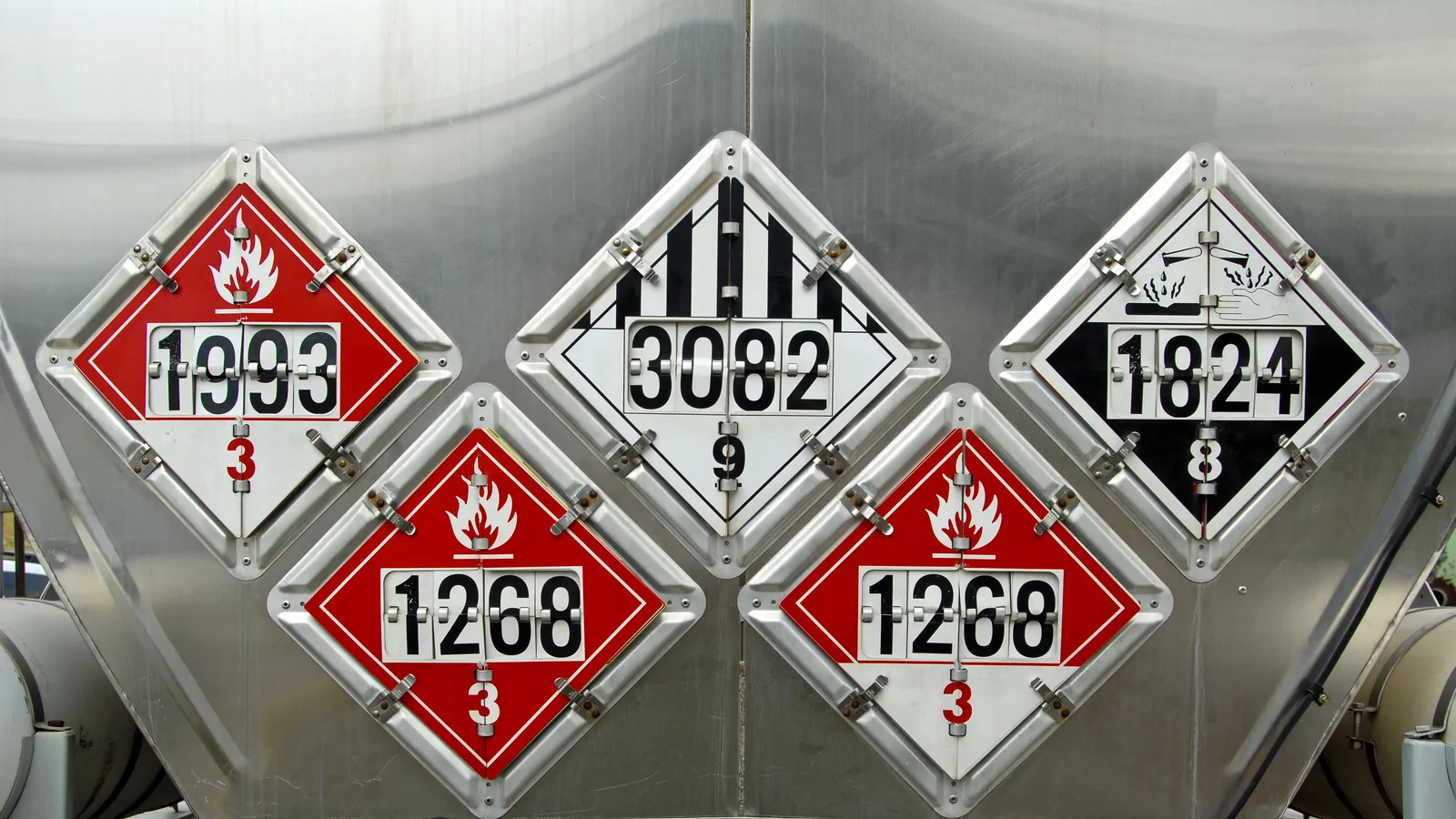
When a surfactant does carry a DOT hazmat classification, shipping documentation must include the proper shipping name, UN number, hazard class, packing group, and emergency response information as required by 49 CFR Part 172. Carriers must hold active hazmat endorsements, and vehicles must display appropriate placards. Emergency response guidebook information must be accessible to the driver throughout transit.
Most surfactants ship in stainless steel or lined chemical tanker trailers. Tank cleanliness is critical, surfactants are formulated to interact with other chemicals, which means they're particularly sensitive to contamination from prior cargo residue. Tank wash protocols must be followed strictly, and prior cargo records should be verified before loading.
Some surfactants are viscous at ambient temperature and may require heated or insulated tanker equipment for pumpability during winter months. Typical heating systems use indirect steam coils or hot oil circulation to avoid direct flame contact with the product.
How Total Connection ships surfactants
We handle surfactant shipping across all three major application sectors, oilfield, industrial, and agricultural. Our carrier network includes operators with the right tanker equipment, hazmat certifications, and cleanliness standards for specialty chemical freight.
Every surfactant shipment gets carrier screening, equipment matching, tank wash verification, hazmat documentation where applicable, and a dedicated account manager. For temperature-sensitive loads or time-critical oilfield shipments, we track in real time and coordinate directly with your receiving facility.
Our experience with surfactant logistics extends to coordinating multi-stop deliveries for manufacturers with regional distribution networks, managing seasonal volume fluctuations for agricultural customers, and handling the urgent delivery requirements of oilfield operations. We maintain relationships with carriers who understand the contamination sensitivities specific to surfactant chemistry and the importance of proper tank wash verification between loads.
See our truckload shipping service for more on our carrier network and execution standards.
Call 732-817-0401 or request a quote.
Frequently Asked Questions
Are surfactants hazardous materials?
Some are, some aren't. Classifications depend on the specific surfactant chemistry, pH, and flash point. Common classifications include DOT Class 8 (corrosive) for highly alkaline or acidic surfactants, Class 3 (flammable) for solvent-based formulations, and Class 6.1 (toxic) for certain specialty products. Your SDS identifies the applicable classification.
What tanker equipment is needed for surfactant shipping?
Most surfactants ship in stainless steel or lined chemical tankers. Tank cleanliness is especially important because surfactants are designed to interact chemically with other substances, making them sensitive to prior cargo contamination. Some viscous surfactants require heated equipment in cold weather.
Does Total Connection ship oilfield surfactants?
Yes, we've shipped oilfield chemicals including surfactants for enhanced oil recovery since 1994. We handle the bulk volumes, tight timelines, and remote site delivery requirements of oilfield surfactant logistics.
How is surfactant shipping different from other chemical shipping?
Surfactants are particularly sensitive to contamination because their chemistry is designed to interact with other substances. This makes tank wash verification and prior cargo management more critical than for many other chemical products. Otherwise, the logistics follow standard liquid bulk chemical shipping practices.