
.png)
A tank wagon truck is a self-contained, straight-body vehicle with a tank permanently mounted on a single chassis, not an articulated semi-trailer combination. Standard tank wagon capacity runs 500 to 3,000 gallons, compared to 4,000 to 11,600 gallons for a semi-tanker trailer. They operate primarily on short-haul, local, or last-mile delivery routes for liquid chemicals, fuels, agricultural products, and food-grade liquids.
The distinction matters for shippers because tank wagons are a different freight mode with different regulatory requirements, different capacity economics, and different carrier networks than long-haul tanker trucking. The same hazmat rules that apply to full tankers apply here, so understanding the equipment and its limitations keeps you compliant and avoids surprises at the dock.
For more on liquid bulk freight, see our complete guide to liquid bulk freight.
Tank Wagon vs. Tanker Trailer: Key Differences
The core difference is chassis configuration. A tank wagon is a straight truck: the tank body sits on the same chassis as the cab, with no articulation between cab and cargo. A tanker trailer is a separate tank mounted on a semi-trailer dolly, pulled by a tractor.
| Feature | Tank Wagon (Straight Truck) | Tanker Trailer (Semi) |
|---|---|---|
| Typical capacity | 500 to 3,000 gallons | 4,000 to 11,600 gallons |
| Chassis configuration | Single chassis, no articulation | Tractor plus semi-trailer |
| Typical use | Last-mile, local, short-haul delivery | Regional and long-haul bulk transport |
| Maneuverability | Higher; navigates tighter spaces and smaller facilities | Requires standard truck docks and turning clearance |
| DOT specification | DOT 406, 407, or 412 depending on product | DOT 406, 407, 412, or MC 331 depending on product |
| Hazmat requirements | Placarding, driver endorsement, and SDS required | Placarding, driver endorsement, and SDS required |
| Driver CDL requirement | CDL required if GVWR over 26,001 lbs or hazmat cargo | CDL required; Class A license for semi combination |
Tank Wagon Capacity and Specifications
Tank wagons are built to DOT tank specifications under 49 CFR 178, the same regulatory framework that applies to semi-tanker trailers. The three most common tank wagon specifications in chemical service are:
- DOT 406. Aluminum or stainless low-pressure tank, maximum allowable working pressure typically under 3 psi. Used for petroleum products including gasoline, diesel, and aviation fuel. Not suitable for corrosive or reactive chemicals. These are the fuel delivery trucks common at gas stations and airports.
- DOT 407. Low-pressure stainless or carbon steel tank, working pressure up to 25 psi per 49 CFR 178.346. The standard specification for industrial liquid chemicals that are not corrosive: solvents, polymer additives, agricultural chemicals, cleaning compounds. Most industrial chemical tank wagons are DOT 407.
- DOT 412. Corrosive materials tank, working pressure up to 75 psi per 49 CFR 178.347. Required for Class 8 corrosive materials including hydrochloric acid (UN 1789, Class 8, Packing Group II), sulfuric acid (UN 1830, Class 8, Packing Group II), and formic acid (UN 1779, Class 8, Packing Group II). Tank material, fittings, and lining must be compatible with the corrosive product.
Gross vehicle weight rating (GVWR) for a typical chemical tank wagon ranges from 26,000 to 52,000 lbs depending on chassis and tank size. The usable payload is limited by GVWR minus tare weight. For a 3,000-gallon tank on a 33,000 lb GVWR chassis, you may be limited to 2,000 to 2,500 gallons of a dense product like acid before hitting the weight limit. Product density matters as much as tank volume when calculating actual payload.
For comparison with full semi-tanker capacities, see our guide to how many gallons a tanker truck holds.
What Products Ship by Tank Wagon?
Tank wagons handle a wide range of liquid products, including regulated hazardous materials. Common categories:
- Petroleum products. Gasoline, diesel, heating oil, and aviation fuel on DOT 406 aluminum wagons. Local fuel distribution is the largest single use case for tank wagons.
- Industrial liquid chemicals. Solvents, surfactants, cleaning compounds, polymer additives, and process chemicals where the delivery quantity is below a full tanker load. For these commodities, a tank wagon serves as the liquid bulk equivalent of LTL: you pay for what you ship, not for a full trailer.
- Corrosive chemicals. Dilute acids, alkali solutions, and industrial cleaning chemicals on DOT 412 specification. Common examples include muriatic (hydrochloric) acid delivered to water treatment plants, industrial cleaning operations, and metal processing facilities.
- Agricultural chemicals. Liquid fertilizers, herbicides, and pesticides delivered to farm co-ops, distributors, or directly to farms during application season. Many are regulated hazardous materials. Verify UN numbers and hazard class with your SDS before tendering.
- Food-grade liquids. Edible oils, liquid sweeteners, and food-ingredient liquids on documented food-grade or kosher-certified equipment. Tank wash documentation and prior product history are required.
- Water treatment chemicals. Sodium hypochlorite, ferric chloride, and polymer solutions delivered to water and wastewater treatment facilities. Many are Class 8 or Class 9 regulated materials.
Hazmat Regulations for Tank Wagon Trucking
A common misconception is that small tank wagons operate under lighter hazmat rules than full-size tanker trailers. They do not. The same 49 CFR Part 171-180 framework governs both. The relevant requirements for shippers and carriers:
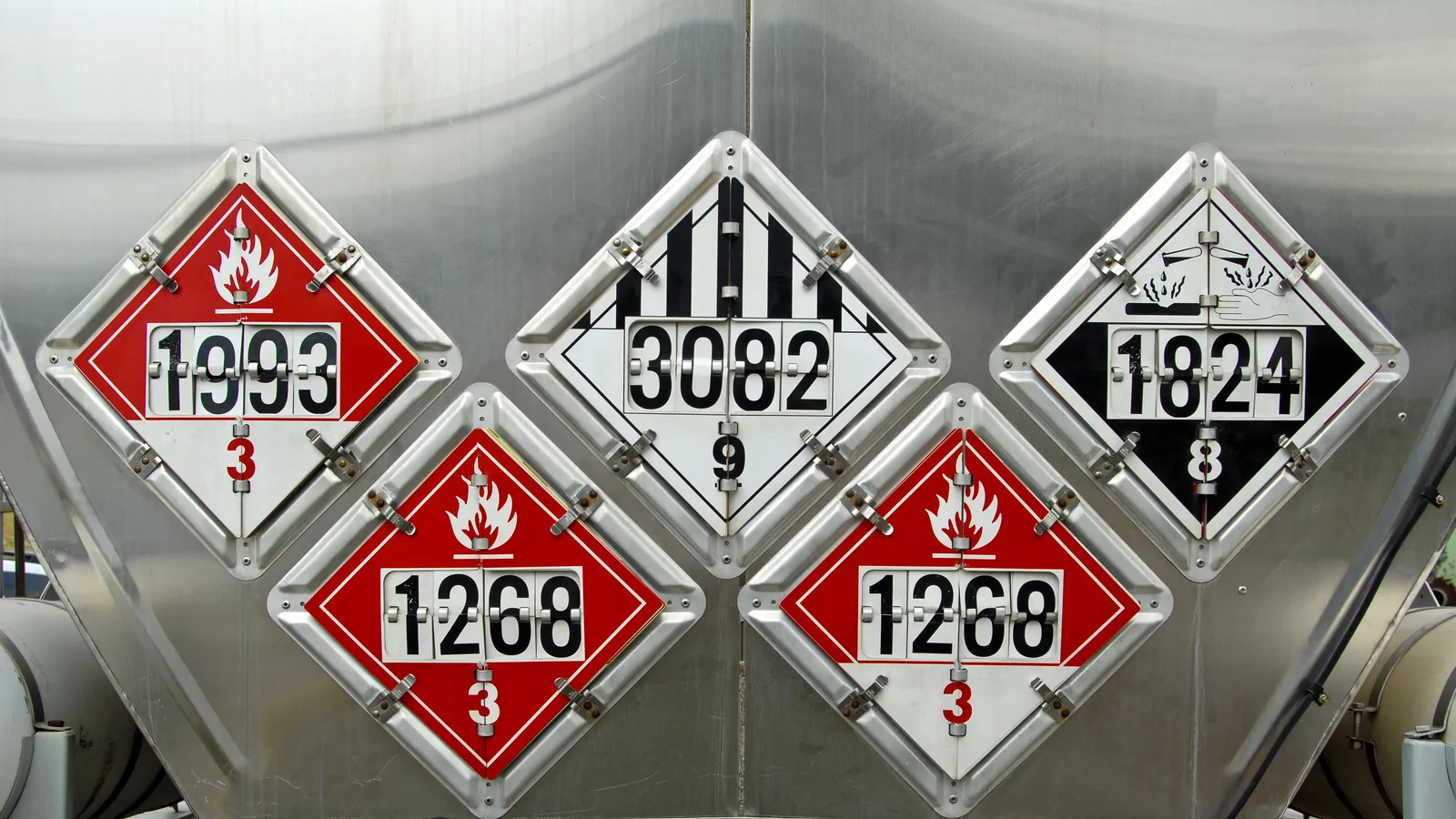
- Placarding. Any vehicle transporting a hazardous material in quantities exceeding 1,001 lbs per 49 CFR 172.500 must display the appropriate DOT hazmat placard. For most industrial chemicals shipped by tank wagon, placarding is required. The placard must match the hazard class: Class 3 for flammable liquids, Class 8 for corrosives, Class 6.1 for toxic materials.
- Driver hazmat endorsement. If the cargo is a regulated hazardous material, the driver must hold a Hazardous Materials endorsement (H endorsement) on their CDL, regardless of whether the vehicle is a tank wagon or a semi. No endorsement means no legal tender.
- Shipping papers. A proper shipping description must accompany every hazmat shipment, including UN number, proper shipping name, hazard class, and packing group. For a tank wagon delivering sulfuric acid, the shipping paper reads: Sulfuric acid, UN 1830, 8, PG II.
- Emergency response information. Per 49 CFR 172.600, emergency response information must travel with the shipment (an SDS, an emergency response telephone number, or both), and the carrier must have 24-hour access to a hazmat emergency response service.
- Tank inspection and testing. DOT specification tanks must be tested and inspected on a schedule defined in 49 CFR 180. Visual inspections, pressure tests, and lining inspections are required at defined intervals. Ask for current test dates before tendering a load.
For a broader overview of what hazmat compliance requires from your carrier, see hazmat trucking regulations and what every shipper needs to know.
When a Tank Wagon Is the Right Choice for Your Freight
A tank wagon is the right equipment when:
- Your load is less than a full tanker trailer. If you need 800 gallons of a chemical delivered and the minimum semi-tanker load is 4,000 gallons, a tank wagon is the appropriate equipment. Filling a full tanker for a sub-truckload shipment means paying for air.
- Your delivery point cannot accommodate a semi-trailer. Smaller manufacturing facilities, farm locations, construction sites, and urban delivery points often cannot receive a 53-foot semi-tanker. A tank wagon on a straight-truck chassis navigates tighter spaces and lower clearances.
- You need same-day or short-notice delivery. Tank wagons operate on local and regional circuits. For urgent restocking of liquid chemicals at a nearby facility, local tank wagon carriers can often respond same-day, faster than sourcing an over-the-road tanker trailer.
- You are distributing from a transload point. Chemical importers who transload from ISO containers into smaller quantities for regional distribution frequently use tank wagons for the final-mile delivery leg after the bulk ISO container is offloaded at a terminal.
A tank wagon is not the right choice when:
- Your load requires full tanker capacity (5,000 gallons or more): the unit economics favor a semi-tanker trailer at those volumes
- Your lane is long-haul interstate: tank wagons are not efficient beyond 150 to 200 miles
- Your product requires MC 331 specification (compressed gas): tank wagons are not built to MC 331 for most applications
For a full breakdown of equipment options across the liquid bulk spectrum, see our guide to liquid bulk transport equipment types and when to use each. If you need coverage on a liquid bulk lane (tank wagon, tanker trailer, or ISO container), request a quote from Total Connection's liquid bulk team.
Frequently Asked Questions
What is a tank wagon truck used for?
A tank wagon truck delivers liquid products (including petroleum, industrial chemicals, agricultural chemicals, and food-grade liquids) in quantities smaller than a full semi-tanker trailer can carry. They are common in local and short-haul delivery for fuel distribution, water treatment chemical supply, agricultural application, and industrial maintenance chemical delivery. The straight-truck chassis makes them practical for tight delivery locations that cannot accommodate a semi.
How many gallons does a tank wagon hold?
Tank wagon capacity typically ranges from 500 to 3,000 gallons depending on chassis size and tank specification. This compares to 4,000 to 11,600 gallons for a semi-tanker trailer. The actual usable payload is also limited by the vehicle's gross vehicle weight rating (GVWR): dense products like acids may reach the weight limit before filling the full tank volume.
What is the difference between a tank wagon and a tanker truck?
A tank wagon is a straight-body vehicle (cab and tank on one chassis), while tanker truck in common usage often refers to a tractor-trailer combination with a separate semi-tanker. The distinction matters for capacity, maneuverability, lane coverage, and CDL classification: Class B CDL for straight trucks versus Class A for semi combinations. Both operate under the same hazmat regulatory framework.
Do tank wagons require hazmat placards?
When transporting hazardous materials in quantities over 1,001 lbs under 49 CFR 172.500, a tank wagon must display the appropriate DOT hazmat placard for the cargo's hazard class. Vehicle size does not create an exemption from placarding requirements. Drivers must also hold the Hazardous Materials endorsement on their CDL for regulated hazmat cargo, regardless of vehicle type.
What is the DOT specification for a chemical tank wagon?
Most industrial chemical tank wagons operate under DOT 407 specification (49 CFR 178.346) for non-corrosive liquids, or DOT 412 specification (49 CFR 178.347) for corrosive materials. Petroleum products typically use DOT 406 specification. The correct DOT spec depends on your commodity's hazard class and compatibility requirements. Verify this against your SDS and confirm the tank spec with the carrier before loading.
Can a tank wagon carry food-grade liquids?
Yes, provided the tank is certified for food-grade service and has documented tank wash history showing no prior incompatible products. Food-grade tank wagon service requires stainless steel construction, sanitary fittings, and a documented cleaning and inspection protocol. Ask specifically for food-grade certification and prior product documentation. A clean-looking tank does not automatically qualify.