
.png)
Liquid bulk freight is the transportation of liquid products in bulk quantities (typically 4,000 to 7,000 gallons per tanker truck, or 21,000 to 26,000 liters per ISO tank container) without the intermediate packaging of drums, totes, or bottles. For chemical manufacturers, distributors, and industrial users, liquid bulk is the most cost-effective way to move large volumes of liquid product across truck, rail, ocean, and pipeline modes.
The decision to ship liquid bulk versus packaged freight depends on volume, distance, hazmat classification, equipment availability, and the contamination tolerance of your product. This guide covers what liquid bulk freight is, the equipment that moves it, the regulatory compliance it requires, how carriers and brokers fit together, and how to choose a provider for your specific freight.
For shipper-led capacity and hazmat-fluent execution, see Total Connection's liquid bulk and chemical logistics service.
What Is Liquid Bulk Freight?
Liquid bulk freight is freight transported in tanks, not packages. A liquid bulk tanker truck carries 4,000 to 7,000 gallons of product directly in a single tank. An ISO tank container carries 21,000 to 26,000 liters intermodally. A railcar tank carries 20,000 to 30,000 gallons. Pipeline moves continuous flow at higher volumes still.
The defining characteristic of liquid bulk: the product itself is the cargo. There is no drum, no IBC, no bottle between the product and the tanker wall. This drives both the economic efficiency (no packaging cost) and the operational risk (contamination, which we will return to in detail).
Compared to packaged liquid freight (drums on pallets, totes, or IBCs in a van trailer), liquid bulk reduces cost-per-gallon-shipped by 30 to 60 percent on full-tanker loads. The trade-offs: liquid bulk requires equipment compatibility, prior cargo verification, and a logistics provider who understands chemical-specific requirements.
Equipment Types: Stainless, Aluminum, Lined, and Specialty Tankers
Tanker equipment selection is one of the most consequential decisions in liquid bulk shipping. The wrong tank can contaminate product, corrode through, or violate DOT specification requirements. The right tank protects product quality and stays within compliance.
Stainless Steel Tankers
The standard for chemical service. Stainless steel resists corrosion from most chemicals, cleans thoroughly, and maintains product purity. Grade matters: 304 stainless is common; 316 and 316L offer higher nickel content and better resistance to chloride corrosion. DOT 407 stainless tankers are the most widely used configuration for liquid bulk chemicals, with typical capacity of 6,000 to 7,000 gallons.
Aluminum Tankers
Lighter than stainless, allowing more payload per trip before hitting DOT weight limits. Used primarily for petroleum products, food-grade applications, and non-corrosive chemicals. Aluminum is not suitable for strong acids, strong alkalis, or chlorinated solvents that attack aluminum.
Rubber-Lined and Polymer-Lined Tankers
Stainless or carbon steel shells lined with butyl rubber, polyethylene, or fluoropolymer materials. Used for corrosive chemicals like sulfuric acid, hydrochloric acid, sodium hydroxide solutions, and bleach. The lining is the chemical barrier; the shell provides structural strength. DOT 412 specification covers corrosive-service tankers with additional construction standards.
Specialty Equipment
ISO tank containers for international intermodal moves. Pressure tankers (MC 331 specification) for compressed gases like anhydrous ammonia. Heated tankers for products that solidify at ambient temperature (fats, tallow, certain resins). Food-grade and kosher-certified tankers with documented wash chains.
For a deeper equipment breakdown, see our complete guide to liquid bulk transport equipment.
Hazmat Compliance for Liquid Bulk Shipping
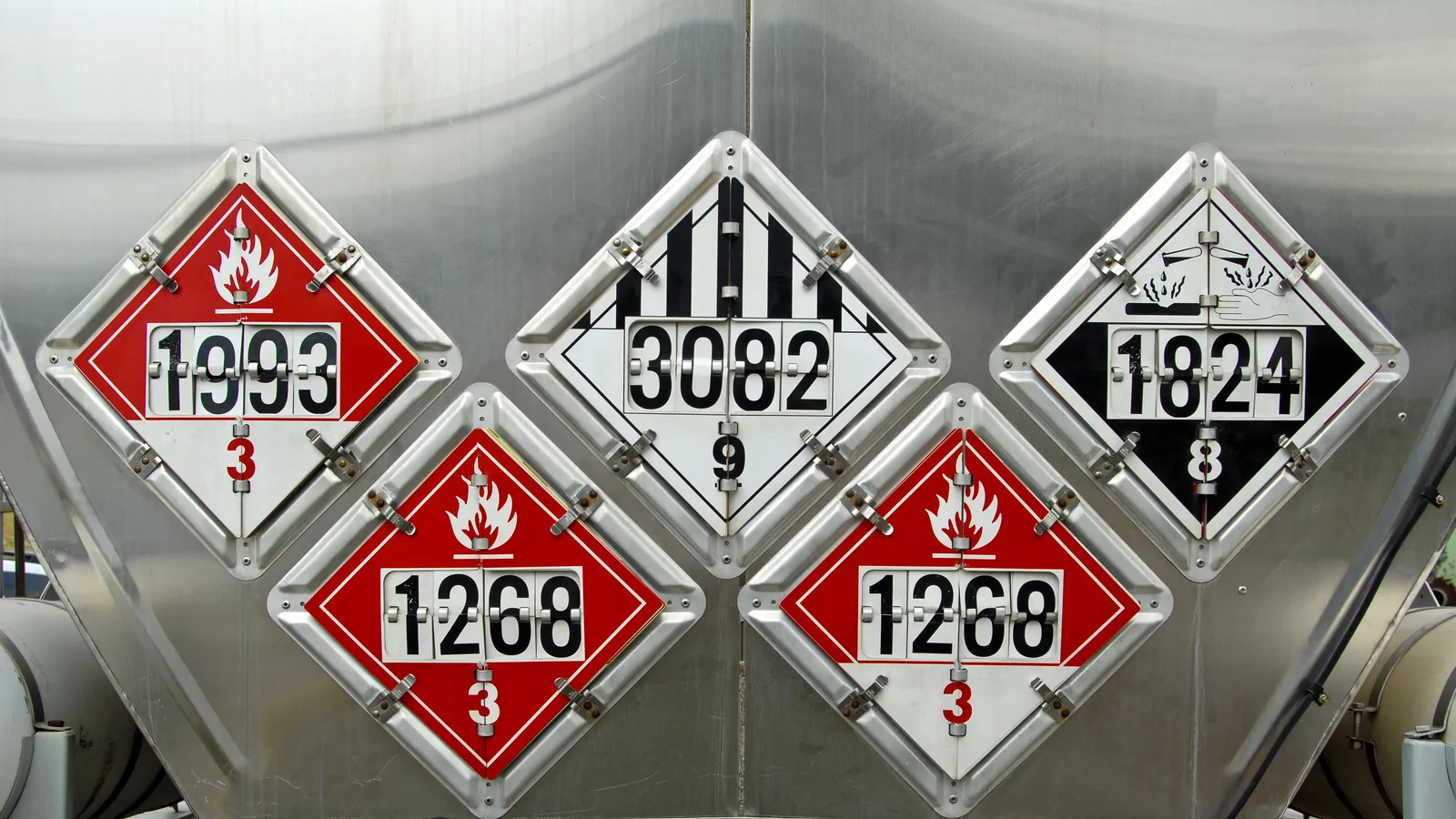
Most liquid chemicals shipped in bulk are classified as hazardous materials under DOT 49 CFR Parts 171-180. The classification determines carrier requirements, driver qualifications, documentation, placarding, and routing.
The hazard classes covering most liquid bulk freight:
- Class 3 (Flammable Liquids): Ethanol, methanol, acetone, xylene, gasoline, many solvents, and unsaturated polyester resins. The most common class in chemical freight.
- Class 6.1 (Toxic Substances): Pesticides, herbicides, certain industrial chemicals like phenol and aniline.
- Class 8 (Corrosives): Sulfuric acid (UN 1830), hydrochloric acid (UN 1789), sodium hydroxide solutions, hypochlorite bleach.
- Class 5.1 (Oxidizers): Hydrogen peroxide, ammonium nitrate solutions, certain industrial bleaches.
- Class 5.2 (Organic Peroxides): MEKP, BPO, and certain reactive catalysts used in polymer manufacturing.
- Class 9 (Miscellaneous): Environmentally hazardous substances, elevated-temperature materials, lithium-containing products.
Each shipment requires a carrier with active FMCSA hazardous materials authority, a driver holding a CDL with hazmat endorsement (and tanker endorsement for liquid bulk, combined as the X endorsement), DOT-compliant shipping papers, proper placarding on all four sides of the tanker, and emergency response information accessible in the cab.
Insurance minimums under 49 CFR 387: $750,000 for general freight, $1,000,000 for non-bulk hazardous substances, $5,000,000 for bulk hazmat in specific categories (Division 1.1/1.2 explosives, 2.3 poisonous gases, and bulk Class 3 or Class 8 above threshold). Total Connection carries $5 million in general liability across the board, five times the FMCSA minimum on most lanes.
For the full hazmat trucking compliance picture, see our hazmat trucking guide.
Tanker Trucking Companies vs. Liquid Bulk Brokers
Liquid bulk freight runs through two carrier models: asset carriers who own their tanker fleets, and non-asset brokers who arrange transportation across a network of contracted carriers. Each has its place.
Asset carriers like KAG, Quality Carriers, Trimac Transportation, and Quality Distribution operate company-owned tankers with company-employed drivers. They offer fleet consistency, established lane density on their core corridors, and direct equipment control. The trade-offs: their dispatch decisions prioritize fleet utilization, equipment is fixed to fleet type (a stainless tank carrier does not pivot to a lined trailer for a corrosive run), and lane coverage has gaps outside their core corridors.
Non-asset brokers like Total Connection maintain a network of pre-screened carriers and match the right carrier to each shipment. The advantages: equipment flexibility across all tanker types, broader geographic coverage through multiple carrier relationships, and a primary obligation to the shipper rather than to equipment utilization. The trade-off: a broker's value depends on the depth of their carrier vetting and the discipline of their compliance management.
For more on the broker model, see what a liquid bulk freight broker does and how to find and vet tanker trucking companies. For a broader view of the third-party logistics model in chemical freight, see what is a third-party logistics company.
How to Choose Between Asset Carrier and Broker
Use an asset carrier when your freight is high-volume, recurring, and runs on a single lane that aligns with their core network. Use a broker when your freight spans multiple equipment types, crosses lanes outside any single carrier's strength, or requires the compliance depth that comes from specializing in chemical freight.
For most chemical shippers moving 25 to 500 loads per month across mixed lanes and commodities, a specialized broker provides better capacity coverage and compliance management than any single asset carrier.
Tank Wash, Prior Cargo, and Contamination Control
Contamination is the single most costly failure mode in liquid bulk shipping. A tanker that previously carried a product incompatible with your cargo, and was not properly washed, can destroy your entire load. The cost of a contaminated 6,000-gallon load of specialty chemical routinely exceeds $50,000 in product value alone, before counting cleanup, claim processing, and production downtime at the receiving facility.
Tank wash protocols depend on prior cargo and incoming cargo:
- Generic rinse: Acceptable when prior and incoming cargo are compatible and non-sensitive. Lowest cost (typically $75 to $150 per wash).
- Caustic wash: Required when prior cargo was an acid or when incoming cargo cannot tolerate acidic residue. Uses sodium hydroxide solution to neutralize and clean.
- Solvent wash: Required between certain hydrophobic chemicals (oils, fats, certain resins) and water-based products.
- Kosher wash: Required for kosher-certified food and pharmaceutical products. Performed at rabbinically supervised facilities. The tanker must maintain kosher status through its wash chain and cargo history.
- Dedicated equipment: Some products (pharmaceuticals, certain specialty chemicals) require dedicated tankers that never carry anything else.
Every shipment should include a wash certificate documenting the wash protocol used, the wash facility, and the prior three to five loads carried in the tanker. This documentation protects your product and your claim rights if contamination occurs.
For the operational details, see our loading and unloading procedures guide.
Temperature-Sensitive Liquid Bulk Freight
Many liquid bulk chemicals solidify, separate, crystallize, or degrade outside specific temperature ranges. Temperature management during transit prevents these failures.
The three temperature control methods used in liquid bulk:
- In-transit heat: Coils along the tank floor circulate hot antifreeze from the truck engine, maintaining product temperature throughout transit. Cost-effective (typically $50 to $200 flat per shipment), widely available, and reliable for products that need to stay above 60 to 120 degrees Fahrenheit.
- Steam heating: At designated stops, the driver connects to a facility steam supply that heats the tank. Effective for higher temperatures or for thicker products that need active heat input rather than maintenance. Each stop adds time and cost.
- Insulated or diesel-fired heated trailers: Independent heating systems for precision temperature control or for products that require active heat throughout long transits. The most expensive option and longest lead time on equipment availability.
For more on temperature options, see our guide to heated tanker truck shipping and the benefits of in-transit heat trailers.
Commodity-Specific Considerations
Different chemical commodities have different shipping requirements. The right partner understands the differences and matches each shipment to compatible equipment, hazmat compliance, and lane coverage.
| Commodity Category | Hazmat Class | Equipment | Special Considerations |
|---|---|---|---|
| Ethanol (denatured fuel-grade) | Class 3 (UN 1170) | DOT 407 or MC 307 stainless or aluminum | Static control, moisture sensitivity, denatured vs undenatured documentation |
| Formalin (formaldehyde solution) | Class 8 + 6.1 (UN 2209) | Stainless or polyethylene-lined | Multi-class compliance, polymerization risk in cold weather, PPE for vapor exposure |
| Plasticizers (phthalate and non-phthalate) | Typically non-hazardous | Stainless, clean equipment | Strict product segregation between regulated and non-regulated types |
| Surfactants | Varies (often Class 8 or 6.1) | Stainless or lined | Sensitive to contamination from prior cargo |
| Drilling fluids and oilfield chemicals | Varies (often Class 3, 6.1, 8) | DOT 407 or 412 depending on product | Remote site delivery, multi-truck coordination for frac jobs |
| Fats, tallow, food-grade oils | Non-hazardous | Stainless heated tankers, kosher certified where required | Temperature maintenance, food-grade wash chain, prior cargo restrictions |
For specific commodities, see our dedicated guides on ethanol tanker shipping, formaldehyde and formalin shipping, plasticizers and regulations, surfactant shipping, oilfield chemicals, fats and tallow shipping, agricultural chemical shipping, polymer additive shipping, liquid hardeners and curing compounds, composite materials and resins, nucleating agents and polymer clarifiers, metal deactivators for polymers, and pesticide shipping regulations.
How Liquid Bulk Freight Is Priced
Liquid bulk rates depend on lane, mileage, equipment type, hazmat class, temperature requirements, market capacity, and accessorials. Unlike standard dry freight where you pay per pound or per pallet, liquid bulk pricing typically uses one of three structures:
- Per-load flat rate: Most common for full tanker shipments. The carrier quotes one rate covering pickup, transit, and delivery on a specific lane.
- Per-mile rate: Used on longer or less common lanes where a flat rate is harder to standardize. Typical range: $4.00 to $7.00 per mile loaded, with premiums for hazmat, heated, lined, or food-grade equipment.
- Contract rates with minimums: For shippers with consistent monthly volume, contract pricing locks in rates for a defined period with minimum volume commitments.
Beyond the base rate, expect accessorials for: fuel surcharge (typically 20 to 35 percent of base rate depending on diesel market), tank wash, hazmat surcharge, heated transit, detention beyond included loading or unloading time (commonly two hours each), layover, multi-stop, weekend delivery, and specialty equipment positioning.
The lowest quoted rate is rarely the best value. A cheap carrier that contaminates a load, fails to meet hazmat compliance, or drops a load at the last minute costs far more than the rate savings. Carrier quality and compliance discipline matter more than per-mile pricing on chemical freight.
How to Choose a Liquid Bulk Freight Provider
Six criteria separate qualified liquid bulk providers from generalist freight brokers and load-board operators:
- Chemical freight specialization. Is liquid bulk and chemical freight the core business, or one category among dry van, flatbed, and reefer? Specialists maintain the regulatory and operational knowledge that generalists cannot keep current.
- Carrier screening discipline. Active FMCSA hazmat authority verification, insurance currency confirmation, CSA safety score thresholds (particularly the Hazardous Materials Compliance BASIC), driver endorsement coverage, and equipment inspection records. Ask for the screening checklist.
- Insurance coverage. The FMCSA minimum is $750,000 for general freight and $1,000,000 for non-bulk hazmat. Premium providers carry $5 million or more, which gives meaningful headroom on chemical cargo where claims can run into seven figures.
- Compliance management. Tank wash coordination, prior cargo verification, hazmat documentation preparation, placarding review, and emergency response coordination as standard services rather than premium add-ons.
- Account management structure. Named accounts with dedicated reps who know your commodity, your facilities, and your lanes. Call-center models rotate reps quarterly and force you to re-educate each one on your freight.
- Operational track record. Years in chemical freight, customer references on similar commodities, and a documented incident response process. Ask for redacted examples of how they handle a contamination claim, a dropped load, or a compliance issue.
Total Connection's Approach to Liquid Bulk Freight
Total Connection has operated as a non-asset chemical logistics broker since 1995. We hold OTI/NVOCC license #026203NF, FMCSA Motor Carrier authority MC 280101, and carry $5 million in general liability coverage (five times the FMCSA minimum on most lanes). Our network of pre-screened tanker carriers covers every major chemical shipping lane in North America.
What that means operationally: every load gets a named account manager (the same person from quote to delivery confirmation), every carrier is screened against a five-point compliance checklist before they touch your freight, every shipment includes equipment matching to your specific product, tank wash coordination, hazmat documentation review, and prior cargo verification. For international moves, our NVOCC license lets us issue our own bills of lading and manage the full document chain across domestic trucking and ocean freight under one point of accountability.
If you ship liquid bulk chemicals (specialty, commodity, hazmat, or food-grade) and want a freight partner whose entire business is built around chemical logistics, request a quote with your lane, commodity, equipment requirements, and volume profile. Our team responds with a complete rate and capacity assessment within one business day. Call 732-817-0401 or request a quote here.
Frequently Asked Questions
What is liquid bulk freight?
Liquid bulk freight is the transportation of liquid products in bulk quantities (4,000 to 7,000 gallons per tanker truck, 21,000 to 26,000 liters per ISO tank container) without intermediate packaging like drums, totes, or bottles. The product itself is the cargo, contained directly by the tank walls.
What's the difference between liquid bulk and packaged liquid freight?
Packaged liquid freight uses drums, IBCs, or totes that are placed in a standard trailer. Liquid bulk eliminates the packaging, reducing cost-per-gallon by 30 to 60 percent on full tanker loads. The trade-off is that liquid bulk requires equipment compatibility, tank wash verification, and a logistics provider with chemical freight expertise.
Is liquid bulk freight always hazardous materials?
No. Many liquid bulk products are non-hazardous, including most food-grade oils, water-based industrial fluids, and certain specialty chemicals. However, the majority of liquid bulk chemicals are classified as hazardous materials under DOT 49 CFR (most commonly Class 3 flammable, Class 6.1 toxic, or Class 8 corrosive), which adds compliance, documentation, and equipment requirements.
Do I need an asset carrier or a broker for liquid bulk freight?
Asset carriers are best when your freight is high-volume, recurring, and runs on a single lane that aligns with their core network. Brokers are best when your freight spans multiple equipment types, crosses lanes outside any single carrier's strength, or requires the compliance depth that specialty providers maintain. For most chemical shippers with mixed lanes and commodities, a specialized broker provides better coverage.
How is liquid bulk freight priced?
Liquid bulk rates use one of three pricing structures: per-load flat rate (most common), per-mile rate (typically $4 to $7 per mile loaded with hazmat and equipment premiums), or contract rates with volume minimums. Beyond the base rate, expect accessorials for fuel surcharge, tank wash, hazmat surcharge, heated transit, detention, layover, and specialty equipment positioning.
What's the most expensive mistake in liquid bulk shipping?
Contamination from improper tank wash or prior cargo incompatibility. A contaminated 6,000-gallon load of specialty chemical can exceed $50,000 in product value alone, before adding cleanup, claim processing, and production downtime at the receiving facility. Tank wash verification and prior cargo documentation on every load prevents this.
What insurance should a liquid bulk freight broker carry?
The FMCSA minimum is $750,000 for general freight and $1,000,000 for non-bulk hazardous substances. Premium providers carry $5 million or more in general liability, which gives meaningful headroom on chemical cargo where claims can run into seven figures. Total Connection carries $5 million on all lanes.