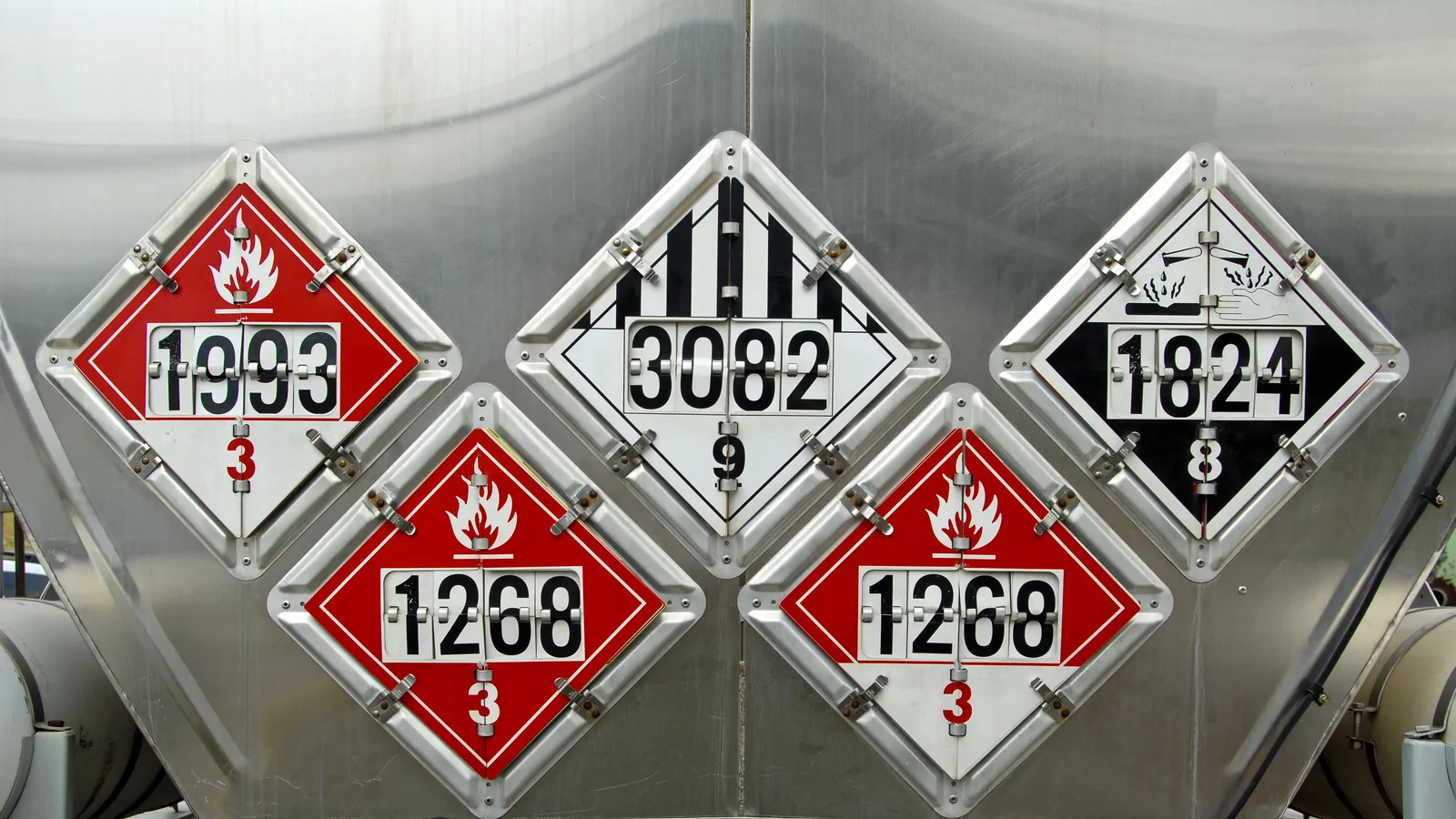


Hazmat trucking is the ground transportation of hazardous materials, flammable liquids, corrosives, gases, oxidizers, toxics, and other products classified as dangerous goods under DOT 49 CFR Parts 171–180. It is the most regulated category of freight in the United States. A shipper, a carrier, and a driver all carry independent legal obligations on every load, and the penalties for getting it wrong run from civil fines per package to felony exposure when an incident causes harm.
If you ship chemicals, petroleum products, agricultural inputs, paints and coatings, pharmaceuticals, or industrial intermediates, hazmat compliance is not a separate workflow, it is the workflow. This guide covers what makes a shipment hazmat, who is allowed to haul it, what drivers and equipment must qualify, what paperwork rides with the load, how truckload and LTL hazmat differ, how to choose a hazmat carrier, and the operational mistakes that cost shippers the most money and risk.
What makes a shipment hazmat
A material is hazmat, DOT calls it a "hazardous material," PHMSA and the UN call it a "dangerous good", when it meets the criteria of one of nine hazard classes defined in 49 CFR 173. The classification depends on the material's physical and chemical properties, not on quantity or packaging. A drum of acetone is Class 3 whether you ship one or twenty.
The starting point is always the Safety Data Sheet (SDS) Section 14, which lists the proper shipping name, UN/NA identification number, hazard class, and packing group. Many products carry subsidiary hazards, a corrosive that is also toxic, a flammable that is also an environmental hazard, and every applicable hazard must be communicated on the shipping papers and reflected in the placarding.
The nine DOT hazard classes
| Class | Hazard | Common chemical examples | Notes for shippers |
|---|---|---|---|
| 1 | Explosives | Industrial blasting agents, detonators | Divisions 1.1–1.6; the most restrictive class. Most chemical shippers will never see this. |
| 2 | Gases | Compressed/liquefied/dissolved, chlorine, anhydrous ammonia, refrigerants | Divisions for flammable (2.1), non-flammable (2.2), toxic (2.3). |
| 3 | Flammable liquids | Acetone, ethanol, methanol, xylene, gasoline, many resins and solvents | The most common class for chemical shippers. |
| 4 | Flammable solids / spontaneously combustible / dangerous when wet | Sodium, magnesium, sulfur | Three divisions; equipment compatibility matters. |
| 5 | Oxidizers and organic peroxides | Hydrogen peroxide, ammonium nitrate, MEKP | Cannot be co-loaded with most flammables. |
| 6 | Toxic and infectious substances | Pesticides, cyanides, medical waste | Division 6.1 (toxic) and 6.2 (infectious) are handled very differently. |
| 7 | Radioactive materials | Industrial radiography sources, medical isotopes | Specialized carriers and routing. Outside scope for most chemical shippers. |
| 8 | Corrosives | Sulfuric acid, hydrochloric acid, sodium hydroxide, hypochlorite | Aggressive on equipment, lined trailers and rinse-out matter. |
| 9 | Miscellaneous dangerous goods | Lithium batteries, environmentally hazardous substances, elevated-temperature materials | Catch-all for materials that don't fit 1–8. |
Two operational details that catch new shippers:
- Packing group (I, II, or III) describes the degree of danger within a class. PG I is the most dangerous and triggers the strictest packaging, marking, and placarding rules. PG III is the lightest. The group determines which UN-spec containers you can use.
- Reportable quantity (RQ) materials trigger additional EPA reporting under CERCLA when released. The shipping paper must include "RQ" before or after the basic description if the package contains a reportable quantity.
If a load is misclassified, wrong UN number, wrong class, missing subsidiary hazard, missing RQ, every downstream document is wrong. That is the single most common hazmat compliance failure, and the one that surfaces first at a DOT roadside inspection.
Who is allowed to haul hazmat
Not every motor carrier can haul hazmat, and the carriers that can are not interchangeable with the carriers that can't. The federal floor:
- Active FMCSA operating authority with hazardous materials authorization. Carriers must register with PHMSA annually under 49 CFR 107 Subpart G and pay the registration fee for any year in which they transport hazmat in placardable quantities.
- Insurance minimums under 49 CFR 387. $750,000 minimum for most general freight; $1,000,000 when transporting oil or "hazardous substances" in non-bulk; $5,000,000 for bulk hazmat in specific categories (Division 1.1/1.2 explosives, Division 2.3 poisonous gases, certain Class 7 quantities, and bulk Class 3/8 hazmat above threshold).
- A safety management program that documents training, vehicle inspection, incident response, and drug and alcohol testing.
- A security plan under 49 CFR 172.800 for any carrier handling the materials listed in 172.800(b), including most bulk Class 3 above 3,500 gallons, Division 1.1/1.2/1.3 explosives, certain Class 6.1 PG I, and others.
- Hazmat training every three years for every employee whose job functions affect hazmat transportation, per 49 CFR 172.704. That includes dispatchers and warehouse personnel, not just drivers.
Total Connection carries $5 million in general liability, five times the FMCSA minimum for most hazmat lanes, and every carrier in our network has been pre-screened for active FMCSA hazmat authority, insurance currency, CSA safety scores, and incident history before they touch a single load. Generic 3PLs and load boards do not screen at this level.
Drivers, endorsements, and equipment
A driver hauling hazmat must hold a Commercial Driver's License with a Hazardous Materials (H) endorsement. Liquid bulk shippers also care about the Tanker (N) endorsement, and the combination of the two is the X endorsement.
| Endorsement | What it allows | How a driver gets it | Renewal |
|---|---|---|---|
| H, Hazardous Materials | Transport of placardable hazmat in any vehicle | DOT knowledge test + TSA Security Threat Assessment (background, fingerprints, immigration check) | Every 5 years; TSA reassessment each renewal |
| N, Tanker | Transport of liquid or liquid gas in a tank with rated capacity ≥ 1,000 gallons (or any individual tank ≥ 119 gallons) | DOT knowledge test | Every 5 years (no TSA component) |
| X, Combined | All of the above on a single endorsement | Both knowledge tests + TSA STA | Every 5 years; TSA reassessment each renewal |
TWIC (Transportation Worker Identification Credential) is separate and is required for unescorted access to secure port and maritime facilities. Bulk chemical shippers with port pickups and deliveries should expect every driver to carry a TWIC in addition to the X endorsement.
Equipment selection is its own decision tree. A Class 3 flammable in a non-pressurized aluminum tanker is straightforward. A Class 8 corrosive may require a lined trailer, rubber, polyethylene, or fluoropolymer, to prevent equipment attack. Sodium hydroxide and tallow share Class 8 and food-grade lanes respectively, but a tanker that hauled NaOH then loaded tallow without the right kosher wash is a $200K production problem. We covered the operational detail of tank loading and unloading procedures in a separate guide.
For commodity-specific equipment guidance, see How to find chemical tanker trucks and the liquid bulk transport equipment guide.
Documentation, placarding, and routing
Three documents and one set of placards travel with every hazmat shipment.
Shipping papers (49 CFR 172 Subpart C)
Every hazmat shipment requires a shipping paper, typically the Bill of Lading, that includes, in this exact sequence (or as 172.202 allows):
- The proper shipping name from the 172.101 Hazardous Materials Table
- The hazard class or division number
- The UN/NA identification number, preceded by "UN" or "NA"
- The packing group in Roman numerals
- The total quantity by mass or volume
- The number and type of packages
- An emergency response telephone number that is monitored 24/7 by a person knowledgeable about the material (CHEMTREC or equivalent)
- The shipper's certification, signed by hand or electronically
Papers must be within reach of the driver, either in the door pouch on the driver's side or, when the driver is out of the vehicle, on the seat or in a holder on the door.
Placarding (49 CFR 172 Subpart F)
Diamond-shaped placards go on all four sides of the vehicle when placards are required. The trigger thresholds depend on hazard class and quantity. A few that matter most:
- Table 1 materials (Class 1.1, 1.2, 1.3, 2.3, 4.3, 5.2 Type B, 6.1 PG I inhalation, Class 7 Yellow III) require placards at any quantity.
- Table 2 materials (most other hazmat) require placards once the aggregate gross weight is 1,001 lbs or more in one shipment.
- Bulk packagings (a single packaging with capacity > 119 gallons liquid, > 882 lbs solid, or > 1,000 lbs water capacity for a gas) are placarded regardless of quantity.
Mixed loads use either the specific class placards for each material or, for some combinations, a single "DANGEROUS" placard, but not always. Combinations involving Table 1 materials, or 5,000 lbs or more of one class loaded at one facility, force the specific placard.
Routing (49 CFR 397)
Carriers transporting placarded hazmat must use the safest practical route, which is not necessarily the shortest. Subpart C governs nonradioactive shipments; Subpart D governs Class 7. Tunnel and bridge restrictions are issued by the FMCSA and individual states, the Holland and Lincoln Tunnels into Manhattan, for example, are closed to most placarded loads, which forces a longer routing through Goethals or the GWB. Carriers must also avoid populated areas where practicable and follow state-specific routing where states have designated hazmat routes.
Emergency response
Beyond the 24/7 phone number on the BOL, the driver must carry the Emergency Response Guidebook (ERG) or have access to it electronically. In the event of a release, federal reporting under 49 CFR 171.15 (immediate notice) and 171.16 (written report within 30 days) is on the carrier, but discovery and remediation costs flow back to the shipper through the contract. A clean documentation package is your best defense and your fastest path back to operations after an incident. (For the post-incident process, see how to file a chemical freight claim.)
Hazmat truckload vs. LTL, pick the right mode
Most hazmat shippers default to truckload because it is operationally simpler, but LTL has a place. The choice changes which carriers will quote and which compliance details surface.
| Hazmat truckload (FTL) | Hazmat LTL | |
|---|---|---|
| Typical fit | Bulk liquid in a tanker, drum or tote loads filling a 53' van, time-sensitive lanes | Smaller drum, IBC, or palletized hazmat moves; multi-stop distribution; sub-pallet quantities |
| Carrier pool | Specialized hazmat fleets and chemical-focused asset carriers | A small subset of national LTL carriers, most regional LTLs decline hazmat |
| Compatibility / segregation risk | Single shipper, single load, segregation is your problem only when co-loading multiple hazards | Carrier handles co-load segregation across many shippers; refusals and reclassifications are common |
| Cost | Higher per-shipment, lower per-pound at full utilization | Lower per-shipment but per-pound rates step up sharply for hazmat surcharges |
| Documentation burden | One BOL, one set of placards, one driver | One BOL per shipment but the LTL terminal may consolidate placards by trailer; reweighs and reclasses are routine |
| Transit predictability | High, direct lane | Lower, terminal handling, cross-docks, and hazmat-only trailers can extend transit |
The most common mistake we see: shippers who built an LTL program around general freight try to use the same carriers for hazmat. Three weeks in, they have a stack of refusal notices and reclasses, and the actual landed cost is higher than truckload would have been. (For background on the mode itself, see FTL vs LTL freight and what is FTL freight.)
How to choose a hazmat carrier
Six things matter, in this order:
- Active FMCSA hazmat authority. Verify on SAFER. Confirm the specific hazmat classes the carrier is authorized for, not just "hazmat."
- Insurance. Pull the certificate. Confirm coverage exceeds the 49 CFR 387 minimum for the materials you ship, and confirm the policy is current, not lapsed mid-term.
- CSA safety scores. The Hazardous Materials Compliance BASIC is the one that matters here. A carrier above the FMCSA intervention threshold in HM Compliance is one DOT audit away from suspension.
- Driver pool quality. Ask how many drivers hold the X endorsement, average tenure, and turnover. A carrier with high X-endorsement turnover is a carrier where compliance training is being repeated for new hires every quarter.
- Equipment fit and tank wash discipline. For liquid bulk, the right material of construction (stainless, aluminum, lined) and a documented prior-load history are non-negotiable. Ask for the tank wash certificate format before you tender the first load.
- Incident response. A 24/7 dispatch line that answers in three rings, and a documented post-incident protocol. Ask for a redacted example.
Brokers add a layer if, and only if, they actually screen on these dimensions. A broker that rebrokers your load to a load-board carrier without re-running these checks is worse than no broker at all.
Common mistakes that cost shippers the most
In 30 years of running hazmat freight for chemical shippers, the same handful of mistakes account for the majority of fines, denied claims, and operational delays:
- Misclassification at the SDS-to-BOL handoff. A product gets reformulated, the SDS is updated, and the BOL template is not. The driver hits a DOT scale, the inspector compares the SDS Section 14 to the BOL, and the citation is automatic.
- Subsidiary hazards dropped. A material is correctly identified as Class 8 but the Class 6.1 subsidiary hazard is left off. The placarding is wrong, the driver is unaware, and emergency response is inadequate if anything happens.
- Wrong placards or no placards. Counting the Table 2 quantity threshold wrong, or assuming a "DANGEROUS" placard covers a Table 1 material. Either is a fix-it-on-the-side-of-the-road inspection.
- Stale emergency response number. The CHEMTREC contract lapses, or the shipper-of-record line is no longer 24/7. Discovered only at incident.
- Routing into a tunnel-restricted lane. Dispatching a placarded load through a hazmat-restricted tunnel without informing the driver. The driver either turns around (delay) or proceeds illegally (citation, possibly suspension).
- Tank wash documentation gaps. A prior-load that should have triggered a kosher or solvent flush is recorded as a generic rinse. The next product loads, contaminates, and the claim is denied because chain-of-custody on the wash is broken.
- Co-loading hazmat with incompatible materials. Class 5 oxidizers next to Class 3 flammables, Class 8 acids next to Class 8 bases. The 49 CFR 177.848 segregation table is unforgiving, and the inspector knows it cold.
- Treating hazmat as an LTL afterthought. Building a distribution program on general LTL carriers and assuming hazmat will move the same way. It will not.
How Total Connection runs hazmat trucking
Hazmat freight has been our core business since 1995. Every carrier in our network is screened for active FMCSA hazmat authority, insurance currency, CSA HM Compliance scores, driver endorsement coverage, and equipment fit. We carry $5M in general liability, five times the FMCSA minimum on most lanes. We prepare and verify shipping papers, confirm placarding and segregation against the actual load mix, route around tunnel and bridge restrictions, and hold a 24/7 dispatch line answered by a human who knows your account and your commodities.
Single account manager per shipper. No call centers. No rotating reps. The same person who quotes the lane today is the person who answers when a driver is sitting at a DOT scale in Texarkana at 2 a.m.
If you ship Class 3, 6.1, or 8 hazmat in liquid bulk or packaged form and want to consolidate carriers, tighten compliance, or simply get a quote on a specific lane, request a quote with your origin, destination, UN number, and equipment preference, and we will come back inside one business day. Call 732-817-0401 or request a quote.
Frequently Asked Questions
What makes freight hazmat?
A material is hazmat if it meets the criteria of any of the nine DOT hazard classes in 49 CFR 173, flammability, toxicity, corrosivity, reactivity, radioactivity, infectious risk, or one of the catch-all Class 9 categories. The Safety Data Sheet Section 14 lists the proper shipping name, UN number, class, and packing group. If Section 14 is blank, the product is not hazmat for transportation purposes, but check that the SDS is current.
Can any trucking company haul hazmat?
No. A motor carrier hauling placardable hazmat needs active FMCSA hazardous materials authority, PHMSA registration, insurance that meets or exceeds the 49 CFR 387 minimums for the specific materials, a safety management program, hazmat training every three years for affected employees, and, for materials in 49 CFR 172.800, a written security plan. A general LTL or truckload carrier without that stack will refuse the tender or, worse, accept it and run uncompliant.
What is the difference between the H, N, and X endorsements?
The H endorsement (Hazardous Materials) authorizes a CDL holder to transport placardable hazmat. The N endorsement (Tanker) authorizes the transport of liquid or liquid gas in tanks at or above the volume thresholds in 49 CFR 383.5. The X endorsement combines both. H and X both require a TSA Security Threat Assessment with background and fingerprinting; N alone does not. All three renew every five years.
How much insurance does a hazmat carrier need to carry?
The federal minimums under 49 CFR 387 are $750,000 for most general freight, $1,000,000 for oil and certain non-bulk hazardous substances, and $5,000,000 for bulk hazmat in specific categories, Division 1.1/1.2 explosives, Division 2.3 poisonous gases, and bulk Class 3 or Class 8 above threshold quantities. Total Connection carries $5M general liability across the board, which exceeds the federal floor on every lane we run.
Does Total Connection specialize in hazmat trucking?
Yes. Hazmat chemical freight has been our core business since 1995. We hold OTI/NVOCC license #026203NF, FMCSA Motor Carrier authority MC 280101, and $5M general liability. Our network includes 30,000+ pre-screened carriers, with 100,000+ in our broader truckload pool, and every hazmat lane we run is audited against the same compliance criteria, FMCSA authority, current insurance, CSA HM Compliance scores, driver endorsement coverage, and equipment fit.