
Container ocean freight is the international movement of cargo in standardized shipping containers (typically 20-foot or 40-foot intermodal containers) on container vessels operated by carriers like Maersk, MSC, CMA CGM, and Hapag-Lloyd. For chemical importers and exporters, container ocean freight is the dominant mode for product moving in volumes too large for air freight and too small for dedicated vessel charters. This guide covers what container ocean freight is, the equipment options for chemical cargo, the regulatory layers that apply (DOT, IMDG, customs, FMC), how the NVOCC and freight forwarder models differ, and how to manage cost and compliance on international chemical shipments.
For shipper-led capacity and international chemical freight execution under one licensed NVOCC, see Total Connection's ocean freight service.
What Container Ocean Freight Is for Chemical Shippers
Container ocean freight is shipping by container vessel between international ports. Standard equipment is the 20-foot or 40-foot dry container, the 20-foot or 40-foot high cube, or the specialty container types (reefers, flat racks, open tops, ISO tanks). For chemical cargo, the equipment choice depends on whether the product moves in drums, totes, or bulk liquid.
A standard 20-foot container carries up to 28,000 kg (62,000 lbs) of payload. A 40-foot container carries up to 27,000 kg of payload over a longer cargo deck (the weight limit is set by structural design, not cube). A 40-foot high cube adds 1 foot of internal height for taller cargo. An ISO tank container carries 21,000 to 26,000 liters of liquid bulk product directly, without intermediate packaging.
The defining characteristic of container ocean freight: standardization. The same container moves from a Houston chemical plant on a chassis truck, gets loaded onto a vessel at Port of Houston, sails to Rotterdam, gets unloaded onto a chassis, drays inland to a German chemical compounder, and the cargo never leaves the container. This intermodal continuity reduces handling, contamination risk, and cost compared to breakbulk alternatives.
FCL vs LCL vs ISO Tank: Choosing the Right Container
Chemical shippers have three primary container options for international moves. The right choice depends on cargo volume, packaging, and hazmat profile.
FCL (Full Container Load)
The shipper books an entire container exclusively for their cargo. Used when shipment volume fills (or nearly fills) a 20-foot or 40-foot container, and when the shipper wants direct port-to-port routing without consolidation handling. FCL is the standard for chemical drum, tote, or IBC freight in volumes above roughly 8 cubic meters.
FCL pricing is per-container with no consolidation fees. Transit times are faster (no terminal consolidation or deconsolidation), handling is minimized, and the container is sealed at origin and broken at destination only.
LCL (Less than Container Load)
Multiple shippers share a container that is consolidated at origin and deconsolidated at destination. Used when shipment volume is below the FCL break-even (typically 8 to 15 cubic meters depending on lane and freight class).
LCL pricing is per-cubic-meter with consolidation and deconsolidation fees. Transit times include terminal handling at both ends, which can add 5 to 10 days versus FCL. Chemical LCL is more restrictive than dry freight LCL because many hazmat consolidators decline regulated cargo, and contamination risk increases with shared container handling.
ISO Tank Containers
Stainless steel tanks (typically 316L grade) mounted inside a 20-foot ISO frame. Carry 21,000 to 26,000 liters of liquid bulk product directly. The standard for international liquid bulk chemical shipping when the volume is too large for drums or totes but too small to justify a dedicated chemical tanker vessel.
ISO tanks ship under T-code classifications (T1 through T22) that specify maximum allowable pressure, minimum shell thickness, and acceptable cargo categories. The product's Safety Data Sheet specifies the required T-code. A T11 tank cannot legally carry a product that requires T14 service.
For more on ISO tank specifications, capacity, and selection, see our ISO tank container shipping guide.
IMDG Code: Hazmat by Ocean
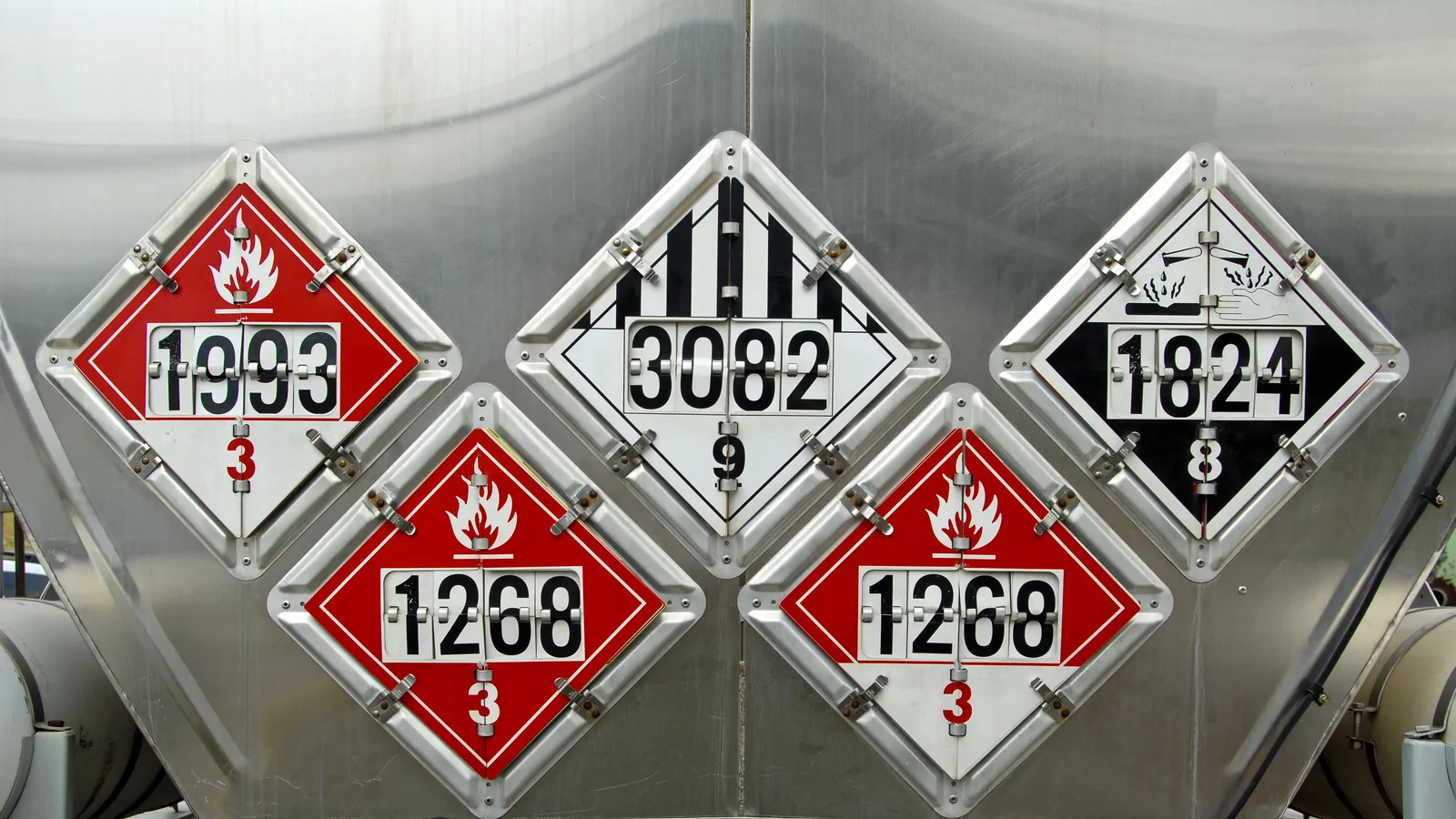
Ocean freight hazmat compliance is governed by the International Maritime Dangerous Goods Code (IMDG Code), published by the International Maritime Organization. The IMDG Code is similar in structure to DOT 49 CFR (the same nine hazard classes) but differs in important details for ocean shipping.
Key IMDG differences from DOT for chemical shippers:
- Documentation: Ocean shipments require a Multimodal Dangerous Goods Form, not just the domestic shipping paper. The form includes IMDG-specific data fields including the proper shipping name in IMDG nomenclature (which sometimes differs from DOT nomenclature for the same product).
- Packaging: Ocean freight requires UN-rated packaging certified to IMDG standards. Some packaging acceptable for domestic DOT shipping is not acceptable for ocean transit.
- Stowage and segregation: IMDG defines stowage categories (A through E) and segregation requirements between incompatible classes. The vessel's stowage plan accounts for these rules.
- Limited Quantity and Excepted Quantity: IMDG provides specific exemptions for small quantities that allow simplified packaging and documentation. These differ from DOT's small-quantity exceptions.
- EmS numbers: Ocean shipments include Emergency Schedule (EmS) numbers on the dangerous goods form. These reference the IMDG Code emergency response procedures.
For chemical exporters, the practical implication: the shipping paper that worked for domestic trucking is not adequate for the ocean leg. The Multimodal Dangerous Goods Form has to be prepared correctly for the IMDG portion of the transit, and the cargo's classification details have to be verified against IMDG (not just DOT) requirements before the booking is confirmed.
NVOCC vs Freight Forwarder: When Each Is Right
International ocean freight involves multiple intermediary roles, and the difference between them affects who issues your bill of lading, who carries cargo liability, and who you have a contract with.
NVOCC (Non-Vessel Operating Common Carrier)
An NVOCC is licensed by the Federal Maritime Commission to operate as the legal shipper of record on ocean shipments. The NVOCC contracts with ocean carriers for vessel space, then issues its own bill of lading to the actual shipper. The shipper's contract is with the NVOCC, not the ocean carrier. The NVOCC accepts cargo liability and issues its own house bill of lading.
Total Connection holds OTI/NVOCC license #026203NF, which authorizes us to act as carrier of record on international ocean shipments. For chemical cargo, the NVOCC model provides single-source accountability: one contract, one bill of lading, one compliance chain across the entire international move.
Freight Forwarder
A freight forwarder acts as the shipper's agent rather than as a carrier. The forwarder arranges transportation but does not issue its own bill of lading or accept carrier-level liability. The bill of lading is issued by the ocean carrier directly to the shipper, with the forwarder named on the document.
For chemical shippers, the forwarder model works when the shipper has the internal capability to manage hazmat documentation, customs entries, and carrier coordination. The NVOCC model works better when the shipper wants single-source accountability across multiple modes and prefers a logistics provider that takes carrier-level responsibility.
For more on the freight forwarder model, see our freight forwarder guide.
The Bill of Lading: Master, House, Surrendered, and Telex Release
The bill of lading is the central document in ocean freight. It serves three functions: receipt confirming the carrier received the goods, contract of carriage defining transport terms, and document of title controlling who can claim the goods at destination.
For chemical shippers, the four bill of lading types that matter:
- Master Bill of Lading (MBL): Issued by the ocean carrier to the NVOCC. Covers the vessel transit from port of loading to port of discharge.
- House Bill of Lading (HBL): Issued by the NVOCC to the actual shipper. The shipper uses the HBL to claim cargo at destination.
- Surrendered Bill of Lading: The originals are returned to the carrier at origin, eliminating the need to present originals at destination. Common for shipments between trusted trading partners.
- Telex Release: Electronic authorization from the carrier's origin office to their destination office releasing cargo without original paper documents. The mechanism that makes a surrendered BOL work.
For a deeper breakdown, see our guide to types of bills of lading.
Port Operations: Drayage, Demurrage, and Bonded Warehousing
Container ocean freight does not end at the port. The container has to be drayed from the marine terminal to its final destination, and time at the port costs money once free time expires.
Container Drayage
Drayage is the short-haul trucking of containers between ports, rail terminals, and final delivery locations. Drayage involves terminal appointment scheduling, chassis availability, container weight compliance, and demurrage/detention management. More supply chain failures happen in the drayage leg than in ocean transit or customs clearance combined.
For more, see our complete container drayage guide.
Demurrage and Detention
Demurrage is the charge assessed when a container remains at the port beyond the carrier's allotted free time (typically 3 to 5 days after vessel discharge). Detention is the charge when the container or chassis is held outside the terminal beyond its return deadline. Both can accrue at $150 to $300+ per day per container.
The most reliable way to avoid these charges is proactive coordination: pre-clearing customs before vessel arrival, scheduling drayage pickup early within the free time window, confirming chassis availability before dispatch, and coordinating delivery appointments in advance. See our guide on how to avoid demurrage charges.
Bonded Warehousing
A bonded warehouse is a customs-authorized facility where imported goods can be stored without paying duties or taxes until withdrawn for domestic consumption. For chemical importers, bonded warehousing provides cash flow flexibility and duty deferral on inventory that may be re-exported or used in further manufacturing.
For more, see our bonded warehouse guide.
Cost Components: Ocean Rate, BAF, CAF, Drayage, and Customs
The all-in cost of an international ocean freight move includes more than just the ocean rate quoted by the carrier. The components that show up on an invoice:
| Cost Component | What It Covers | Typical Range or Note |
|---|---|---|
| Base ocean rate | Vessel transport from port of loading to port of discharge | Varies by lane, market, and equipment |
| BAF (Bunker Adjustment Factor) | Fuel cost adjustment based on bunker fuel price | Adjusted monthly or quarterly by carrier |
| CAF (Currency Adjustment Factor) | Currency exchange rate adjustment | Adjusted by carrier |
| THC (Terminal Handling Charge) | Loading and unloading at origin and destination terminals | Fixed per container by terminal |
| Documentation fee | Bill of lading issuance and amendments | Typically $50 to $150 per BOL |
| Customs clearance | Entry filing, classification, duties calculation | Per shipment, varies by complexity |
| ISF (Importer Security Filing) | 10+2 data submission for US imports | $25 to $50 per filing |
| Drayage | Trucking between port and inland destination | $300 to $800 per move at major US ports |
| Chassis | Container chassis rental during drayage | Daily rate plus pool fees |
| Demurrage / Detention | Charges for container at port or held past free time | $150 to $300+ per container per day |
For hazmat shipments, add: hazmat surcharge from the ocean carrier (typically 5 to 15 percent of base rate), dangerous goods documentation fee, and any required IMDG Code packaging or labeling supplies.
Major Chemical Export and Import Lanes
Total Connection moves chemical freight on every major ocean lane. The highest-volume corridors for North American chemical shippers:
- US Gulf Coast to Europe: Houston, Galveston, New Orleans to Rotterdam, Antwerp, Hamburg, Le Havre. The dominant petrochemical and specialty chemical export lane.
- US East Coast to Asia: NY/NJ, Norfolk, Savannah, Charleston to Shanghai, Ningbo, Singapore. Mixed chemical, polymer, and intermediate exports.
- US West Coast to Asia: Long Beach, Los Angeles, Oakland to Shanghai, Tokyo, Busan, Singapore.
- US imports from Europe: Specialty chemicals, additives, and intermediates from Rotterdam and Antwerp to NY/NJ, Norfolk, Houston.
- US imports from Asia: Polymers, additives, fine chemicals from Shanghai and Ningbo to Long Beach, NY/NJ.
- US to Latin America: Miami, Houston, NY/NJ to Veracruz, Cartagena, Santos, Buenos Aires.
- Intra-Asia: Shanghai, Singapore, Busan moves for shippers with regional Asian production and distribution.
Lane selection affects transit time, rate level, transshipment risk, and capacity availability. For chemical shippers with consistent volume, contract rates locked with specific carriers on specific lanes provide better predictability than spot booking.
Compliance: ISF 10+2, Customs Entry, and Hazmat Declarations
US chemical importers face three compliance requirements beyond standard ocean freight documentation:
ISF 10+2 (Importer Security Filing)
US Customs and Border Protection requires importers to submit 10 data elements (and ocean carriers to submit 2) at least 24 hours before cargo is loaded onto the US-bound vessel at the foreign port. Late or incorrect ISF filings can result in $5,000 per shipment penalties.
The 10 importer data elements: seller, buyer, importer of record, consignee, manufacturer, ship-to party, country of origin, HTS number, container stuffing location, and consolidator. The 2 carrier elements: vessel stow plan and container status messages.
For more on ISF compliance, see our ISF 10+2 guide.
Customs Entry
Every commercial import to the US requires a customs entry filing through a licensed customs broker. Chemical imports require accurate HTS classification (the Harmonized Tariff Schedule code that determines duty rate), accurate value declaration, country of origin documentation, and any required FDA or EPA filings depending on the chemical.
Hazmat Declarations
Hazmat ocean shipments require a Dangerous Goods Declaration (or Multimodal Dangerous Goods Form) prepared in compliance with the IMDG Code. The declaration includes proper shipping name, hazard class, UN number, packing group, EmS number, packaging type, and total quantity. Errors result in cargo refusal at the loading port.
How to Choose an NVOCC for Chemical Freight
Six criteria separate qualified chemical-focused NVOCCs from generalist forwarders:
- FMC license verification. Confirm the NVOCC holds an active OTI license from the Federal Maritime Commission. Total Connection's license is #026203NF.
- Chemical and hazmat experience. Years of operating IMDG Code-compliant chemical ocean freight, with specific lane experience on your trade routes.
- Carrier relationships. Established space allocations with major ocean carriers (Maersk, MSC, CMA CGM, Hapag-Lloyd, ONE, Evergreen, COSCO, ZIM) plus access to ISO tank operators for liquid bulk.
- Documentation capability. In-house preparation of bills of lading, dangerous goods declarations, ISF filings, and customs entry coordination. Avoid providers who subcontract documentation to third parties.
- Port and inland network. Strong drayage and inland delivery coverage at the US ports you use, plus established overseas agent relationships at your destination ports.
- Insurance and bonding. Cargo liability coverage, OTI bond per FMC requirements, and general liability that fits the value of chemical cargo. Total Connection carries $5 million in general liability.
Total Connection's Approach to Container Ocean Freight
Total Connection has operated as a licensed NVOCC (OTI #026203NF) and freight forwarder since 1995. We move container ocean freight for chemical importers and exporters across every major North American trade lane, with full IMDG Code hazmat compliance, in-house bill of lading issuance, and coordinated drayage at every major US port.
Single point of accountability across the entire international move: the same account manager who quotes the lane handles the booking, the documentation, the port coordination, and the inland delivery. No handoffs between domestic and international teams. No call-center rotation. One contract, one bill of lading, one compliance chain.
Frequently Asked Questions
What is container ocean freight?
Container ocean freight is the international movement of cargo in standardized intermodal shipping containers (typically 20-foot and 40-foot) on container vessels. It is the dominant mode for chemical importers and exporters moving volumes too large for air freight and too small for dedicated vessel charters.
What's the difference between FCL and LCL?
FCL (Full Container Load) means the shipper books the entire container exclusively. LCL (Less than Container Load) means multiple shippers share a container consolidated at origin and deconsolidated at destination. FCL is the standard for chemical drum, tote, or IBC freight above roughly 8 cubic meters. LCL is used for smaller volumes but adds 5 to 10 days of transit time and is more restrictive for hazmat cargo.
When should I use an ISO tank instead of FCL?
Use an ISO tank when shipping liquid bulk chemical product (21,000 to 26,000 liters) that you do not want to package in drums or totes. ISO tanks eliminate packaging cost, reduce contamination risk, and move intermodally between vessel, rail, and chassis without transferring the product. They are the standard for international liquid bulk hazmat freight.
What is an NVOCC and why does it matter for chemical exporters and importers?
An NVOCC (Non-Vessel Operating Common Carrier) is licensed by the Federal Maritime Commission to operate as the legal shipper of record on ocean shipments. The NVOCC issues its own bill of lading and accepts cargo liability. For chemical shippers, the NVOCC model provides single-source accountability: one contract, one bill of lading, and one compliance chain across the entire international move. Total Connection holds OTI/NVOCC license #026203NF.
What is the IMDG Code and how does it differ from DOT 49 CFR?
The IMDG Code (International Maritime Dangerous Goods Code) governs hazmat by ocean. It uses the same nine hazard classes as DOT 49 CFR but differs in documentation (Multimodal Dangerous Goods Form vs domestic shipping paper), packaging requirements (UN-rated packaging certified to IMDG standards), stowage and segregation rules, and emergency response (EmS numbers). Domestic shipping papers are not adequate for the ocean leg; the IMDG documentation has to be prepared correctly before the booking is confirmed.
What is ISF 10+2 and who files it?
ISF (Importer Security Filing) is a US Customs and Border Protection requirement that the importer submit 10 data elements (and the ocean carrier submit 2) at least 24 hours before cargo is loaded onto a US-bound vessel at the foreign port. Filing is the importer's responsibility, typically handled by their customs broker or NVOCC. Late or incorrect filings can result in $5,000 per shipment penalties.
How do I avoid demurrage charges on imported containers?
Pre-clear customs before vessel arrival, schedule drayage pickup early within the carrier's free time window (typically 3 to 5 days after discharge), confirm chassis availability before dispatching a truck, coordinate delivery appointments with the receiving facility in advance, and use a drayage provider who manages the full process proactively rather than reactively.