
.png)
Pesticides are essential to modern agriculture. They protect crops from insects, rodents, fungi, and weeds that would otherwise devastate yields. But shipping pesticides by liquid bulk tanker is one of the most compliance-intensive freight categories in chemical logistics.
Most pesticide products are classified as hazardous materials under DOT regulations. The active ingredients that make pesticides effective against pests also make them dangerous in transport: toxic to humans, harmful to the environment, and subject to strict federal and state regulations at every stage of the shipping process.
For more on liquid bulk freight, see our complete guide to liquid bulk freight.
Here's what you need to know about shipping pesticides safely, compliantly, and on time.
For shipper-led capacity and hazmat-fluent execution on this freight, see Total Connection's liquid bulk and chemical logistics service.
What is pesticide shipping
Pesticide shipping refers to the transportation of liquid or dry agricultural chemicals designed to control pests, including insecticides (target insects), herbicides (control weeds), fungicides (prevent fungal disease), and rodenticides (control rodents). Most concentrated pesticide products ship as liquid bulk freight in specialized chemical tanker trailers.
The complexity of pesticide shipping stems from three factors: most pesticides are classified as hazardous materials under DOT regulations, the products are highly sensitive to contamination from prior cargo, and demand follows the agricultural calendar, creating seasonal capacity constraints during peak application periods.
A pesticide shipment is not a commodity truck move. It's a regulated hazmat transport that requires specialized carriers, certified equipment, and compliance with both Department of Transportation and Environmental Protection Agency regulations.
DOT hazmat classifications for pesticides
The DOT classifies pesticides based on their chemical properties and toxicity. Most liquid pesticides fall into one or more of these categories:
Class 6.1: Toxic substances. This is the most common classification for concentrated liquid pesticides. Products in this class are toxic to humans through ingestion, inhalation, or skin contact. They require specific placarding (skull and crossbones symbol), DOT shipping papers with proper shipping name and UN number, carriers with active hazmat authority covering Class 6.1, and drivers holding a CDL with hazmat endorsement.
Packing groups within Class 6.1 indicate the degree of toxicity. Packing Group I is the most toxic (highly dangerous), Packing Group II is moderately toxic, and Packing Group III is less toxic but still hazardous. The packing group determines specific handling and documentation requirements.
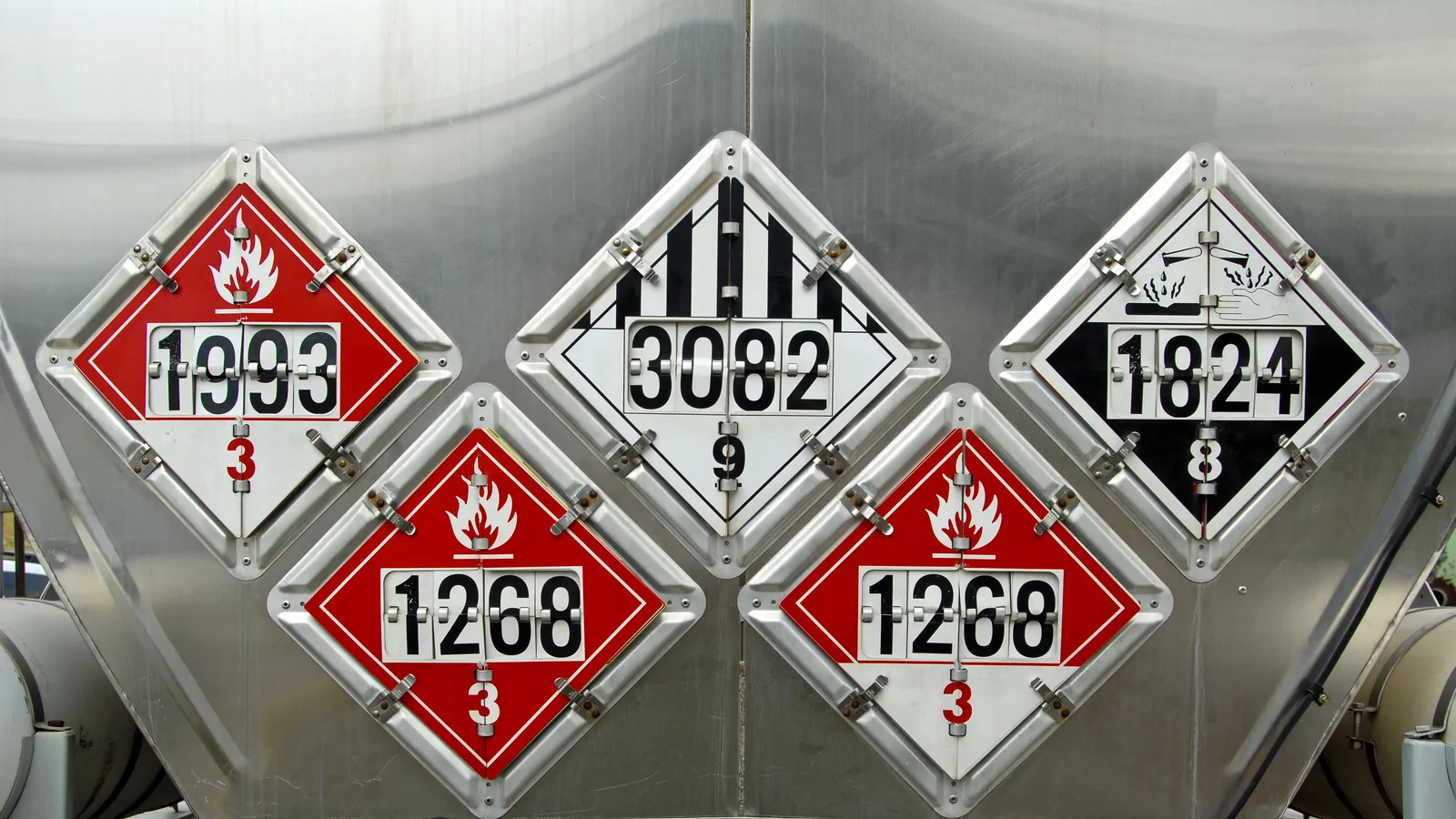
Class 3: Flammable liquids. Some pesticide formulations contain flammable solvents or carriers that put them in this class, either as a primary or subsidiary hazard. Class 3 pesticides require red diamond placards, spark-proof equipment during loading and unloading, and carriers certified for flammable liquid transport.
Many solvent-based pesticides carry both Class 6.1 (toxic) and Class 3 (flammable) classifications. In these cases, the primary hazard class determines the main placard, but the shipping papers and carrier qualifications must cover both hazards.
Class 8: Corrosives. Certain pesticide products, particularly those with acidic or alkaline carriers, fall under the corrosive classification. Class 8 materials can cause severe damage to skin, metals, and other materials on contact. They require black and white corrosive placards and tanker equipment with corrosion-resistant linings.
Class 9: Miscellaneous hazardous materials. Some pesticide products don't fit neatly into Classes 3, 6.1, or 8 but still pose hazards during transport. Environmentally hazardous substances that don't meet thresholds for other classes often fall here.
Many pesticides carry multiple hazard classifications. A product can be both toxic and flammable, requiring compliance with regulations for both classes simultaneously. Your product's Safety Data Sheet (SDS) identifies every applicable classification. The SDS is the authoritative document for determining how your pesticide must ship.
DOT requirements for compliant pesticide shipping
Every pesticide shipment by liquid bulk tanker requires specific certifications, documentation, and procedures. Missing any one of these elements puts the shipment out of compliance and exposes your company to DOT enforcement actions.
Carrier hazmat authority. The carrier must hold active FMCSA hazmat authority covering all applicable hazard classes for your pesticide. A carrier with Class 3 authority cannot legally transport a Class 6.1 pesticide. Verify hazmat authority for every carrier on every shipment.
CDL with hazmat endorsement. The driver must hold a valid Commercial Driver's License with a hazmat endorsement. This requires passing a TSA background check and a written hazmat knowledge test. The endorsement must be current. An expired hazmat endorsement is the same as no endorsement.
DOT shipping papers. Every pesticide shipment requires DOT-compliant shipping papers that include the proper shipping name (specific DOT designation, not the product trade name), UN identification number (four-digit code that identifies the specific hazardous material), hazard class and subsidiary hazards, packing group (I, II, or III for Class 6.1 materials), total quantity by weight or volume, emergency response telephone number, and shipper and consignee information.
The shipping papers must be within the driver's reach while driving and immediately accessible outside the vehicle during inspections. Errors in shipping paper documentation are one of the most common DOT violations on pesticide shipments.
Hazmat placarding. Pesticide tankers must display placards on all four sides of the vehicle that correspond to the hazard class of the product. The placards must meet DOT size, color, and symbol specifications and remain visible and legible throughout transport. For multi-hazard pesticides, the primary hazard determines the main placard, but subsidiary placards may also be required.
Emergency response information. Carriers must have immediate access to emergency response information (ERI) that describes the hazards of the pesticide and the appropriate response in case of spill, fire, or exposure. This is typically the SDS or a DOT emergency response guidebook entry.
Tanker certification and inspection. The tanker trailer must meet DOT specifications for chemical transport and pass annual inspections. Depending on the pesticide, the tank lining must be compatible with the chemical (stainless steel, epoxy lining, rubber lining). Incompatible tank materials can cause product degradation or container failure.
This is more than a checklist. It's a compliance chain where every link has to hold. A single error in documentation, placarding, or carrier qualification can result in DOT fines, shipment delays, or enforcement actions that affect your ability to ship in the future.
EPA requirements for pesticide transport
Pesticide shipping doesn't just fall under DOT hazmat regulations. The Environmental Protection Agency also regulates pesticide transport under FIFRA (Federal Insecticide, Fungicide, and Rodenticide Act). This federal law controls the manufacture, distribution, and use of pesticides to protect human health and the environment.
EPA registration and labeling. Every pesticide product sold or transported in the United States must be registered with the EPA and carry an EPA registration number on its label. The label includes handling and application instructions, hazard warnings, and environmental precautions. Transporting unregistered pesticides or products with improper labeling violates FIFRA.
Container standards. FIFRA establishes standards for pesticide containers to prevent leaks, spills, and contamination. Bulk liquid pesticides must ship in containers that meet these standards and are properly labeled with the product name, EPA registration number, and hazard information. For tanker shipments, this means the tank itself must be certified and the shipping papers must document compliance.
Record-keeping requirements. EPA regulations require shippers and carriers to maintain records of pesticide shipments, including product name and EPA registration number, quantity shipped, origin and destination, carrier name and contact information, and shipping date. These records must be retained for at least two years and made available to EPA inspectors on request.
State-level pesticide regulations. In addition to federal EPA requirements, many states impose additional regulations on pesticide transport. California, for example, requires pesticide shipment permits and imposes stricter labeling and record-keeping rules than federal law. Your logistics partner needs to know and comply with state-specific requirements for every lane you ship.
Violating EPA pesticide transport regulations can result in civil penalties up to $25,000 per violation and criminal penalties for knowing violations that endanger human health or the environment. Compliance is not optional.
Equipment and carrier requirements for pesticide tanker transport
Not every hazmat carrier can handle pesticide freight. The specialized nature of agricultural chemicals requires carriers with specific equipment, certifications, and operating procedures.
Tanker equipment specifications. Liquid pesticides typically ship in stainless steel or epoxy-lined chemical tanker trailers with capacities ranging from 4,000 to 6,500 gallons. The tank lining must be compatible with the specific pesticide formulation. Corrosive pesticides require acid-resistant linings. Some temperature-sensitive products require insulated or heated tankers.
Pneumatic discharge systems are common for viscous pesticide products. These systems use compressed air to push the product out of the tank into storage at the receiving facility. Pump-off systems are used for less viscous liquids. The carrier must have the discharge equipment that matches your receiving facility's infrastructure.
Prior cargo and tank wash requirements. This is critical for pesticide freight. Many pesticide formulations cannot be loaded into a tanker that previously carried incompatible chemicals, even after washing. Residual contamination from prior cargo can degrade the pesticide, trigger chemical reactions, or violate EPA purity standards.
Before loading a pesticide, the tanker must be washed to remove all traces of prior cargo. The wash procedure depends on what the tank previously carried. A tank that hauled acidic chemicals may require multiple washes with neutralizing agents before it can carry an alkaline pesticide. Some pesticides require dedicated equipment that never carries anything else.
Your logistics partner must coordinate tank wash scheduling, verify wash certifications, and maintain prior cargo records for every tanker. A contaminated load will be rejected at the receiving facility, resulting in disposal costs, reshipment charges, and potential liability for product damage.
Carrier insurance requirements. Pesticide carriers must carry higher insurance limits than standard freight carriers. Minimum requirements typically include $1 million in auto liability coverage, $5 million in hazmat pollution liability, and $100,000 in cargo insurance. For high-value or high-risk pesticides, shippers may require even higher limits.
Driver training and certification. Pesticide tanker drivers need more than a CDL with hazmat endorsement. They need specific training on chemical handling procedures, emergency response protocols, DOT and EPA regulations for agricultural chemicals, tank wash verification, and loading and unloading procedures for liquid bulk freight.
The best pesticide carriers maintain in-house training programs and require annual recertification for all drivers. Ask your logistics partner about the driver qualification and training standards they enforce on their carrier network.
Documentation requirements for every pesticide shipment
Compliant pesticide shipping generates multiple documents that must travel with the load and be retained for regulatory and liability purposes.
DOT shipping papers. As described earlier, these papers document the hazmat classification, UN number, quantity, and emergency response information. They must be signed by the shipper certifying that the shipment is properly classified, described, packaged, marked, and labeled.
Bill of lading (BOL). The BOL is the contract between the shipper and carrier. It includes shipment details (product, quantity, weight), pickup and delivery locations, special instructions (temperature control, time-sensitive delivery, dedicated equipment), and liability and claims procedures.
For pesticide freight, the BOL should reference the DOT shipping papers and note any special handling requirements: prior cargo restrictions, required tank wash certifications, delivery appointment windows, or dedicated equipment mandates.
Safety Data Sheet (SDS). The SDS provides detailed information on the pesticide's chemical composition, hazards, handling procedures, and emergency response. A copy must travel with every shipment and be immediately available to the driver and emergency responders.
Tank wash certificate. This document certifies that the tanker has been properly washed and is free of residual prior cargo. It should specify the wash date, wash facility, wash procedure used, and prior cargo carried. Your logistics partner should obtain and verify this certificate before authorizing the carrier to load.
EPA compliance records. For pesticides subject to EPA record-keeping requirements, maintain documentation of EPA registration number, quantity shipped, shipper and receiver information, carrier details, and shipping date. Retain these records for at least two years.
Missing or incorrect documentation is a common source of pesticide shipping delays. Inspectors at weigh stations, state agricultural checkpoints, and receiving facilities will request these documents. Having them complete and accessible prevents costly delays.
Seasonal timing and capacity planning for pesticide freight
Pesticide shipping follows the agricultural calendar. Demand spikes before planting season for pre-emergence products and during growing season for in-season applications. During these peak windows, tanker capacity for agrochemical freight tightens significantly.
Spring surge (March through May). This is the highest-demand period for pesticide shipping. Farmers need herbicides, insecticides, and fungicides in place before and during planting. Tanker capacity becomes scarce, rates increase, and lead times extend from days to weeks.
Shippers who book capacity 3 to 6 weeks ahead of delivery windows secure better rates and more reliable carriers. Waiting until peak season means competing for whatever capacity is available, often at premium rates with less experienced carriers who don't specialize in agricultural chemicals.
Summer application season (June through August). In-season pesticide applications create a secondary demand surge during mid-summer. This period is less intense than spring but still creates capacity constraints, particularly in major agricultural regions like the Midwest, Central Valley California, and the Southeast.
Fall and winter (September through February). Demand drops significantly outside of planting and growing seasons. This is when rates are lowest and capacity is most available. For products with extended shelf life, some shippers pre-position inventory during off-peak periods to avoid spring capacity crunches.
Freight market dynamics. Pesticide shipping competes for the same tanker capacity as other chemical freight: liquid fertilizers, industrial chemicals, food-grade products. When demand is high across multiple sectors, capacity tightens further and rates climb.
Working with a specialized chemical freight broker gives you access to a broader carrier network and better visibility into capacity trends. A broker who specializes in agricultural chemicals can forecast peak periods, pre-book capacity, and help you avoid the worst of the spring surge.
How Total Connection handles pesticide shipping compliance
We've been shipping agricultural chemicals (pesticides, herbicides, insecticides, fungicides, and liquid fertilizers) since 1995. Our team handles the full compliance chain on every pesticide shipment.
Carrier screening and hazmat verification. Every carrier in our network is pre-qualified for chemical freight. We verify active hazmat authority covering the specific hazard classes for your products, insurance coverage that meets or exceeds standard minimums, CSA safety scores and inspection records, and equipment capability (tank lining, discharge systems, temperature control).
We don't use spot market carriers for pesticide freight. Every carrier has an established track record with us and has been vetted for chemical handling capability.
Equipment matching and prior cargo management. We coordinate tank wash scheduling and verify wash certifications before authorizing loading. We maintain prior cargo records for every tanker and match equipment to your product requirements, whether that's stainless steel tanks for corrosive pesticides, heated trailers for temperature-sensitive formulations, or dedicated equipment for ultra-pure products.
DOT and EPA documentation. Our team prepares DOT-compliant shipping papers with accurate proper shipping names, UN numbers, hazard classes, and packing groups. We ensure that SDS documents travel with every load and that all EPA record-keeping requirements are met and retained.
Delivery scheduling aligned to the agricultural calendar. We understand that pesticide shipments are time-critical during planting and application seasons. Our account managers coordinate delivery windows with your receiving facilities and track every load in real time to ensure on-time delivery.
Dedicated account management. Every pesticide shipper gets a dedicated account manager who understands the products, the regulations, and the urgency of agricultural timing. You're not routed through a call center. You work with one person who knows your freight and responds immediately when issues arise.
Call 732-817-0401 or request a quote. We respond within minutes and can move your pesticide freight on the timeline you need.
Frequently Asked Questions
What DOT hazmat class are pesticides?
Most concentrated liquid pesticides are classified as Class 6.1 (toxic substances). Some pesticides are also Class 3 (flammable liquids) or Class 8 (corrosives) depending on their chemical composition. Many pesticides carry multiple hazard classifications simultaneously. The product's Safety Data Sheet (SDS) identifies all applicable DOT hazard classes.
Do all pesticides require hazmat shipping?
Not all pesticides are classified as hazmat, but most concentrated liquid pesticide products are. Diluted, ready-to-use consumer pesticide products may not meet the hazmat threshold, but commercial-grade agricultural pesticides typically do. Always check the SDS to confirm classification.
What documentation is needed for pesticide shipments?
Every pesticide shipment requires DOT shipping papers (with proper shipping name, UN number, hazard class, packing group), bill of lading, Safety Data Sheet (SDS), tank wash certificate (for bulk liquid shipments), emergency response information, and EPA compliance records (product registration number, quantities, shipper and receiver details). Missing or incorrect documentation can delay the shipment and trigger compliance violations.
Can pesticides be shipped with other chemicals in the same tanker?
No. Pesticides are highly sensitive to contamination and typically require dedicated equipment or thoroughly washed tankers with verified prior cargo records. Shipping pesticides in a tanker that previously carried incompatible chemicals can contaminate the product, even after washing. Most pesticide shippers specify acceptable prior cargo or require dedicated equipment.
What's the difference between shipping liquid and dry pesticides?
Liquid pesticides typically ship in chemical tanker trailers and require DOT hazmat compliance, tank wash coordination, and specialized carrier equipment. Dry pesticides (granular or powder formulations) ship in bulk pneumatic trailers, super sacks, or packaged containers. Both may be classified as hazmat, but the equipment and handling procedures differ significantly. This guide focuses on liquid bulk pesticide transport.
How far in advance should I book pesticide shipping?
Three to six weeks before your delivery window is recommended, especially during peak spring planting season (March through May). During peak agricultural season, capacity for agrochemical freight tightens significantly. Advance booking secures better rates, more reliable carriers, and guaranteed delivery windows.
Does Total Connection handle EPA compliance for pesticide shipping?
Yes. We ensure that all carrier and documentation requirements under both DOT and EPA regulations are met on every pesticide shipment. Our team understands the EPA registration, labeling, container standards, and record-keeping requirements that FIFRA imposes on pesticide transport. We maintain compliance records and make them available for audits or inspections.