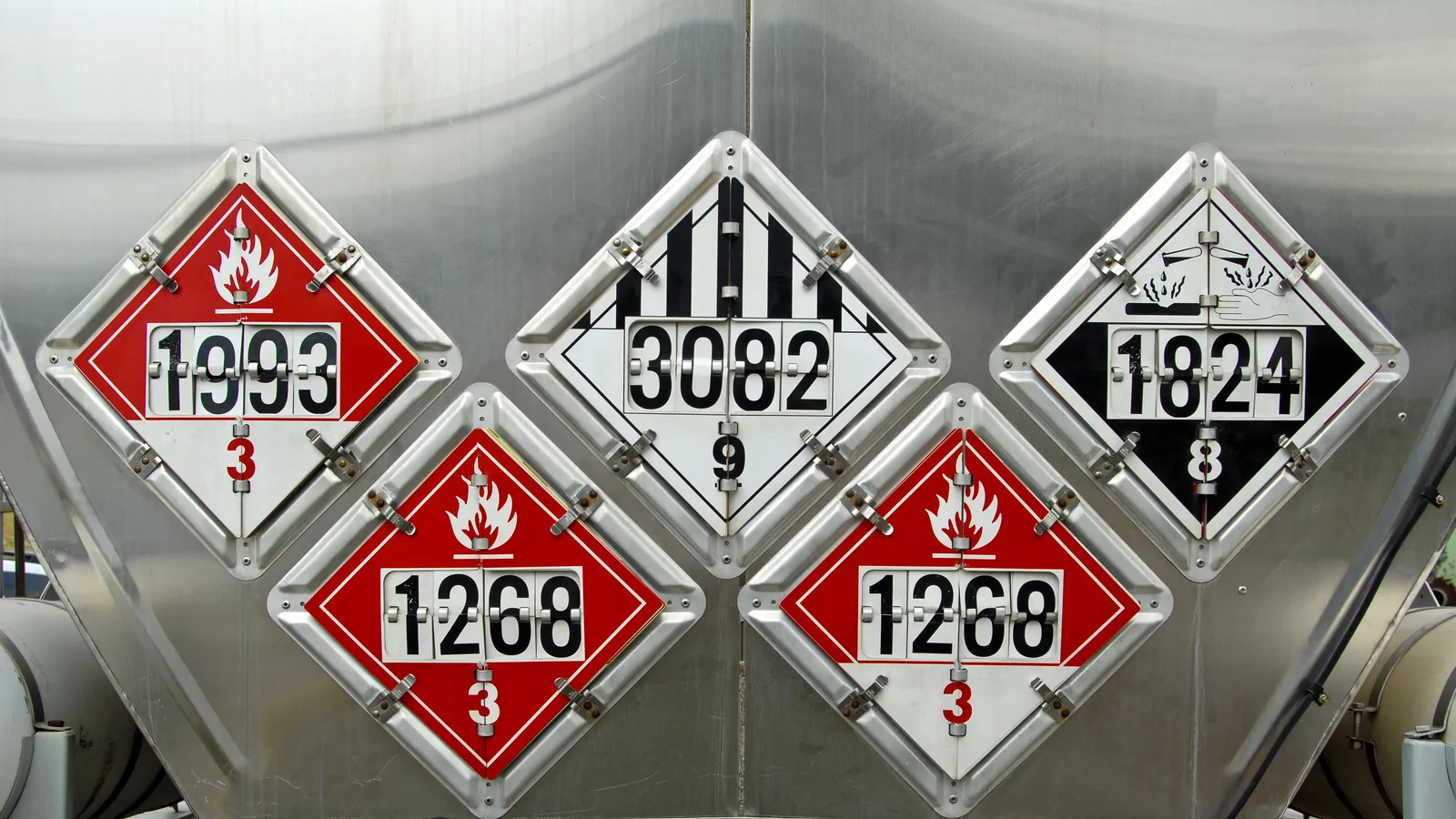


Chemical hauling companies are FMCSA-licensed motor carriers that move hazardous and non-hazardous chemicals in DOT 407, DOT 412, MC 331, ISO tank and pneumatic dry bulk equipment under 49 CFR Parts 171 through 180. Choosing one comes down to seven things you can verify before the first tender. The insurance test alone thins the field: a hazmat carrier moving bulk freight must carry at least $5M in financial responsibility under 49 CFR 387.9, five times the $1M federal floor for general freight.
What Chemical Hauling Companies Do (and What They Don't)
Their scope is tankerload pickup and delivery, hazmat paperwork (shipping papers, placards and emergency response information), tank preparation and in-transit incident response. They are not regulatory consultants on your Safety Data Sheets, they are not packaging engineers, and most are not warehousing providers. Compatibility review before the load moves happens on your side of the fence.
The split that determines fit is asset carrier versus chemical broker. An asset-based hauler owns the tractors and tankers and dispatches off its own fleet. A forwarder builds a vetted carrier network and matches purpose-built equipment to each commodity, lane and delivery window. Total Connection works the independent side: we pick the equipment for the load, not the truck sitting in a yard. Both models serve real use cases, and the wrong fit on the wrong load runs from a failed roadside inspection to an environmental cleanup with a cost-recovery claim attached.
Before you tender to either one, run the company through FMCSA SAFER. Confirm active MC authority, hazmat registration on file and the BASIC categories under the Compliance, Safety, Accountability program. Look hardest at Hazardous Materials Compliance, where a score above the federal alert threshold of 60 puts the carrier on the enforcement radar and the file on your auditor's desk.
The 7 Criteria That Separate Qualified Chemical Haulers From Generic Carriers
The price quote is a poor signal of carrier quality. The seven criteria below are the operational filter. Run every candidate through all of them before you tender the first load.
- Hazmat and tank endorsements on the CDL. H is the hazmat endorsement, N is the tank endorsement, X is both under 49 CFR 383.93. A chemical hauler's drivers need X to move hazmat in bulk. No endorsement, no load.
- Equipment match. DOT 407 for non-pressure mild chemicals, DOT 412 for corrosives, MC 331 for compressed and liquefied gases, ISO tank for intermodal, pneumatic dry bulk for solids. Mixing equipment and commodity is the most common failure mode in chemical freight.
- Tank wash certifications. Chemical wash, food-grade wash, kosher (OU or Star-K) wash and the carrier's NTTC wash code documentation. The last three loads on the tanker have to clear against your commodity to rule out residue contamination.
- Insurance limits. Federal minimum general liability is $1M. Hazmat carriers moving bulk freight must carry a minimum of $5M in financial responsibility under 49 CFR 387.9. A carrier that maxes at $1M exhausts its policy early in a cleanup.
- Lane density. A carrier running several trucks on your origin and destination pair every week can cover a surge. A carrier running the lane once a month strands you when its one truck goes down.
- CSA Hazardous Materials Compliance under 60. This is the BASIC that flags hazmat-specific violations. Above the federal alert threshold, expect more roadside inspections and a paper trail your auditor will surface.
- Driver retention. A carrier that keeps its chemical drivers year over year has the institutional memory to handle a contaminated load, a hazmat hold or a refused delivery. A carrier constantly restaffing the seat does not.
Equipment Types: DOT 407, DOT 412, MC 331, ISO Tank, and Dry Bulk
The most expensive mistake in chemical freight is putting the wrong commodity in the wrong tanker. Each spec is built for a specific pressure profile, chemical resistance and discharge method, and a carrier that offers to make one work for another commodity is telling you something. The table below sets out the five most common bulk options.
| Equipment | Capacity | Common Commodities | Hazmat Class Fit | Pressure Rating | Build Notes |
|---|---|---|---|---|---|
| DOT 407 | 6,500 to 7,000 gal | Resins, latex, mild solvents, food-grade liquids | Class 3, certain 6.1, 8 | Non-pressure (atmospheric) | Stainless or aluminum shell, insulated options |
| DOT 412 | 5,500 to 6,000 gal | Sulfuric acid, hydrochloric acid, caustic soda, ferric chloride | Class 8 corrosives, certain 5.1 | Non-pressure, thicker shell | Rubber or fluoropolymer lining for corrosion resistance |
| MC 331 | 10,000 to 11,500 gal (water capacity) | LPG, anhydrous ammonia, chlorine, compressed gases | Class 2.1, 2.2, 2.3 | 250 to 265 PSI | ASME pressure vessel construction |
| ISO Tank | Design-dependent, sized to the commodity | Specialty chemicals, intermodal moves, ocean export | Class 3, 6.1, 8 (load-dependent) | Pressure-rated per tank design | Container frame, drayable on a chassis, ocean and rail compatible |
| Pneumatic Dry Bulk | Design-dependent by trailer | Resin pellets, soda ash, sodium bicarbonate, cement | Class 4.1, 5.1, dry Class 8 | Blower-driven discharge | Discharged through hose into a silo or hopper |
For the deeper breakdown of tanker spec and lining choices, see our guide to tanker types and selection.
Hazmat Endorsements and Certifications to Verify
The carrier's paperwork is the second filter after equipment. Four documents tell you whether the driver and the company can legally move the load, and all four belong in hand before you tender, not after the truck is at the gate.
- CDL H endorsement. The hazardous materials endorsement on the driver's commercial license, required for any placarded load. A TSA security threat assessment and fingerprinting sit behind it, so a carrier cannot add it to a driver overnight.
- CDL N endorsement. The tank vehicle endorsement, required to move bulk liquid or liquefied gas in a tank vehicle. A driver holding H but not N cannot legally pull your loaded DOT 407.
- CDL X endorsement. Hazmat and tank combined under 49 CFR 383.93, the working standard for bulk chemical drivers. Confirm X on the specific driver assigned to the load, not on the roster in general.
- HM-126F training records. Under 49 CFR 172.704, every hazmat employee must be trained within 90 days of hire and recertified every three years. The file should cover general awareness, function-specific, safety and security awareness training.
Carriers also register with PHMSA under 49 CFR Part 107 Subpart G, and the registration number and fee receipt should be on file. If pickup or delivery sits inside a secured maritime facility, the assigned driver needs a TWIC, and the carrier should know that before dispatch rather than at the gate.
Insurance Coverage: Why $1M General Liability Isn't Enough for Chemical Freight
The federal floor for motor carrier general liability is $1M. Hazmat motor carriers moving bulk freight have to carry a minimum of $5M in financial responsibility under 49 CFR 387.9, and $5M is the working benchmark for chemical-grade freight generally. Total Connection carries $5M in general liability.
The reason is exposure. An overturned DOT 412 of concentrated corrosive triggers an emergency response, soil remediation, groundwater monitoring and cost recovery claims that reach the shipper, the carrier and the forwarder at the same time. A policy that stops at $1M is exhausted early in that sequence.
Collect three documents, not one.
- Certificate of insurance. Check the limits and effective dates, then check the endorsements. Plenty of general freight policies exclude pollution outright, which makes the headline limit meaningless on a chemical load.
- MCS-90 endorsement. The federally required rider guaranteeing the carrier satisfies a judgment for negligence in transporting hazardous materials. If it is not attached, walk away.
- Pollution liability. A separate policy with a separate limit. Cargo coverage pays for the product, not the cleanup, and the cleanup is the number that hurts.
Have the certificate sent by the carrier's broker or agent directly, and re-verify at renewal.
Tank Wash Certifications and What They Actually Mean
Residue from a prior load is the most common cause of a rejected chemical shipment at destination. A tanker that hauled latex yesterday cannot haul food-grade glycerin today without a documented wash, and the wash type has to match the next commodity.
- Chemical wash. The base wash for industrial commodities: detergent, rinse and inspection, documented with an NTTC wash code on the wash ticket.
- Food-grade wash. Additional sanitation steps certified by the wash facility, required for any food-contact commodity.
- Kosher wash. OU or Star-K certification, required for kosher-grade glycerin, vegetable oils and certain pharmaceutical intermediates. The certification covers the tanker and the wash facility both.
- NTTC wash code. The National Tank Truck Carriers code system that documents which commodities a wash cycle clears. The code on the ticket has to match the residue tolerance of the next load.
Ask for the wash ticket and the prior three loads before the tanker leaves origin, not when it arrives. This is one of the steps we cover in our piece on how to get chemical freight covered faster by carriers.
Chemical Broker vs Asset Carrier: When to Use Each
Both models work. The right fit depends on your lane profile and how much your demand moves.
Asset-based chemical haulers are strongest on high-frequency dedicated lanes with a single commodity. One company owns the equipment, the drivers and the dispatch, so accountability is clear and the drivers learn the plant. The trade-off is rigidity: when demand spikes or the lane shifts, the asset carrier either scrambles or declines.
A forwarder is strongest on variable demand, multi-commodity portfolios and seasonal peaks. Total Connection matches purpose-built equipment from a network of 100,000+ vetted carriers to each load, so a shipper needing a DOT 407 one week and an ISO tank for an export move the next works through one point of contact instead of several separate contracts. The same team also handles the drayage, the truckload and LTL, the warehousing, the customs entry and the ocean or air leg, which keeps a chemical portfolio from turning into a vendor list.
8 Red Flags That Disqualify a Chemical Hauler
Walk away if any of the following show up. Each is a known precursor to a failed load, an inspection hit or a claim that follows your account.
- CSA Hazardous Materials Compliance over 60. The carrier is already inside the federal alert zone.
- No tank wash documentation. Cannot produce the wash ticket for the assigned tanker.
- A $1M general liability ceiling. Cannot meet the 49 CFR 387.9 bulk hazmat threshold.
- No MCS-90 endorsement on file. The required hazmat rider is missing from the policy.
- Improvised equipment. Anything other than purpose-built tankers for the commodity class you are tendering.
- Constant turnover on chemical routes. No institutional memory, and every load is the new driver's first.
- No incident response protocol. The carrier cannot describe what happens in the first minutes after a spill.
- No record of the prior three loads. Either the records do not exist or they hide a commodity that compromises yours.
Choosing the Right Chemical Hauling Company: Next Steps
Run every candidate through the seven criteria, pull the CSA scores, and confirm the wash ticket before the tanker leaves origin. For more on matching equipment to commodity, see our guides on tanker trucking companies and how to find chemical tanker trucks, our pillar on liquid bulk freight, and the regulatory detail in hazmat trucking regulations. See the full liquid bulk and chemical logistics service, or request a quote to get your next chemical load matched to the right carrier.
What license do chemical hauling companies need?
Chemical hauling companies need active FMCSA MC authority plus PHMSA hazmat registration under 49 CFR Part 107 Subpart G. Drivers moving bulk hazmat need the CDL X endorsement, which combines the hazmat and tank vehicle endorsements.
What is the difference between a chemical hauler and a chemical broker?
A chemical hauler dispatches its own tractors and tankers on the lanes it runs. An independent forwarder like Total Connection matches each load to purpose-built equipment across a network of 100,000+ vetted carriers, so a shipper can move a DOT 407 one week and an ISO tank export the next through one point of contact. The hauler model suits a single steady lane; the forwarder model suits a mixed portfolio.
How much insurance should a chemical hauling company carry?
Federal minimum general liability for motor carriers is $1M, but hazmat carriers moving bulk freight must carry at least $5M in financial responsibility under 49 CFR 387.9. Total Connection carries $5M in general liability, and any hazmat carrier you tender to should also have the MCS-90 endorsement attached to its policy.
What CDL endorsements are required to haul chemicals?
The H endorsement covers hazardous materials and the N endorsement covers tank vehicles; X combines both under 49 CFR 383.93. Bulk chemical loads require the driver to hold the X endorsement.
What equipment do chemical hauling companies use?
DOT 407 tankers handle non-pressure liquids like resins and food-grade products, DOT 412 tankers handle corrosives, and MC 331 pressure vessels handle compressed gases like LPG and anhydrous ammonia. ISO tanks cover intermodal and export moves, and pneumatic dry bulk trailers move dry commodities like resin pellets and soda ash.
How do I check a chemical hauling company's safety record?
Run the carrier's MC number through FMCSA SAFER to confirm active authority, hazmat registration and CSA BASIC scores. Focus on the Hazardous Materials Compliance BASIC, where a score over 60 puts the carrier in the federal alert zone.