
.png)
Sunlight destroys plastics. Specifically, the ultraviolet radiation in sunlight breaks polymer chains, causing discoloration, chalking, cracking, embrittlement, and loss of mechanical properties. A plastic product that performs perfectly indoors can fail within months of outdoor exposure without UV protection.
UV absorbers and light stabilizers are the chemical additives that prevent this degradation. They're added to polymers during manufacturing and work through different mechanisms to protect the material from UV-induced damage throughout its service life.
For shipper-led capacity and hazmat-fluent execution on this freight, see Total Connection's liquid bulk and chemical logistics service.
What are UV stabilizers and light stabilizers
UV stabilizers and light stabilizers are chemical additives incorporated into polymers, coatings, and plastics to prevent degradation from ultraviolet radiation. The terms are often used interchangeably, but they cover different mechanisms. UV absorbers block harmful UV energy from reaching the polymer. Light stabilizers (specifically HALS, hindered amine light stabilizers) interrupt the degradation reactions that UV initiates.
Without stabilization, most polymers exposed to sunlight lose 50 percent or more of their mechanical strength within one to three years. With proper stabilization, outdoor service life extends to 10, 20, or 50-plus years depending on the polymer, application, and UV stabilizer package selected.
The global UV stabilizers market is worth over $1.5 billion annually because polymer performance outdoors depends entirely on UV protection. Automotive manufacturers specify UV stabilization for 10-year warranties. Building product manufacturers specify it for 20 to 50-year performance. Agriculture film producers tailor UV packages to match seasonal or multi-year crop cycles.
How UV degradation works
UV radiation in the 290 to 400 nanometer wavelength range has enough energy to break chemical bonds in polymer chains. When UV photons are absorbed by the polymer, they create free radicals, highly reactive molecular fragments that initiate chain reactions of oxidative degradation. These chain reactions propagate through the material, progressively breaking down the polymer structure and degrading its physical properties.
The rate of UV degradation depends on the polymer type (polypropylene and polyethylene are highly UV-sensitive, polycarbonate and PVC less so), the intensity and duration of UV exposure (Arizona desert versus Seattle coast), temperature (heat accelerates degradation), the presence of oxygen and moisture (oxidative degradation requires both), and whether UV stabilizers have been added.
Without stabilization, most polymers would have unacceptably short outdoor service lives. A polypropylene part exposed to full sunlight in Florida or Arizona will embrittle and crack within 6 to 12 months without UV protection. The same part with optimized UV stabilization can perform for 10 years or more.
Types of UV stabilizers: HALS, benzotriazoles, benzophenones
UV absorbers (UVAs)
UV absorbers work by absorbing UV radiation before it can reach and damage the polymer chains. They convert the UV energy into harmless heat that dissipates into the surrounding material. Major types include benzotriazoles, the most widely used UV absorber class, effective across a broad UV spectrum (290 to 400 nm) and compatible with most polymer systems. Benzotriazole UVAs are the standard in automotive, construction, and high-performance applications.
Benzophenones are cost-effective UV absorbers used in a wide range of polymers. They're less expensive than benzotriazoles but offer lower performance and shorter service life. Benzophenones are common in agricultural films and packaging where moderate UV protection is sufficient.
Triazines are newer UV absorbers with excellent thermal stability and long-term performance. They're used in engineering plastics and high-temperature applications where benzotriazoles would degrade.
Hindered amine light stabilizers (HALS)
HALS don't absorb UV radiation directly. Instead, they scavenge the free radicals that UV radiation creates, interrupting the degradation chain reaction before it can propagate. HALS are regenerated during the scavenging process, so they remain effective much longer than UV absorbers that are consumed as they work.
HALS are the most cost-effective UV stabilizer class on a performance-per-dollar basis, particularly for long-term outdoor exposure. They're widely used in polyolefins (polyethylene, polypropylene), where they provide 5 to 10 times longer service life than UV absorbers alone.
HALS are often used in combination with UV absorbers for maximum protection. The UV absorber blocks the initial UV energy. The HALS scavenges any free radicals that escape. This synergistic combination delivers performance greater than either additive alone.
Quenchers
Quenchers deactivate the excited-state polymer molecules that UV radiation creates, preventing them from initiating degradation reactions. Nickel-based quenchers were historically common but have been largely replaced by HALS and UVA combinations due to color (nickel quenchers impart green or yellow tint) and regulatory concerns (nickel compounds face restrictions in some markets).
Industries using UV stabilizers (plastics, coatings, automotive)
Automotive manufacturers use UV stabilizers in exterior trim, bumpers, mirror housings, door handles, grilles, and all painted and unpainted plastic exterior components. Dashboards, instrument panels, and interior trim exposed to sunlight through windows also require UV protection. Automotive specifications demand the highest performance levels, typically 3,000 to 5,000 hours of accelerated weathering per SAE J2527 or similar standards.
Building and construction applications include window profiles (vinyl and composite), siding, decking, fencing, roofing membranes, geomembranes, and outdoor furniture. These products must withstand years or decades of continuous UV exposure. UV stabilizer selection directly determines product warranty periods, a building product with 5-year warranty uses a different UV package than one with 50-year warranty.
Agriculture relies on UV stabilizers for greenhouse films, mulch films, silage covers, irrigation tubing, and shade cloth. UV protection is tailored to expected service life, from 6-month seasonal films to 5-year or longer permanent greenhouse structures.
Packaging applications include outdoor-stored packaging, agricultural bulk bags, UV-sensitive product packaging (pharmaceuticals, food, cosmetics), and masterbatch carriers for color concentrates.
Coatings use UV absorbers in automotive clear coats, wood coatings, marine coatings, and architectural coatings where UV degradation causes chalking, gloss loss, and color fade.
Hazmat considerations for UV stabilizers
Most UV stabilizers are non-hazardous or DOT Class 9 (miscellaneous hazardous material). HALS are typically non-hazardous in solid form or low-concentration solutions. Benzotriazole and benzophenone UV absorbers are generally Class 9 or non-hazardous depending on formulation and concentration.
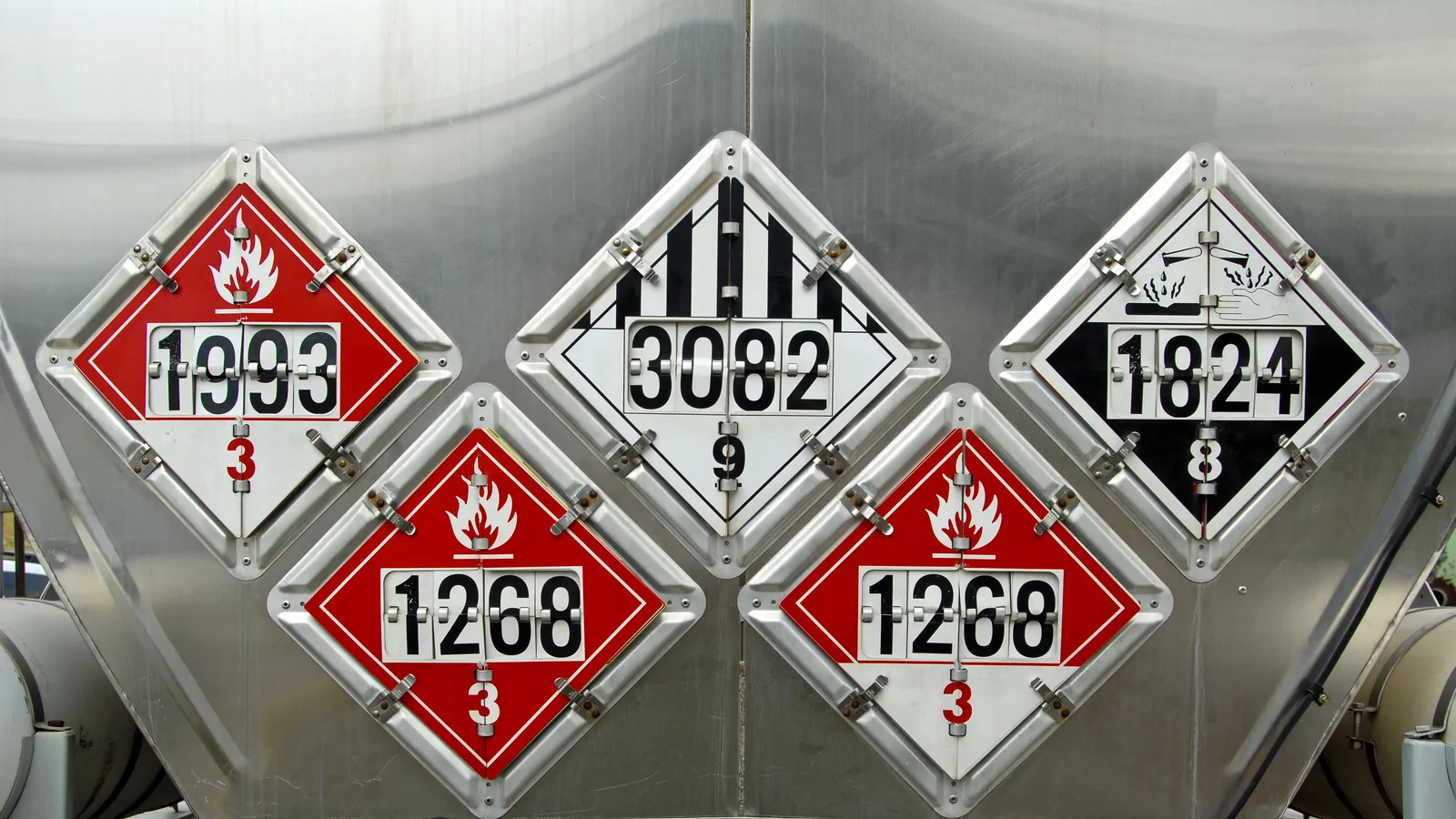
Some UV stabilizer formulations dissolved in organic solvents are DOT Class 3 (flammable liquid) due to the solvent carrier. These require placarding, hazmat endorsement, and emergency response information. Triazine UV absorbers may be Class 9 depending on the specific compound and concentration.
Every UV stabilizer shipment requires SDS review to determine classification, packaging, and documentation requirements. Carriers must verify their equipment and driver certifications match the cargo hazmat class before accepting the load.
Temperature and storage requirements
Many liquid UV stabilizers are temperature-sensitive. Benzotriazole UV absorbers can crystallize at temperatures below 60°F to 70°F depending on formulation, requiring heated transport in cold weather or insulated tanks with temperature monitoring. HALS solutions may increase viscosity at low temperatures, making pump unloading difficult or impossible without heat.
Some UV stabilizers require refrigerated transport to prevent degradation or polymerization during transit, particularly high-purity or reactive formulations. Temperature excursions outside specified ranges can compromise stabilizer performance or render the product out of specification.
Storage at the receiving facility requires climate control for temperature-sensitive products, protection from direct sunlight (ironic for UV stabilizers, but UV exposure can degrade some formulations in concentrated form), sealed containers to prevent moisture pickup, and nitrogen blanketing for oxidation-sensitive products.
Packaging and handling for UV stabilizer shipping
UV stabilizers ship in multiple formats depending on form, volume, and customer requirements. Liquid UV stabilizers ship in drums (55-gallon steel or plastic), IBC totes (275-gallon intermediate bulk containers), or tanker trucks (5,000 to 7,000-gallon loads for high-volume customers). Solid UV stabilizers ship in bags, drums, or bulk bags (supersacks).
Purity is paramount for UV stabilizers. These are precision additives added at 0.1 to 3 percent by weight in polymer formulations. Trace contamination from prior cargo can affect stabilizer performance, alter the additive package compatibility, compromise the finished polymer product's UV protection, and cause customer rejections or quality claims.
Tank wash verification and prior cargo documentation are essential for liquid bulk shipments. Many UV stabilizer manufacturers require dedicated tanker fleets or kosher wash certification before accepting deliveries. Product segregation between different stabilizer chemistries (benzotriazoles, HALS, benzophenones) prevents cross-contamination that could affect additive package compatibility in multi-additive formulations.
Why Total Connection for UV stabilizer and light stabilizer shipping
We ship specialty polymer additives including UV absorbers, HALS, stabilizer blends, and combination packages to compounders and manufacturers across North America. Our carrier network includes operators with the cleanliness standards, temperature-controlled equipment, and hazmat capabilities that specialty chemical freight demands. For more on related polymer additive categories, see our guides on plasticizers and liquid bulk freight.
We handle hazmat classification and compliance for Class 3 or Class 9 formulations, temperature management (heated or refrigerated transport, insulated tanks, temperature monitoring), tank cleanliness verification (wash certificates, prior cargo tracking, dedicated fleets), purity protection through product segregation and contamination prevention, and batch traceability (lot tracking, certificates of analysis, chain of custody).
We built Total Connection on specialty chemical logistics, where UV stabilizers and polymer additives are a regular part of the freight mix. We know which carriers run the cleanest equipment, which operators can handle temperature-sensitive formulations, and how to coordinate just-in-time deliveries to keep polymer compounding schedules on track.
Call 732-817-0401 or request a quote for UV stabilizer and light stabilizer logistics.
Frequently Asked Questions
What's the difference between UV absorbers and HALS?
UV absorbers (benzotriazoles, benzophenones) absorb UV radiation before it reaches the polymer. HALS scavenge the free radicals that UV creates, interrupting the degradation chain reaction. They work through different mechanisms and are often used together for maximum protection.
Are UV stabilizers hazardous materials?
Most are non-hazardous or DOT Class 9. Some formulations with organic solvents may be Class 3 (flammable). Each product must be verified against its SDS.
Why do UV stabilizers need clean tanker equipment?
UV stabilizers are precision additives added at specific concentrations. Contamination from prior cargo can affect stabilizer performance, alter the additive package compatibility, and compromise the finished polymer product's UV protection.
What industries use UV stabilizers the most?
Automotive (exterior trim, dashboards), building and construction (vinyl siding, decking, window profiles), agriculture (greenhouse films, irrigation tubing), packaging (bulk bags, UV-sensitive product protection), and coatings (automotive clear coats, architectural coatings).
Does Total Connection ship UV stabilizers?
Yes, UV absorbers, HALS, quenchers, and stabilizer blends. We handle the purity requirements and equipment matching that specialty polymer additive logistics demand.