
.png)
Protective coatings are the invisible layer between industrial assets and the forces that destroy them. Corrosion, UV radiation, chemical exposure, abrasion, moisture, and extreme temperatures all degrade metal, concrete, and other materials over time. Protective coatings stop that degradation, or at least slow it to a manageable rate.
The protective coatings market is massive, worth over $30 billion globally, because the alternative to coating is replacement. Replacing a corroded pipeline costs millions. Replacing a degraded bridge deck costs tens of millions. A properly applied protective coating extends asset life by decades at a fraction of the replacement cost.
For shipper-led capacity and hazmat-fluent execution on this freight, see Total Connection's liquid bulk and chemical logistics service.
Why protective coatings matter
Corrosion alone costs the global economy an estimated $2.5 trillion annually, roughly 3.4% of global GDP. That number includes direct costs (material replacement, repair, maintenance) and indirect costs (production downtime, safety incidents, environmental cleanup). Protective coatings are the primary defense against this economic drain.
Beyond corrosion, protective coatings provide fire resistance for structural steel and other materials, chemical resistance for equipment exposed to acids, solvents, and other aggressive chemicals, UV protection for exterior surfaces exposed to sunlight, anti-fouling protection for marine vessels and underwater structures, thermal insulation for equipment operating at extreme temperatures, and abrasion resistance for surfaces subject to mechanical wear.
The performance of a protective coating depends on three factors: substrate preparation (surface must be clean and properly profiled), coating selection (right coating for the environment and expected service life), and application method (proper film thickness, cure conditions, and quality control).
Types of protective coatings
Epoxy coatings
Epoxies are the workhorse of industrial protective coatings. They provide excellent adhesion, chemical resistance, and mechanical properties. Used extensively in marine, infrastructure, oil and gas, and industrial applications. Epoxy raw materials, resins and hardeners, ship in liquid bulk by tanker truck to coating manufacturers.
Two-component epoxy systems consist of a resin (typically based on bisphenol A or bisphenol F) and a hardener (polyamide, polyamine, or phenolic). The ratio must be precise. Off-ratio mixing reduces crosslink density and compromises coating performance. High-build epoxies can achieve 10-20 mils per coat, reducing the number of coats required for thick film applications.
Polyurethane coatings
Polyurethanes provide superior UV resistance, gloss retention, and weathering performance compared to epoxies. They're commonly used as topcoats over epoxy primers for exterior applications where appearance and UV stability matter.
Aliphatic polyurethanes maintain color and gloss far better than aromatic systems. The raw materials, polyol resins and aliphatic isocyanates, are moisture-sensitive and require sealed storage. Aromatic polyurethanes offer lower cost but chalk and yellow when exposed to sunlight. They're used where UV stability isn't critical.
Zinc-rich primers
Zinc-rich coatings provide cathodic protection to steel, the zinc sacrificially corrodes instead of the steel underneath. They're the standard first coat for structural steel in aggressive environments.
Inorganic zinc-rich primers (IOZ) use silicate binders and provide maximum galvanic protection but require excellent surface preparation (near-white blast) and have limited recoatability windows. Organic zinc-rich primers use epoxy or other organic binders, are easier to recoat, and tolerate less-than-perfect surface prep, but provide slightly less galvanic protection than IOZ systems.
Intumescent coatings
Intumescent coatings expand when exposed to heat, forming an insulating char layer that protects the substrate from fire damage. Used on structural steel in buildings and industrial facilities to maintain structural integrity during fire events.
Water-based intumescent coatings are common for interior applications. Solvent-based systems provide better moisture resistance for exterior or high-humidity environments. Film thickness requirements range from 20 mils to over 100 mils depending on the required fire rating (1-hour, 2-hour, 3-hour).
Polyaspartic coatings
Polyaspartics are fast-cure aliphatic polyurethanes with excellent UV resistance, chemical resistance, and abrasion resistance. They cure in minutes to hours rather than days, making them ideal for high-throughput industrial applications and cold-weather projects where traditional coatings won't cure.
The fast cure comes from aliphatic polyaspartic ester chemistry, which reacts rapidly with isocyanates even at low temperatures. Polyaspartic topcoats are increasingly used over epoxy primers in infrastructure, flooring, and OEM applications where speed and performance both matter.
Specialty and high-performance coatings
Fluoropolymer coatings (extreme chemical and weather resistance), silicone coatings (high-temperature applications up to 1200°F), and ceramic coatings (extreme abrasion and temperature resistance) serve niche applications where standard coatings can't perform.
Novolac epoxies provide enhanced chemical resistance for immersion service in aggressive chemicals. Phenolic coatings offer high-temperature resistance and chemical resistance for crude oil, refined products, and ethanol storage tanks. Coal tar epoxies, once common for marine and underground applications, are being replaced by epoxy and polyurethane systems due to environmental and health concerns.
Industries served by protective coatings
Oil and gas infrastructure relies on protective coatings for pipelines (both internal and external protection), storage tanks, offshore platforms, refineries, and petrochemical plants. Coatings in this sector must withstand crude oil, refined products, saltwater, H2S environments, and decades of service life with minimal maintenance access.
Marine applications include ship hulls (anti-fouling and corrosion protection), ballast tanks, cargo holds, offshore wind turbines, port facilities, and underwater structures. Marine coatings face constant saltwater exposure, mechanical abrasion from waves and ice, biofouling from marine organisms, and UV degradation above the waterline.
Infrastructure and construction use protective coatings on bridges (steel and concrete), water treatment facilities, wastewater systems, parking structures, industrial flooring, and architectural steel. Service life requirements range from 10 years for parking decks to 75+ years for major bridges.
Manufacturing and processing facilities apply protective coatings to chemical processing equipment, pulp and paper mills, food and beverage plants, pharmaceutical facilities, and power generation equipment. Chemical resistance and cleanability are often as important as corrosion protection in these environments.
Transportation infrastructure protects railcars (tank cars and freight cars), highway barriers, tunnels, airport facilities, and mass transit systems. Coatings must meet fire safety codes, resist de-icing chemicals, and maintain appearance under heavy public use.
Hazmat requirements for coating chemical shipments
Most protective coating raw materials fall under DOT hazardous material regulations. Compliance starts with proper classification, packaging, marking, labeling, and documentation.
DOT classifications
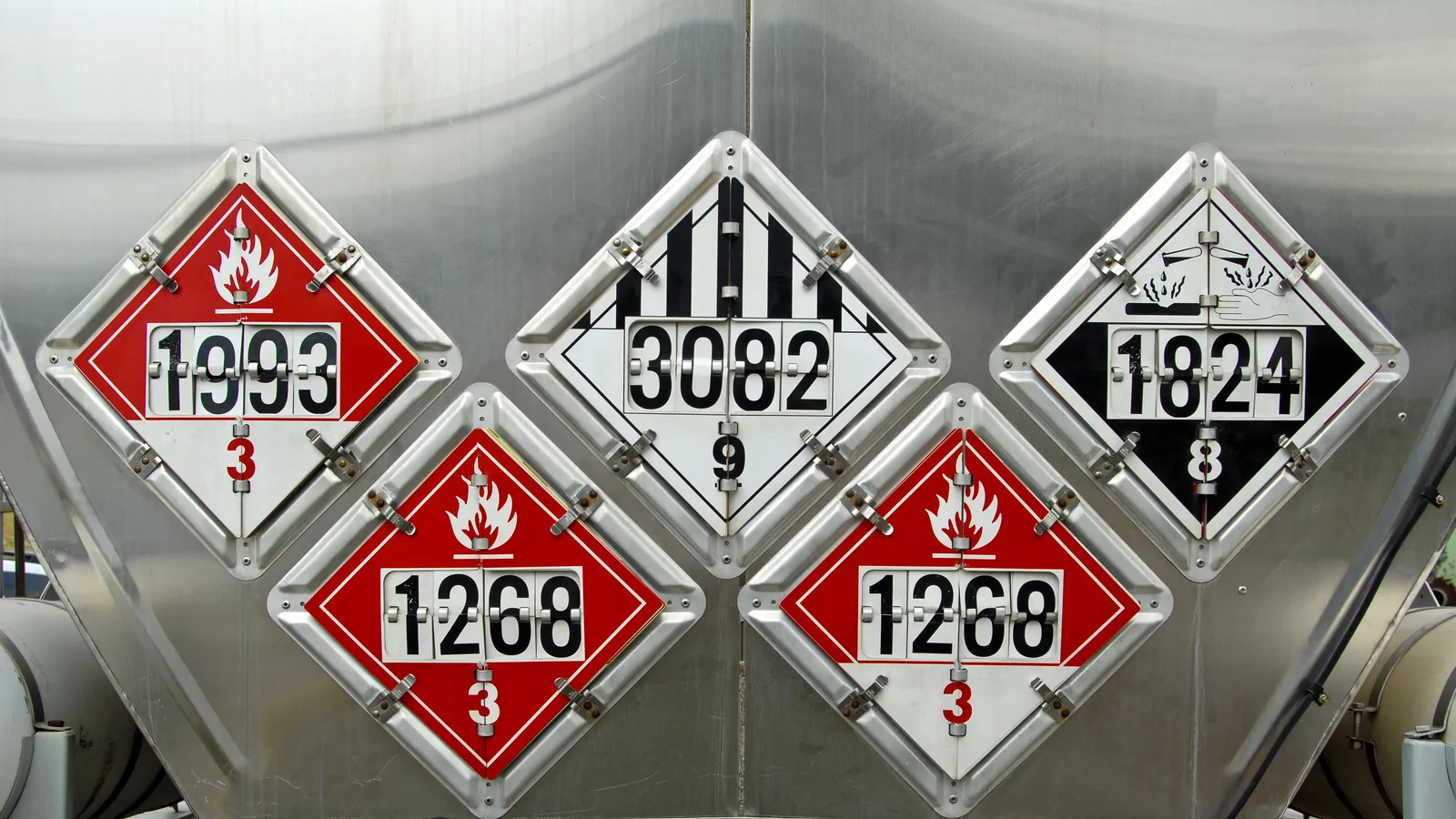
Solvents used in coating formulations, xylene, toluene, MEK, acetone, and mineral spirits, are Class 3 flammable liquids. Packing groups vary (PG II or PG III) based on flash point. Most require placarding at any quantity.
Isocyanates, the reactive component in polyurethane coatings, are Class 6.1 toxic materials. Toluene diisocyanate (TDI) and methylene diphenyl diisocyanate (MDI) are both regulated. MDI-based systems are less volatile and easier to handle than TDI systems, but both require toxic placards and driver certification.
Epoxy resins are often Class 9 miscellaneous hazardous materials or non-regulated, depending on formulation. Liquid epoxy resins with viscosity below certain thresholds may be classified as marine pollutants. Solid epoxy resins are typically non-hazardous.
Corrosive pigments and additives, certain zinc compounds, phosphoric acid-based treatments, and amine hardeners, may be Class 8 corrosives. These require corrosive placards and compatible packaging.
Packaging and transport requirements
Bulk liquid coating chemicals ship in MC 306 atmospheric tankers (for non-corrosive, non-toxic materials), MC 307 low-pressure chemical tankers (for most coating chemicals), or MC 312 corrosion-resistant tankers (for corrosive materials like certain hardeners and additives).
Tank material compatibility is critical. Stainless steel tanks are standard for most coating raw materials. Aluminum tanks are sometimes used for solvents but are incompatible with alkaline materials. Mild steel tanks with coatings or linings may be acceptable for some products but require verification against the chemical's SDS.
Smaller quantities ship in drums, totes, or returnable containers. UN-rated packaging is required for hazardous materials. Drum labels must include proper shipping name, UN number, hazard class, and packing group.
Equipment and handling requirements
Tanker specifications
Coating chemical tankers typically feature stainless steel construction, heating coils or hot water jackets for temperature-sensitive materials, bottom discharge with dry-break couplings, vapor recovery systems for VOC-emitting solvents, and clean-out ports for inspection and washing.
Tank heating is often required for epoxy resins, which can crystallize or become too viscous to pump at low temperatures. Typical heating set points range from 100°F to 140°F. Overheating can degrade certain products, so temperature control and monitoring are essential.
Tank cleaning and contamination control
Coating formulations are intolerant of contamination. A tanker that carried crude oil, even after washing, will contaminate coating raw materials. Cross-contamination between incompatible coating chemicals, like epoxy resin and hardener, can cause premature reaction and product loss.
Dedicated fleets are ideal but expensive. Most coating chemical shipments use tankers from wash-approved commodity groups, typically high-grade chemical tankers that carry only compatible specialty chemicals. Tank wash verification, including visual inspection and sometimes lab testing, is required before loading.
Three-compartment tankers allow multiple products to ship on the same truck, but only when the products are compatible. Epoxy resin and hardener should never share a truck unless isolated in separate sealed compartments with no shared vapor space.
Loading and unloading procedures
Bottom loading and unloading through closed systems minimizes vapor emissions and contamination risk. Vapor recovery systems are required in many jurisdictions for VOC-emitting solvents.
Grounding and bonding are mandatory during transfer of flammable liquids to prevent static discharge. Transfer rates must be controlled, high flow rates can generate static or create turbulence that entrains air and causes foaming in certain products.
Product sampling at loading and unloading verifies identity, quality, and absence of contamination. Samples are retained for traceability. If a coating performance issue arises weeks or months later, those samples can be tested to determine if the raw material met specification.
Storage and handling considerations
Temperature management extends beyond transport. Many coating raw materials require climate-controlled storage at the destination. Epoxy resins stored below 60°F can crystallize and require reheating before use. Isocyanates are moisture-sensitive and must be stored in sealed containers with desiccant protection or nitrogen blanketing.
Shelf life is critical for reactive coating components. Epoxy hardeners and isocyanates have finite shelf lives, typically 6 to 12 months from manufacture. Proper inventory rotation (first in, first out) prevents expired material from reaching the production line. Date codes and lot tracking are mandatory for quality control and traceability.
Segregation requirements prevent incompatible materials from proximity. Flammable solvents must be stored separately from oxidizers. Acids and bases require separation. Epoxy resins and hardeners are stored in different areas to prevent accidental mixing in case of container failure.
Ventilation is required for solvent storage areas due to VOC emissions. Fire suppression systems must match the stored hazards (water-based systems for most areas, foam or CO2 for flammable liquid storage). Spill containment, secondary containment with capacity for 110% of the largest container, is required for liquid chemical storage under EPA and OSHA regulations.
How Total Connection ships protective coating chemicals
We ship coating raw materials, resins, hardeners, solvents, pigment dispersions, and specialty additives, to coating manufacturers across North America. Our carrier network includes operators with the right tanker equipment, hazmat certifications, and cleanliness standards for specialty chemical freight. For related coating chemical logistics, see our guides on paint additives and hazmat trucking regulations. For broader liquid bulk context, see our complete guide to liquid bulk freight.
Call 732-817-0401 or request a quote for your coating chemical logistics.
Frequently Asked Questions
What are the main types of protective coatings?
Epoxy coatings (chemical and corrosion resistance), polyurethane coatings (UV resistance and weathering), zinc-rich primers (cathodic protection for steel), intumescent coatings (fire protection), and specialty coatings (fluoropolymer, silicone, ceramic) for extreme environments.
Are protective coating chemicals hazardous materials?
Many are. Solvents are typically DOT Class 3 (flammable). Isocyanates for polyurethane coatings are Class 6.1 (toxic). Epoxy resins may be Class 9 or non-hazardous. Each component requires verification against its SDS for proper shipping classification.
Why is tank cleanliness important for coating chemicals?
Coating formulations are precise. Even trace contamination from prior cargo can affect adhesion, cure rate, color, gloss, and chemical resistance of the finished coating. This makes tank wash verification essential on every load of coating raw materials.
What industries use protective coatings most?
Oil and gas (pipelines, tanks, offshore platforms), marine (ships, ports, offshore wind), infrastructure (bridges, water treatment), manufacturing (chemical processing, power generation), and transportation (railcars, tunnels, mass transit).
Does Total Connection ship all types of coating raw materials?
Yes, epoxy resins, polyurethane components (polyols and isocyanates), solvents, pigment dispersions, and specialty additives. We handle hazmat compliance, temperature management, and tank cleanliness as standard on every coating chemical shipment.