
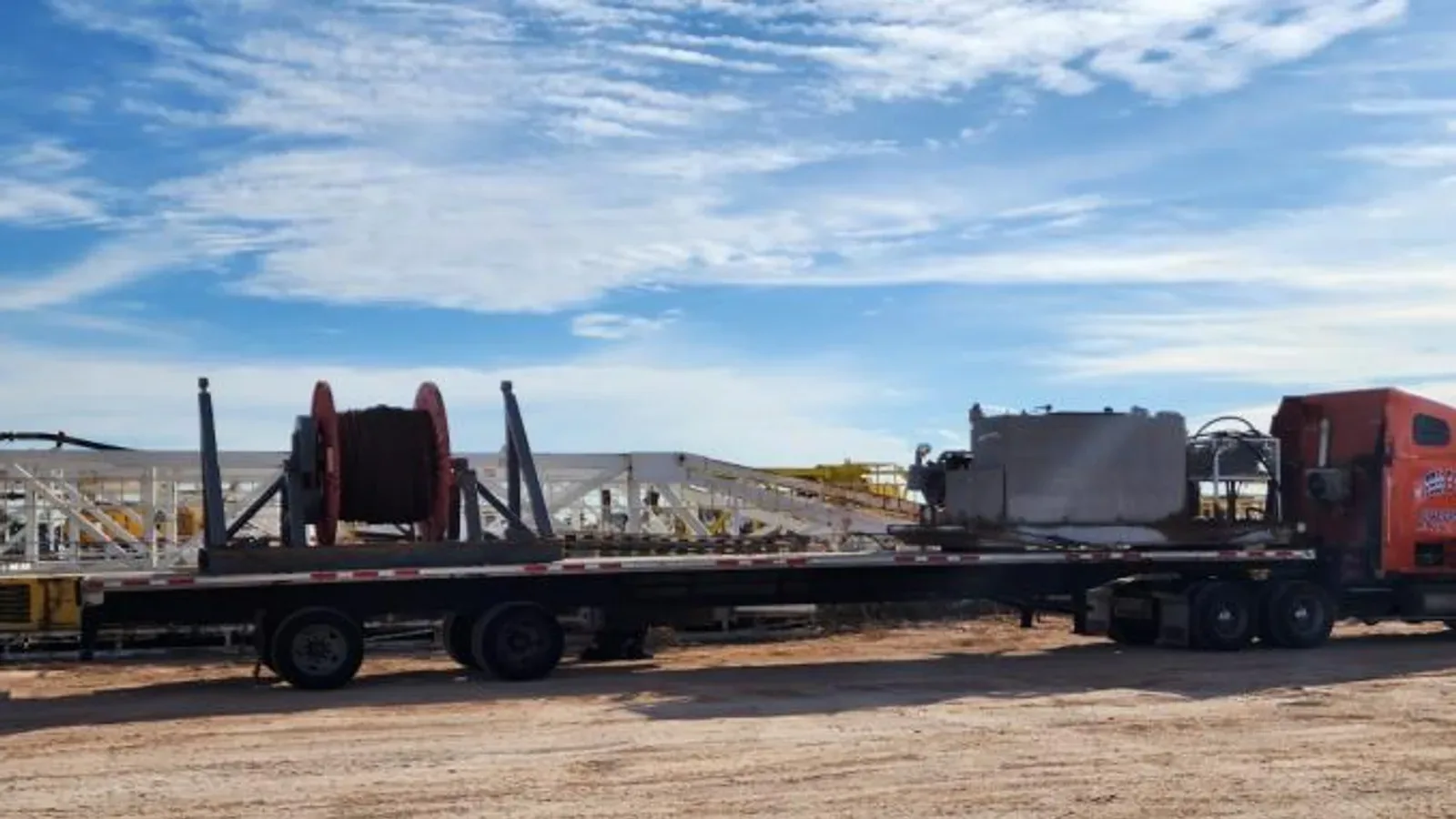
A flat rack trailer is an open-deck trailer with fixed or collapsible end walls and no sides, built to carry oversize or irregularly shaped cargo that a standard 48 or 53 foot flatbed cannot handle. The open sides let a crane set a load from either direction, and the collapsed ends create a flush deck for pieces that run long. Once the cargo passes the federal legal width limit of 8 feet 6 inches under 23 CFR 658, the move also needs a state oversize permit, so the trailer choice and the permit plan get settled in the same conversation. For oilfield shippers moving wellheads, skids and pipe racks, the flat rack is often the difference between a load that books in a day and one that sits waiting for the right deck.
A standard flatbed has a flat deck and no end structure at all. A flat rack has walls at the front and rear that fold down when the cargo needs the full length of the deck or has to be loaded from the end, and fold back up when the load needs a stop point, such as stacked pipe or palletized equipment. That is why flat racks turn up so often on oilfield work: the cargo on a single lease road job can be a compressor skid one week and a stack of casing the next, and the same deck handles both.
What Is a Flat Rack Trailer
A flat rack is an open-deck platform trailer with no sides and with end walls that are either removable or hinge flat against the deck. The deck is typically steel or aluminum and is built to take concentrated point loads, which matters when the cargo is one heavy skid sitting on four feet rather than palletized freight spread evenly across the length.
The design feature that decides the booking is access. With no sides, a crane or forklift can approach the load from either flank, not only from above or the rear. That matters for wellheads, valve trees and other components that are awkward to lift straight up and need a side approach instead. The collapsible end walls fold flat to create a continuous loading surface, which is what lets a long piece sit past the point where a fixed bulkhead would stop it.
Flat racks run in both over-the-road trucking and ocean container service, where a flat rack container fills the same role for break-bulk cargo moving by vessel. A compressor skid leaving a fabrication yard for an export sailing may ride a flat rack trailer on the inland leg and a flat rack container on the water, with the same securement thinking applied at both stages and the same dimensional questions asked twice before either booking is confirmed.
Flat Rack vs Conestoga vs Curtain Side
When each trailer type fits
Shippers moving oilfield and project cargo often take whatever deck is available rather than the one that matches the load. The three deck trailers most often confused are the flat rack, the conestoga and the curtain side, and each is built for a different combination of access and weather exposure.
A conestoga uses a retractable tarp system over a flatbed frame, which combines flatbed-style loading from the top or rear with weather protection the flat rack does not offer. A curtain side has fixed structure with a sliding curtain, which protects the cargo on the sides but limits crane access compared with a flat rack's open profile. The table below lines up the three for a dispatcher deciding which deck to call for.
| Trailer Type | Sides / Walls | Loading Method | Weather Protection | Best Use Case |
|---|---|---|---|---|
| Flat Rack | No sides, collapsible end walls | Crane or forklift from either side or the end | None, cargo is exposed | Wellheads, skids and overwidth equipment needing side access |
| Conestoga | Open sides with retractable tarp roof | Top or rear loading, forklift accessible | Full cover when the tarp is closed | Moisture-sensitive equipment that does not need crane side access |
| Curtain Side | Fixed structure with sliding curtain | Side loading through the curtain opening | Good, the curtain closes over the load | Palletized or boxed freight loaded from the side by forklift |
On most oilfield heavy haul the flat rack wins on access even though it offers no cover, because the cargo is steel and the crane needs room to work from any angle.
Oversize Oilfield Cargo That Needs a Flat Rack
Oilfield equipment rarely arrives in neat, palletized dimensions, which is why flat racks show up on rig moves and plant turnarounds far more than on general freight lanes. The cargo is heavy, irregular in shape and often wider or taller than a standard trailer deck, the same profile of freight handled by project cargo companies across heavy industry.
- Wellheads and Christmas trees, which are compact but extremely heavy and need crane access from the side rather than lift points on top.
- Pump jacks and compressor skids, which are long, low and frequently pass the 8.5 foot legal width once mounted on their shipping frame.
- Pipe racks and casing strings, which run long and use a flat rack's collapsible end walls to take the full deck length.
- Separator vessels and tank sections, which are tall and cylindrical and have to be cradled, chocked and chained rather than stacked.
- Rig mast sections and substructure components, which are irregular enough that a standard flatbed's fixed geometry does not fit the piece.
In each case the decision is not only whether the cargo fits on a deck. It is whether the crane or forklift on the receiving end can reach the load once it arrives, which is where the flat rack's open sides pay off against a conestoga or a curtain side.
Dimensions, Weight Limits and Permitting
The federal legal trailer width limit is 8 feet 6 inches, or 102 inches, before a load requires an oversize permit in most states, under the federal size regulations at 23 CFR 658. Loads over 8.5 feet wide or 13.5 feet tall typically require state oversize permits and may require pilot car escorts, though the exact thresholds, travel windows and escort rules vary state by state.
Weight capacity on a flat rack depends on axle configuration and state axle-weight limits rather than one fixed number. A tandem-axle flat rack carries a payload in the same range as a conventional flatbed, while spreading the load across additional axles or moving to a specialized trailer raises the allowable gross weight within those limits. Dimension and weight are permitted separately, so a load that is legal width but overweight still needs a permit, and a legal-weight overwidth load needs one as well.
Before booking flat rack capacity on an oversize oilfield load, confirm:
- The exact width, height, length and weight of the cargo once it is mounted on its shipping frame or skid, not the bare equipment dimensions off the drawing.
- Which states the route crosses, since permit thresholds, curfews and escort requirements differ at every state line.
- Whether the load needs one pilot car, two, or a police escort, which depends on width, height and that state's rules.
- How much lead time the permitting takes, since some states turn permits the same day and others run several business days.
Loading, Securement and Crane Access
The open-side design that makes a flat rack useful for crane loading also leaves the cargo exposed to wind, rain and road debris for the whole haul. Oilfield shippers accept that tradeoff because a covered trailer with limited side access slows loading and unloading at both ends of the move.
Securement follows the same federal standard as any flatbed-type trailer. The FMCSA cargo securement rules at 49 CFR 393.106 require securement devices capable of withstanding 0.8g deceleration forward and 0.5g lateral or rearward. In practice that means chains and binders with a working load limit matched to the piece, enough securement points that one failed chain does not let the load travel, and edge protection anywhere a chain crosses a machined surface or a painted skid frame.
Crane loading from the side takes coordination most tenders leave out until the truck is already at the yard. The driver needs to know before arrival whether the load comes from the left, the right or the rear, whether the end walls go down before the crane picks, and where the rigging points are on the piece. Getting that wrong leaves a truck idle while the crew repositions, and on a rig move with a fixed window that is time nobody gets back.
Common Mistakes When Booking Flat Rack Capacity
Flat rack moves go wrong less often because of the equipment and more often because of how the load was booked. These are the mistakes that repeat on oilfield and project cargo tenders.
- Booking a standard flatbed for a load that needs end-wall access, which forces an equipment swap once the crane crew sees the cargo.
- Starting the oversize permit process after the truck is dispatched, which can hold a move for days depending on the states involved.
- Quoting the cargo's bare dimensions instead of its mounted dimensions on the skid, which changes the permit and escort requirements entirely.
- Failing to confirm crane or forklift access at the destination, which leaves an oversize piece on a deck with nowhere to be set down.
- Reusing generic securement without recalculating working load limits for the specific piece, which does not meet the 0.8g forward and 0.5g lateral standard.
Most of these trace back to treating the equipment decision as an afterthought rather than the first question on the tender. The deck type, the permit timeline and the receiving crane all get settled before the load leaves the yard, not after.
How Total Connection Sources Flat Rack and Oversize Equipment
Total Connection matches the deck to the load instead of defaulting to the truck sitting closest to the shipper. On oversize oilfield freight that means confirming mounted dimensions, crane access at both ends and permit lead time before capacity is tendered. With 30+ years in the business and 100,000+ vetted carriers, finding a flat rack is rarely the hard part. Lining up the permits, the escorts and the receiving crane on the same day is where the work actually sits.
Flat rack and oversize cargo is one piece of a larger oilfield program. The same team that books a flat rack for a wellhead also handles the drayage on the container legs, the ocean and air moves, the warehousing between project phases, the hazmat trucking compliance on chemical components traveling alongside the equipment, and the truckload and LTL capacity for everything that is not oversize. Liquid bulk chemical work remains the home turf, and oilfield project cargo runs on the same operating discipline.
For more on how oversize permitting and rig logistics fit together, read our guides on working with a heavy haul broker and rig move trucking companies. Our project cargo and oilfield services page covers the full scope, and to book flat rack capacity on a specific load, request a project cargo quote.
What is the difference between a flat rack and a flatbed trailer?
A flat rack has collapsible or removable end walls and no sides, while a standard flatbed is a flat open deck with no walls at all. The flat rack's end structure gives it more flexibility for loads that need either a flush deck or a stop point at either end, which is why it shows up more often on oversize oilfield cargo.
Can a flat rack trailer carry overwidth cargo?
The open sides on a flat rack let a crane set cargo that overhangs the deck width, which is useful for wellheads, skids and equipment wider than 8.5 feet. That access is the main reason oilfield shippers pick a flat rack over a covered trailer for irregularly shaped pieces.
Do flat rack loads always need an oversize permit?
A permit is required only when the cargo exceeds federal and state legal limits, generally 8.5 feet wide or 13.5 feet tall. Loads inside those limits move on a flat rack without a permit, while anything beyond them needs a state oversize permit and, in many cases, pilot car escorts.
What is the weight capacity of a flat rack trailer?
Weight capacity depends on axle configuration and state axle-weight limits rather than one fixed figure, with a tandem-axle flat rack in the same range as a conventional flatbed. Adding axles or moving to a specialized trailer raises the allowable gross weight, and a load near the limit still needs a weight permit on top of any dimensional permit.
When should a shipper choose a conestoga instead of a flat rack?
A conestoga fits when the cargo needs weather protection and does not require crane access from the side or deck overhang. Its retractable tarp covers the load like a dry van while keeping flatbed-style loading from the top or rear, which suits moisture-sensitive equipment that is not oversize.