

Caproic acid (hexanoic acid) and caprylic acid (octanoic acid) ship under UN2829, Class 8, Packing Group III, and require stainless steel or lined tank equipment rated for corrosive, strong-odor organic acids. The Hazardous Materials Table at 49 CFR 172.101 lists both under the same entry, Corrosive Liquid, N.O.S., which is where most of the confusion on these two products starts. The hazard class is the easy part. The equipment, the residual odor and the carrier's willingness to put that trailer back into general service afterward are what decide whether the load moves this week or sits at the plant.
What Caproic and Caprylic Acid Are and Why They Ship Together
Caproic acid is the six-carbon saturated fatty acid sold commercially as hexanoic acid. Caprylic acid is the eight-carbon version, sold as octanoic acid. Both are fractionated from coconut and palm kernel oil, and both feed the same downstream buyers: flavor and fragrance ester producers, lubricant and plasticizer intermediates, animal feed and nutrition additives, personal care formulators and pharmaceutical intermediate plants.
They ship together on the paperwork because they share a hazardous materials entry. Under 49 CFR 172.101, both are described as UN2829, Corrosive Liquid, N.O.S., Class 8, Packing Group III. They also ship together physically. A plant running a fatty acid fractionation train often tenders caproic one week and caprylic the next out of the same loading rack, to the same customer base, sometimes under the same dedicated trailer program.
The practical consequence for a shipper is that the two products look identical to a dispatcher reading a load tender and very different to a carrier's safety department. Caprylic acid is a solid at cold ambient temperatures and a liquid when warm. Caproic acid stays liquid across a wider range but carries the sharper odor of the two. Treating them as one commodity on the transportation side is how shippers end up with the wrong trailer on the rack and a loader standing there with a hose he cannot connect.
Classification and Regulatory Basics: UN2829, Class 8, PG III
Both acids move as fully regulated hazardous materials in the United States. The shipment is a Class 8 corrosive, the UN identification number is 2829, and the packing group is III, the lowest of the three corrosive severity tiers. That classification drives the packaging authorization, the shipping paper, the placard and the driver's endorsement requirements. The same Class 8 framework governs far more aggressive chemistry, and the contrast is instructive if you also move sulfuric acid in bulk.
Packing Group III Implications
Packing Group III is the least aggressive assignment inside Class 8, and it widens the authorized packagings available under 49 CFR 173.203 for corrosive liquids. It does not make the material non-regulated. A PG III corrosive still requires a hazmat shipping paper, still requires an emergency response telephone number, and still requires a driver with a hazmat endorsement on bulk quantities. The packing group also sets the performance level of the drum or IBC used for non-bulk shipments, which matters when a buyer asks for totes instead of a tanker.
Placarding and Documentation
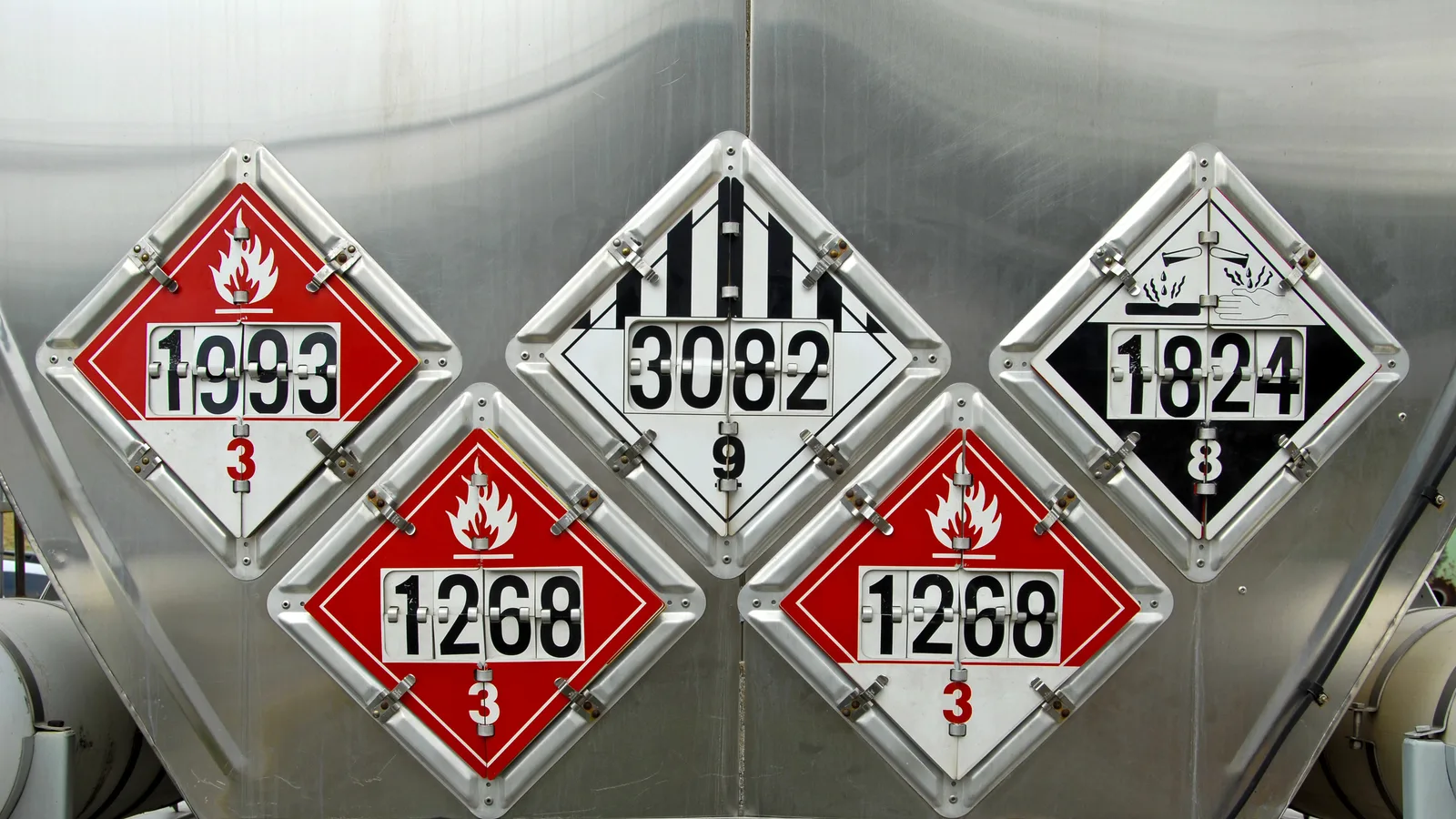
Bulk shipments of UN2829 carry CORROSIVE placards on all four sides, with the identification number displayed as required for bulk packagings. The shipping paper description must list the proper shipping name, hazard class, UN number and packing group in the sequence set by 49 CFR 172.202. The safety data sheet should match the bill of lading description. An SDS that reads "hexanoic acid" while the BOL reads "Corrosive Liquid, N.O.S." without the technical name in parentheses is the kind of discrepancy that turns a roadside inspection into an out-of-service order.
Equipment Requirements for Tanker and ISO Tank Shipment
Short-chain fatty acids attack ordinary carbon steel. For bulk truck movement, the working equipment is a DOT specification cargo tank built for corrosive service under 49 CFR 178.345, commonly a DOT 407 or older MC 307 trailer in stainless steel or with a compatible lining. Valve seats, gaskets, hoses and pump seals have to match organic acid service, not just the trailer shell.
Stainless Steel vs Lined Trailers
Stainless is the default because it tolerates the acid, survives a hot caustic tank wash and does not shed material into product headed for food, feed or pharmaceutical use. Lined trailers work where the lining is specified by its manufacturer for fatty acid service, but a lining is a maintenance item and a blistered liner contaminates the load. Aluminum is not the right call here.
Bottom-Load vs Top-Load Considerations
Bottom loading through a dedicated connection keeps vapor contained and reduces splash, which matters more here than with most Class 8 freight because of the odor. Top loading through the manway is common at smaller racks and demands a drop tube, bonding and a loader who stays at the hatch for the entire fill.
| Packaging | Typical use | Material and fit | Watch for |
|---|---|---|---|
| DOT 407 / MC 307 cargo tank | Domestic bulk truckload | Stainless shell, acid-rated gaskets and hose | Wash history and residual odor from the prior load |
| Lined cargo tank | Domestic bulk where stainless is tight | Lining specified for fatty acid service | Liner condition, blistering, repair records |
| ISO tank | Export and import ocean moves | Stainless portable tank with compatible fittings | Heat capability, depot wash, booking lead time |
| IBC or drum | Smaller or multi-grade orders | UN-marked packaging authorized for PG III | Venting, closure torque, odor transfer in the warehouse |
Odor Control, Temperature and Loading Precautions
Caproic acid carries the pronounced odor typical of short-chain fatty acids, and caprylic acid is not far behind. Odor is not a safety hazard the way the corrosivity is, but it is the single most common reason a carrier declines a reload or charges for an extra wash. A trailer that hauled caproic acid and went straight to a fragrance-sensitive product will generate a claim. Plan the wash and the next load at the same time you plan the pickup.
Temperature is the other variable. Caprylic acid solidifies at cool ambient temperatures, so winter movements out of northern plants need insulated or heat-capable equipment and a heating plan at the receiver. Caproic acid is more forgiving but still benefits from protection against prolonged cold in transit.
- Confirm the tank wash certificate before the trailer spots, and specify the wash code the receiver will accept rather than leaving it to the wash rack.
- Match gaskets, hoses and pump seals to organic acid service, since a compatible trailer with the wrong gasket still fails at the connection.
- Decide on heat before dispatch for caprylic acid in cold weather, including whether the consignee has steam or electric capability on site.
- Keep the loader at the rack for the full fill on top-load operations, with the drop tube in place and bonding connected.
- Brief the driver on the odor so the first comment at the receiving gate does not turn into a refused delivery.
Loading and unloading is where liquid bulk shipments go wrong most often, and these two products add an odor dimension that standard Class 8 procedures do not cover.
Common Shipping Mistakes and Compliance Pitfalls
Most problems with caproic and caprylic acid freight are documentation and equipment problems, not chemistry problems. The same mistakes repeat across shippers who are new to moving these products in bulk.
- Describing the material as a non-regulated fatty acid on the bill of lading because Packing Group III sounds minor. The shipment is still a Class 8 corrosive and still needs the full UN2829 description under 49 CFR 172.202.
- Tendering to a carrier whose stainless trailers are already committed elsewhere, then waiting days for equipment that was never really available for the pickup date.
- Ignoring the wash cycle in the transit plan, which shows up later as detention, a rejected trailer or an odor claim from the next shipper in the rotation.
- Sending an SDS whose product name does not tie to the proper shipping name, leaving an inspector to reconcile two different descriptions at the roadside.
- Booking caprylic acid for a January move in a non-heated trailer and discovering the product has set up when the hose goes on at the consignee.
- Treating an ISO tank export like a domestic truckload, without allowing for depot wash availability, IMDG documentation and vessel booking lead time.
None of these need specialist chemistry to avoid. They need someone who asks about the wash, the heat and the next load before the trailer is ordered.
Typical Lanes, Modes and Packaging Options
Caproic and caprylic acid move domestically as bulk truckload in tank trailers between oleochemical producers, blenders and formulators across the United States, Canada and Mexico. Export volume moves in stainless ISO tanks, with the inland leg, the drayage and the ocean booking handled as one file. Smaller grades and pilot quantities move as drums and IBCs, often alongside other chemistries on the same order.
Choosing the mode is mostly a question of volume, destination and tank availability. Bulk volumes going to a plant with a receiving tank favor a cargo tank. Export orders that must land in one compartment favor an ISO tank. Multi-grade orders and customers without bulk receiving favor packaged freight.
Drum and IBC Alternatives
Packaged shipments pull the move out of tanker scheduling and into standard truckload or LTL handling, which shortens lead time when a tank is not available. The packaging still has to be authorized for a Class 8 PG III liquid, UN-marked and closed to the manufacturer's instructions, and the hazmat IBC specification rules govern what you can legally fill. Venting and closure torque matter, and warehouses that store these products learn quickly to segregate them from odor-sensitive freight. The trade-off is cost per pound and the labor to decant at the far end, which is why most steady-state programs move back to bulk. Our team runs the packaged version and the bulk version of the same program, including the warehousing, the export documentation and the return of empty equipment.
Working With a Forwarder for Short-Chain Fatty Acid Freight
Caproic and caprylic acid are not difficult freight for anyone who works in chemicals every day. They are difficult freight for a carrier that mostly hauls dry van and wants to know why the trailer smells. The value of a specialist is in the pre-dispatch work: confirming the stainless or lined tank, confirming the wash code, confirming heat capability for winter caprylic moves, and confirming the shipping paper matches the SDS before the driver leaves the yard.
Total Connection has been moving liquid bulk chemicals since 1995, works with more than 100,000 vetted carriers, operates under FMC OTI/NVOCC license 026203NF and FMCSA MC 280101 across the United States, Canada and Mexico, and carries $5M in general liability coverage against an industry standard of $1M. The same team handles the tanker, the ISO tank export, the drayage, the warehousing, the customs entry and the packaged LTL when a customer orders two totes instead of a tank.
For equipment selection and loading practice, read our complete guide to liquid bulk freight and our breakdown of shipping fats and tallow in liquid bulk. See what we do in liquid bulk and chemical logistics, then send the product, volume, lane and required wash on our liquid bulk quote form and we will come back with equipment and timing.
What UN number applies to caproic and caprylic acid?
Both caproic acid (hexanoic acid) and caprylic acid (octanoic acid) ship under UN2829, Corrosive Liquid, N.O.S., Class 8, Packing Group III, as listed in the Hazardous Materials Table at 49 CFR 172.101. The same entry covers both products, so the shipping paper description is identical even though the handling is not. The technical name of the specific acid should appear in parentheses with the N.O.S. description.
Can caproic acid be shipped in an IBC instead of a bulk tanker?
Smaller volumes move in IBCs and drums regularly, provided the packaging is UN-marked and authorized for a Class 8 Packing Group III liquid under 49 CFR 173.203. Material compatibility, venting and closure torque all need to be checked against the supplier's recommendation. Packaged freight shortens lead time when a stainless tank trailer is not available, at a higher cost per pound.
What equipment is required to haul caprylic acid by truck?
Bulk caprylic acid moves in a DOT specification cargo tank built for corrosive service, commonly a DOT 407 or older MC 307 trailer in stainless steel or with a compatible lining. Valves, gaskets, hoses and pump seals must be rated for organic acids, not just the tank shell. In cold weather the equipment often needs insulation or heat capability because caprylic acid solidifies at low ambient temperatures.
Why does caproic acid have a strong odor and does that affect shipping?
Caproic acid is a short-chain fatty acid, and that family of compounds carries a pronounced, persistent odor. It affects shipping because residual odor in a trailer can taint the next load and lead to a rejected reload or a claim. Dedicated equipment or a confirmed tank wash with an agreed wash code between loads is the standard way to manage it.
Is caproic acid corrosive to standard carbon steel trailers?
Caproic acid is classified as a Class 8 corrosive under UN2829 and is not suited to ordinary carbon steel equipment for repeated service. Stainless steel is the normal choice, with lined tanks used where the lining is specified by its manufacturer for fatty acid service. Packing Group III is the least severe corrosive tier, but it does not make carbon steel an acceptable substitute.