
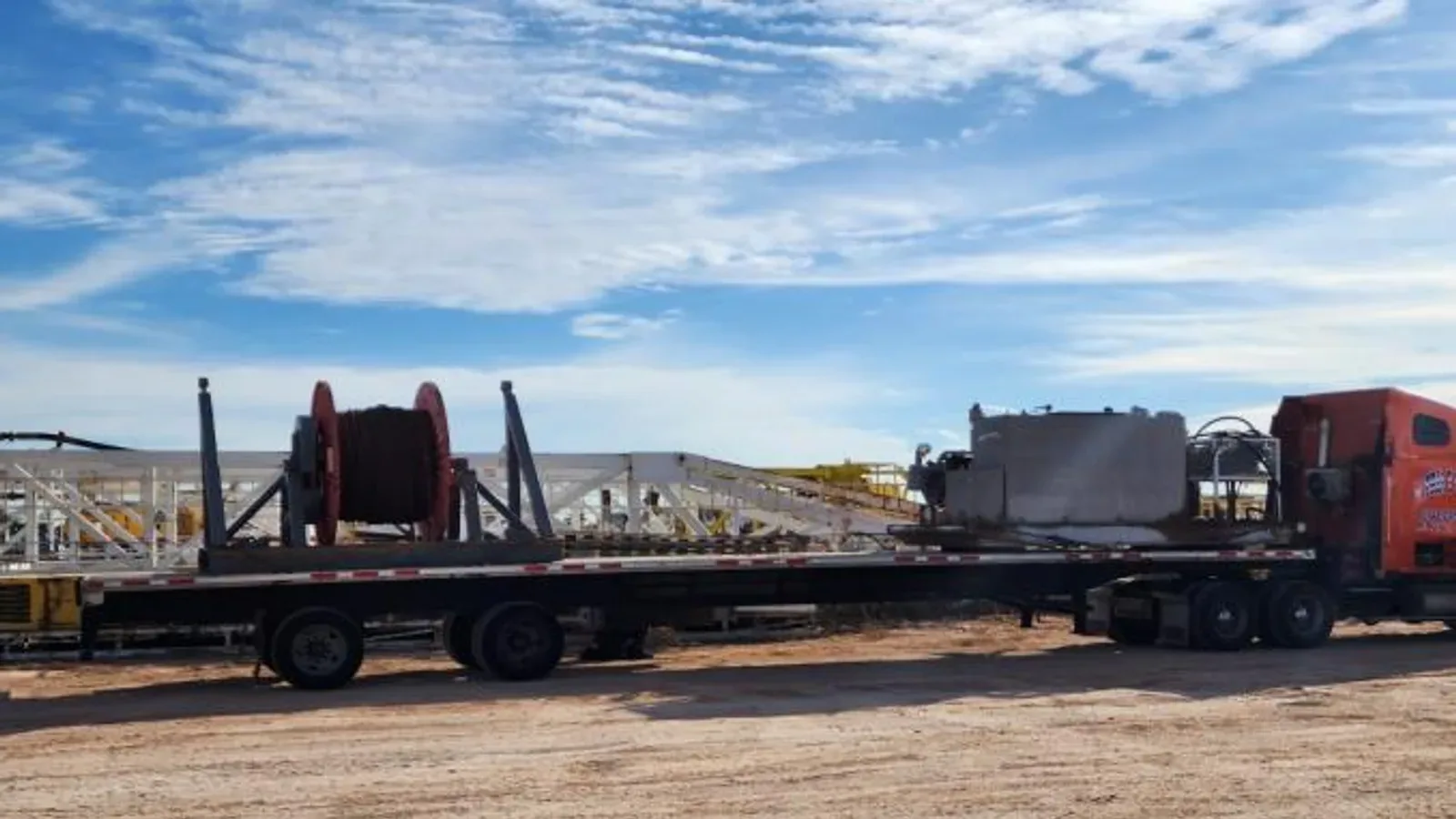
A heavy haul broker arranges oversize and overweight trucking for loads exceeding standard legal limits, typically over 8.5 feet wide, 13.5 feet tall, or 80,000 pounds gross vehicle weight. For oilfield shippers moving rig components, drilling equipment, and plant machinery, the broker's job is to match the load to a carrier with the right trailer, pull the permits, and plan the route before the truck ever leaves the yard.
What a Heavy Haul Broker Actually Does
A heavy haul broker sources the carrier and the trailer for a specific load, then handles the paperwork that keeps the move legal across every state line it crosses. That work includes pulling oversize and overweight permits, coordinating escort vehicles when the dimensions call for them, and building a route plan that accounts for bridge weight limits, overhead clearances, and local curfews on oversize movement. On a rig move, the broker is also sequencing pieces so the yard is not holding a crane while the next trailer is still two states away.
Tendering to a single carrier works differently. A carrier runs a defined fleet out of a defined yard, so the load has to fit the equipment on hand that week. A broker works from the load inward, picking the trailer type that suits the weight distribution and dimensions and pulling it from a vetted carrier network. On a multi-piece move where one component needs a lowboy, another fits a step deck, and a third has to be driven on, that flexibility is the difference between a job that stages cleanly and one that sits waiting on equipment.
Oilfield shippers should also separate a heavy haul broker from a project cargo forwarder. A broker working only the oversize trucking leg may not touch the chemicals, fluids, or consumables that travel with the machinery on the same job. That gap shows up fast when a rig move involves flatbed freight and tanker or ISO tank shipments on the same schedule.
Licensing and Insurance to Verify Before Tendering
FMCSA MC Authority
Any broker arranging interstate truck freight needs active FMCSA motor carrier authority. Ask for the MC number directly and check it against FMCSA's public records before the first tender, not after a claim. Total Connection holds FMCSA MC 280101 along with FMC OTI/NVOCC license 026203NF, which covers the domestic trucking side of a rig move and the ocean leg when equipment is imported.
General Liability Limits
The common industry standard for a logistics provider's general liability coverage is $1 million. For a wellhead assembly or a piece of plant machinery with a long replacement lead time, that limit is thin. Total Connection carries $5 million in general liability, five times the common industry standard, which is the coverage a procurement director should be comparing when two brokers quote the same lane within a few hundred dollars of each other.
Get the certificate of insurance in writing before signing, and confirm the limits apply to the specific mode and cargo type being moved rather than a blanket policy that carves out heavy or specialized freight. A broker that stalls on producing that certificate is not one to hand a high-value oilfield load to.
Permitting and Routing Capability
State Oversize and Overweight Permits
Standard legal truck dimensions are 8.5 feet wide, 13.5 feet tall, and 80,000 pounds gross vehicle weight. Anything past those thresholds needs a permit, and an interstate rig move often means pulling a separate permit in every state on the route. The rules are not uniform: axle weight limits, width allowances, and night travel restrictions vary by state, and a broker without permitting experience will hold a load in the yard waiting on paperwork that should have been filed before the tender went out.
Escort Vehicle Coordination
Depending on width, height, and length, states commonly require front and rear escort vehicles, and some jurisdictions require a police escort for the widest or heaviest movements. A broker handling this properly knows which state thresholds trigger which escort requirement and has those vehicles committed before dispatch rather than chased down the morning of pickup.
Route surveys carry as much weight as the permit. A route that reads fine on a map can hold a low railroad overpass, a weight-restricted bridge, or a construction zone that was not there last quarter. Ask whether the broker runs a route survey before committing to a pickup date, and what the plan is if the survey turns up a restriction after the permit is already filed.
Equipment Access: Lowboys, RGNs and Specialized Trailers
Lowboy and RGN (removable gooseneck) trailers are standard equipment for hauling oilfield machinery such as rig components and drilling equipment, and they are not interchangeable. The right deck depends on the load's height, how its weight sits across the axles, and whether it has to be driven on or lifted into place.
- Lowboy trailers sit low to the ground and suit tall equipment that needs vertical clearance, such as tanks, compressors, and stacked components.
- RGN trailers detach at the gooseneck so equipment can be driven straight onto the deck, which matters for tracked or wheeled machinery that cannot be picked by crane.
- Step deck trailers handle moderate oversize loads that do not need lowboy ground clearance, and they are easier to source on short notice.
- Multi-axle and beam trailers come in for the heaviest single-piece loads, where weight has to be spread across more axles to stay inside state bridge formulas.
The broker's value is in matching the trailer to the load instead of defaulting to the nearest available deck. Ask how deep the carrier network runs for each trailer type and whether equipment is sourced per load. Total Connection works from a vetted network of more than 100,000 carriers, which is what makes per-load equipment selection realistic on short notice.
Broker vs Full-Service Project Cargo Forwarder
Not every heavy haul broker covers the full scope of an oilfield move. Some run the oversize trucking leg only and leave the shipper to find separate coverage for chemicals, fluids, warehousing, or the inbound ocean leg when equipment is imported. A full-service project cargo forwarder runs all of it on one account.
| Capability | Narrow Heavy Haul Broker | Full-Service Project Cargo Forwarder |
|---|---|---|
| Oversize and overweight trucking with permits | Yes | Yes |
| Chemicals and fluids on tankers or ISO tanks for the same job | Rarely | Yes |
| Vessel load-out and ocean coordination for imported equipment | No | Yes, under FMC OTI/NVOCC authority |
| One point of contact across the whole rig move | No, multiple vendors | Yes |
For a one-off flatbed move, a narrow broker may be everything the job needs. For a rig move or plant relocation with machinery, fluids, permits, and a hard start date, consolidating under one forwarder cuts the vendor count a logistics manager has to hold together on the same timeline.
Total Connection runs the full forwarder behind the heavy haul leg: drayage, truckload and LTL, ocean and air, warehousing and distribution, and the customs entry when equipment comes in from overseas. The chemical side runs on the same account, which is the subject of our guide to working with a liquid bulk freight broker.
Questions to Ask Before You Sign a Heavy Haul Broker
Before tendering, get direct answers to a short list of operational questions. These are not formalities. A weak answer to any one of them points to a broker that will struggle mid-move.
- What is your active MC number, and can I verify it against FMCSA records today? A broker that cannot produce it on the call is not currently authorized to arrange interstate trucking.
- What are your general liability limits, and do they apply to this cargo type? Get the certificate in writing before the load is tendered, not after dispatch.
- How many permit states does this route cross, and what is your lead time in each one? Permit timelines vary enough by jurisdiction that a vague answer signals limited experience.
- Do you coordinate escort vehicles directly, or does that fall back on me? Escort coordination pushed to the shipper adds a failure point to a move that already has plenty.
- Can you move the chemicals and fluids tied to this job, or only the machinery? The answer decides whether you are running one vendor or two on the same schedule.
Getting the Full Move Covered
Vetting a heavy haul broker on MC authority, insurance limits, permitting experience, and equipment access protects an oilfield move before it starts. The harder question is whether that broker covers the whole job, flatbed and RGN freight alongside the chemicals, fluids, and ISO tank shipments running on the same timeline, or hands half the work to someone else.
Total Connection has handled oilfield support since 1995 as chemical logistics and heavy project cargo on one account, with the same named people on rig moves, plant machinery, permits, and escorts as on the tankers carrying the fluids. For how a single rig move gets staged, read our guide to rig move trucking companies, and for the chemical side of the same job, see how to ship oilfield chemicals. Our pillar guide on project cargo companies covers evaluating a forwarder for heavy haul work more broadly. When you are ready to put a rig move or plant relocation in front of a team that runs the whole job, start with our project cargo services page or request pricing at /quote?mode=project-cargo.
What is the difference between a heavy haul broker and a heavy haul carrier?
A heavy haul broker arranges capacity across a network of vetted carriers and handles permits, routing, and escort coordination for the shipper. A heavy haul carrier operates its own trailers and moves the load with its own equipment, which limits the shipper to what sits on that carrier's roster. On a multi-piece rig move, the broker can pull a different trailer type for each component.
Do heavy haul brokers need special insurance?
There is no special insurance class required beyond standard general liability coverage, but the limits matter a great deal on high-value oilfield equipment. The common industry standard is $1 million in general liability, while Total Connection carries $5 million. Ask for the certificate before tendering and confirm the limits apply to the cargo type being moved.
What permits are needed for an oversize oilfield load?
Loads exceeding 8.5 feet wide, 13.5 feet tall, or 80,000 pounds gross vehicle weight require state-issued oversize or overweight permits, and an interstate rig move often needs a separate permit in every state the route crosses. Depending on the dimensions, states may also require front and rear escort vehicles or, for the widest moves, a police escort. Permit rules and travel-hour restrictions vary by state.
Can a heavy haul broker also handle the chemicals that go with a rig move?
Full-service project cargo forwarders handle both sides of the job, moving machinery on flatbed or RGN trailers while chemicals and fluids travel on tankers or ISO tanks under the same account. A broker working only the oversize trucking leg typically does not cover the fluids and leaves the shipper to arrange a second vendor. Ask the question before the first tender, not when the fluids are ready to ship.
How do I vet a heavy haul broker's equipment access?
Ask how many carriers the broker can draw from and whether it has direct access to specific trailer types such as lowboys, RGNs, step decks, and multi-axle configurations. A broker that sources equipment per load, matching the trailer to the dimensions and weight distribution of the cargo, has more room to work than one limited to a fixed roster. Ask for the trailer type by name before you tender.