
Rig move trucking companies specialize in relocating drilling rig components, including substructures, mud pumps and generator sets, using heavy haul trailers built for loads that exceed the 80,000 pound federal gross weight limit. A rig move is not a standard flatbed dispatch. It is a coordinated sequence of heavy haul transport that requires the right authority, the right permits, the right equipment matched to each piece coming off location, and a team that has done it in the field before.
What Rig Move Trucking Involves
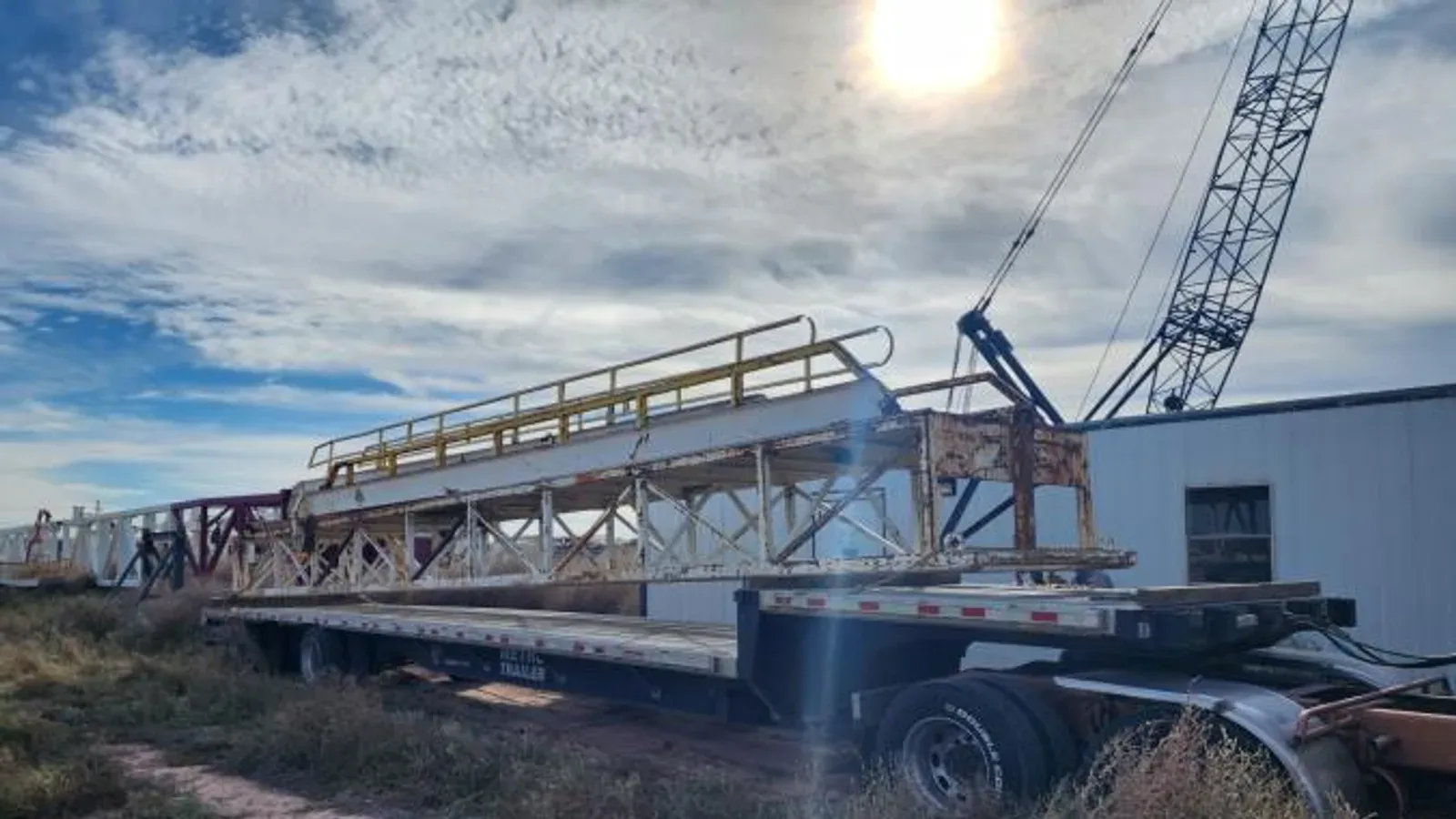
A rig move breaks a drilling rig down into transportable components and relocates them to the next pad. That typically means the substructure, the doghouse, mud pumps, generator sets, the mast or derrick sections, and pipe racks. Each component has its own weight, dimensions and center of gravity, which means a single rig move can require several trailer types working in sequence rather than one truck making repeat trips.
Permits come with the territory. Once a load's weight or dimensions exceed a state's standard limits, the carrier needs an oversize or overweight permit issued by that state's DOT before the load can move on public roads. The federal bridge formula caps gross vehicle weight at 80,000 pounds on interstate highways without a permit, under 23 CFR 658.17, which is why almost every rig move component requires a permit before it leaves location.
A carrier that treats a rig move like routine flatbed freight is the wrong carrier. The work calls for route surveys, permit coordination across state lines when the move crosses them, escort vehicles timed to the load's actual travel window, and someone who knows what a lease road does after three days of rain.
Licensing and Insurance to Verify
FMCSA MC authority
Every rig move carrier needs active FMCSA operating authority (an MC number) that covers the commodity and the vehicle configuration it plans to use. Confirm the authority is not just issued but active, and ask how long the carrier has held it. A newly minted MC number on a heavy haul quote is a reason to ask more questions, not fewer.
Confirm the carrier's authority also covers interstate operation if the move crosses a state line, and ask for its DOT number so the record can be checked directly rather than taken on faith.
Insurance minimums vs industry standard
The industry standard for general liability coverage in trucking is $1M, and that is the floor most carriers quote. Given the replacement value of a substructure, a generator set or a top drive, $1M in coverage does not go far if something is damaged in transit. Total Connection carries $5M in general liability coverage, above that $1M industry standard, and holds FMC OTI/NVOCC license 026203NF and FMCSA MC 280101. Ask any rig move carrier for its certificate of insurance and its cargo coverage limit, not just its liability limit, before you sign a rate confirmation.
- Confirm the MC number is active and matches the carrier's legal name on the quote.
- Request a current certificate of insurance showing both general liability and cargo coverage limits.
- Ask whether coverage extends to the specific equipment type being moved, since some policies exclude high-value machinery above a stated threshold.
Equipment and Permits Required for Rig Moves
Trailer types: lowboy, RGN, beam trailers
Lowboy and removable gooseneck (RGN) trailers are the standard equipment for hauling rig substructures and heavy oilfield machinery. An RGN allows the deck to lower to ground level so equipment can be driven or winched on without a ramp, which matters for substructures and other components that cannot be lifted easily. Beam trailers spread weight across additional axles for the heaviest single-piece loads, such as a mast section that cannot be broken down further.
Oversize/overweight permits and escorts
Heavy haul loads require state-issued oversize/overweight permits, and many states mandate pilot car escorts once a load exceeds specific width or length thresholds set by that state's DOT. Thresholds vary by state, and a load that needs no escort in one state may need one or two once it crosses into the next. A carrier with real rig move experience already knows these thresholds and builds them into the quote instead of discovering them at the state line.
- Ask which states the route crosses and whether permits are already secured or still pending.
- Confirm whether pilot cars, height poles or law enforcement escorts are required for any segment of the route.
- Verify the trailer configuration matches the load's weight distribution, not just its total tonnage.
Questions to Ask Before You Hire
A short list of direct questions separates a carrier that moves rigs regularly from one that is willing to try. Ask them on a video call with the operations lead who will actually run the move, not over email with a sales desk. A rig relocation is a high stakes move with a rig crew waiting on the other end, and the answers tell you quickly whether the experience is real.
- How many rig moves has this specific crew handled in the last twelve months, and in which basins?
- Will someone from your team be on site during the move, at load-out and at the receiving pad, or is this dispatched and tracked from an office?
- What trailer types do you own or have under contract for substructures, mud pumps and mast sections?
- Who pulls the permits, and what is the typical turnaround for the states on this route?
- Do your drivers carry TWIC credentials if the move touches a port-adjacent or restricted facility?
- What happens if a component is damaged in transit: what does the cargo policy actually cover?
TWIC credentials may be required for drivers accessing certain oilfield or port-adjacent facilities, so this is worth confirming early if the route touches restricted access points rather than assuming every driver already carries one.
Red Flags That Signal an Unreliable Carrier
Some warning signs show up before the truck ever gets loaded, and they are worth treating as disqualifying rather than negotiable. A rig move leaves a carrier very little room to improvise once the load is strapped down, so anything vague at the quoting stage tends to turn into a stopped truck later.
- The carrier cannot produce a current certificate of insurance without delay, or the certificate lists a different legal entity than the one quoting the job.
- The quote does not mention permits or escorts at all, which usually means the carrier has not scoped the route.
- Nobody from the carrier is willing to get on a call or go to location, and the whole move is handled by email.
- The dispatcher cannot describe which trailer will carry which component, suggesting the equipment plan was never worked out.
- Nobody asks about pad access, lease road width, turning radius or cattle guards, which are the details that decide whether the last mile works.
- A rate comes back within minutes without a request for the weight and dimensions of each individual component.
Any one of these is a reason to keep looking. A refused permit, a load held at a state line or a damaged mast section costs far more than the spread between two quotes.
How Rig Move Trucking Fits Into Broader Project Cargo
Rig move trucking is a subset of project cargo focused specifically on drilling equipment relocation, and it rarely happens in isolation. The same location that needs a rig moved usually also needs chemicals, drilling fluids or completion products staged on the same schedule, which is why oilfield shippers benefit from working with one team across both. Total Connection handles chemical logistics and heavy project cargo under the same operation, with the same dispatcher managing the rig move and the tank truck delivering the fluids it needs on location.
Project cargo covers more than rig relocation. It takes in plant machinery, heavy haul of single oversized pieces, permit and escort coordination across state lines, and vessel load-out for equipment that finishes its trip by ocean. On an active program the same team is often running the drayage of ISO tanks, the warehousing and distribution of completion products, the customs entry on imported equipment and the truckload backhaul, all while the rig itself is on the road.
For a closer look at the chemical side of an oilfield move, see how to ship oilfield chemicals and shipping drilling fluids, both of which cover the products that typically move alongside a rig relocation.
Get Your Rig Move Quoted
A rig move only goes smoothly when the carrier's oilfield experience, authority, insurance, permits and equipment are confirmed before the load is tendered. For the compliance and cost fundamentals that apply across chemical freight moving through the same sites, see chemical transportation services: a shipper's operational guide. If your operation runs the same lanes on a recurring schedule, dedicated trucking benefits covers what a committed capacity program looks like. Total Connection runs rig moves through the same project cargo services team handling the chemical logistics on site. Request a rig move quote, get us on a call with your operations lead, and we will scope the permits, escorts and trailers before anything leaves location.
What licenses should a rig move trucking company have?
A rig move carrier needs active FMCSA MC authority covering the commodity and vehicle configuration, along with the state oversize/overweight permits required for the specific route. Liability insurance should also sit well above the $1M industry minimum given the value of the equipment involved.
What trailers are used for rig moves?
Lowboy and removable gooseneck (RGN) trailers are the standard equipment for rig substructures and heavy machinery, since an RGN can lower to ground level for loading without a ramp. Beam trailers add axles to spread weight for the heaviest single pieces, such as a mast section that cannot be broken down further.
Do rig moves require pilot car escorts?
Many states require pilot car escorts once a load exceeds specific width, height or length thresholds set by that state's DOT. These thresholds vary by state, so a load needing no escort in one state may require one or two once the route crosses into the next.
How much insurance should a rig move carrier carry?
Look for coverage above the $1M industry standard given the value of oilfield equipment and the cargo exposure involved in a rig move. Ask for a current certificate showing both general liability and cargo coverage limits, not just the liability figure on the quote.
How do you verify a rig move carrier's oilfield experience?
Put the carrier's operations lead on a video call and ask how many rig moves that specific crew has run in the last twelve months and in which basins. Confirm whether someone from their team will be on site at load-out and at the receiving pad. A carrier that will not commit to being on location has not treated the move as the high stakes job it is.
What is the difference between rig move trucking and general project cargo?
Rig move trucking is a subset of project cargo focused specifically on relocating drilling rig components like substructures, mud pumps and mast sections. It is often paired with chemical logistics on the same oilfield site, since the same location typically needs drilling fluids or other chemicals staged on the same schedule.