
A hazmat trucking company is a carrier or broker authorized under 49 CFR Parts 171 through 180 to transport regulated dangerous goods, and vetting one means confirming FMCSA hazmat registration, insurance and driver endorsements before tender. Skipping that step shows up later as a roadside out-of-service order, a rejected load at the receiver, or a fine that lands on the shipper of record as much as the carrier.
What a Hazmat Trucking Company Actually Does
A hazmat trucking company physically moves regulated dangerous goods under its own FMCSA operating authority, which means it runs the equipment, employs or contracts the drivers, and carries the registration required to haul Class 1 through Class 9 materials. That is different from a carrier that subcontracts work it cannot cover, and different again from a freight broker or forwarder, which holds its own authority and insurance and places each load with vetted carriers selected for the product and the lane.
Shippers searching for a "hazmat trucking company" are often really looking for capacity on a specific lane, in a specific trailer type, on a specific timeline, and a single carrier rarely covers all three. A forwarder working across liquid bulk, drayage, truckload, warehousing, ocean and air can match the load to the right equipment instead of forcing the load onto whatever truck is sitting in a yard.
The distinction matters most on hazard classes that require special handling. A Class 8 corrosive in a lined trailer and a Class 3 flammable in a DOT 407 tanker are not interchangeable equipment decisions, and a carrier that only runs dry van cannot absorb either one without subcontracting it out, often without telling the shipper.
Licensing and Insurance to Verify Before You Tender a Load
FMCSA hazmat registration
Any company transporting hazardous materials in quantities that require placarding must carry FMCSA hazmat registration in addition to standard operating authority. This registration is separate from the general MC number and gets checked independently during roadside inspections, so a carrier with a valid MC number but no hazmat registration is not legally allowed to move a placarded load.
Insurance minimums vs industry standard
The general liability level most carriers in trucking carry is $1 million, and that figure is the industry standard a shipper should treat as the floor. Total Connection carries $5 million in general liability, which matters on high-value chemical loads where a single incident can exceed a $1 million policy once cleanup, product loss and third-party claims are added together.
- Confirm the hazmat registration number independently through FMCSA, not just the carrier's own paperwork.
- Ask for the actual certificate of insurance, not a verbal confirmation of coverage limits.
- Check that cargo insurance covers the commodity class being shipped, since some policies exclude specific hazard classes.
Driver Qualifications and Equipment Match
Hazmat endorsement and background check
Drivers hauling placarded hazmat must hold a commercial driver's license with a hazardous materials endorsement, which under 49 CFR 383.93 requires passing a TSA security threat assessment under 49 CFR 1572. That background check is not optional and is not the same as a standard CDL. A driver without the H endorsement cannot legally run the load, full stop.
Equipment matched to hazard class
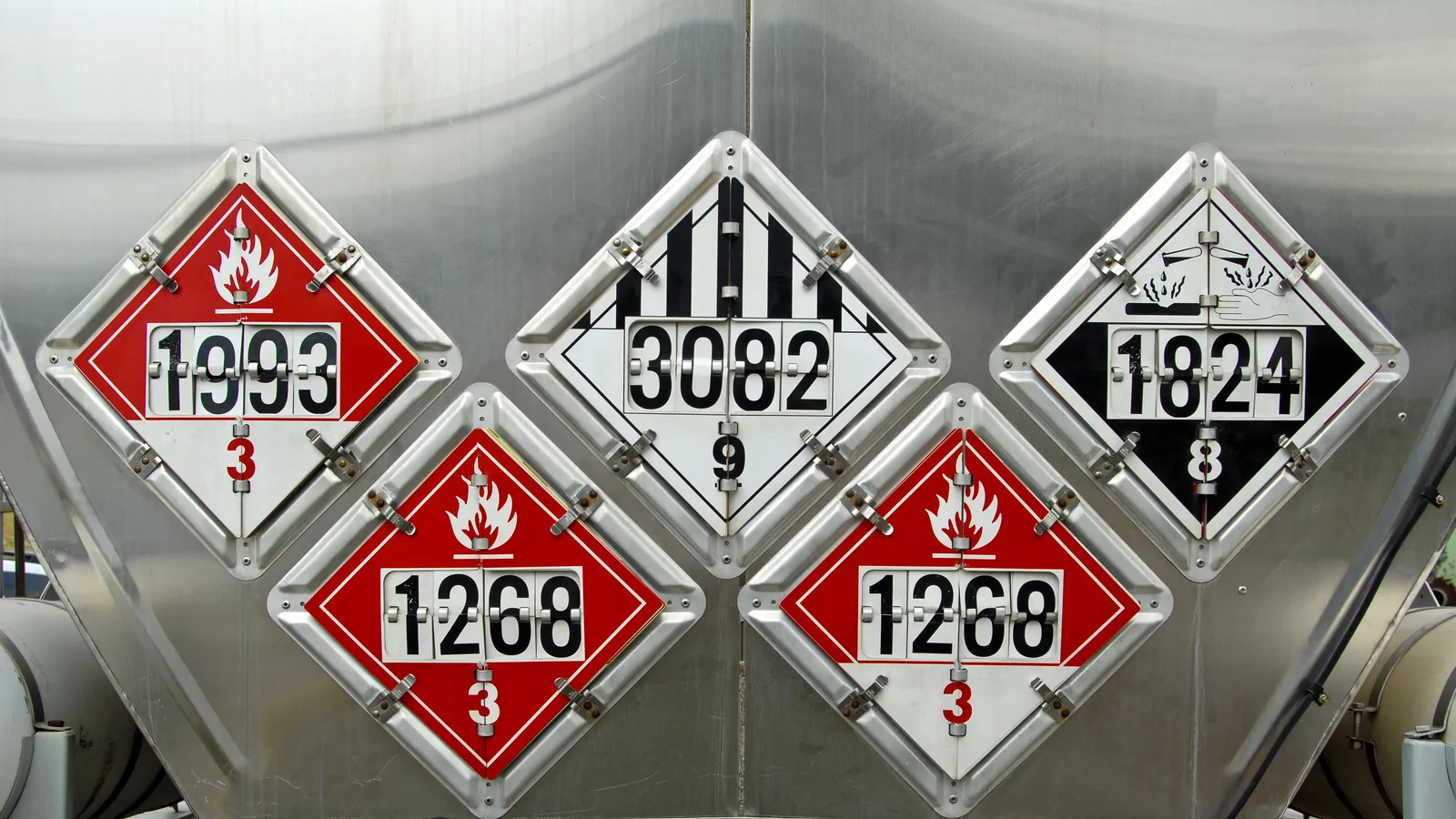
Hazardous materials are classified into nine hazard classes, including Class 3 flammable liquids, Class 6.1 toxics and Class 8 corrosives, each carrying its own packing group and placarding requirement under 49 CFR 172 Subpart E and Subpart F. The trailer has to match the class, not just the general category of liquid. A stainless tanker rated for food-grade product is not automatically rated for a corrosive, and a lined trailer built for one acid family can fail against another.
- Verify the driver's endorsement status matches the hazard class on the bill of lading, not just a generic hazmat endorsement claim.
- Confirm the trailer type, lining and valve configuration against the SDS for the specific product, not the product family.
- Ask whether the carrier runs a documented tank wash program between loads, which matters for cross-contamination risk on multi-product tankers.
Red Flags When Vetting a Hazmat Carrier or Broker
Some warning signs show up before a single load moves, and they are worth treating as disqualifying rather than negotiable. A carrier that cannot produce its hazmat registration number on request, that quotes a rate well below the lane average without explaining the equipment being used, or that cannot name the specific trailer type for the load are all signs the vetting stopped at the sales call.
Subcontracting without disclosure is the hardest red flag to catch and the most common. A broker or small carrier takes the load, cannot cover it with its own equipment, and re-tenders it to a carrier the shipper never vetted. The shipper's bill of lading may list one carrier while a different one shows up at the dock.
- No hazmat registration number available on request, or a number that does not match FMCSA records when checked independently.
- Reluctance to name the specific equipment type before pickup, especially trailer lining, valve type or tank wash history.
- A quoted rate with no explanation of which carrier or driver will actually run the load.
- Insurance documentation that is more than a few months old or does not list the correct commodity class.
Carrier vs Broker vs Freight Forwarder: Which One You Need
The right choice depends on how many lanes, modes and hazard classes a shipper is managing, not just the single load in front of them. A direct carrier works when volume is high and consistent on one lane with one equipment type. A broker can fill gaps but often carries thinner insurance and lighter operational oversight than a forwarder. A forwarder that holds its own licensing and insurance, and that works across liquid bulk, drayage, truckload, warehousing, ocean and air, gives a shipper one point of contact instead of a separate vetting process for every mode.
| Option | Licensing and insurance held | Equipment flexibility across hazard classes |
|---|---|---|
| Direct hazmat carrier | Its own operating authority and hazmat registration | Limited to its own fleet and trailer types |
| Hazmat freight broker | Varies; coverage levels are often minimal | Depends entirely on carrier network quality |
| Hazmat freight forwarder (e.g., Total Connection) | FMC OTI/NVOCC 026203NF, FMCSA MC 280101, $5M general liability | Equipment matched to hazard class across 100,000+ vetted carriers |
Vendor consolidation is the other half of the decision. A shipper running Class 8 corrosives in lined trailers, drums moving LTL and an export leg out of the same plant is managing three vetting files and three sets of paperwork if every mode sits with a different provider. One forwarder holding FMCSA MC 280101 and FMC OTI/NVOCC license 026203NF covers the domestic truckload, the warehousing and the ocean leg under a single file, with the same person answering the phone when the drum count does not match the packing list. That matters little on one spot load and a great deal on a program that tenders every week.
Questions to Ask Before You Sign
A short, specific question list does more vetting work than a long sales conversation. Ask these before a quote becomes a tender:
- What is your FMCSA hazmat registration number, and can I verify it independently through SAFER?
- What is your current general liability coverage, and does it cover the specific hazard class I am shipping?
- Which driver and trailer will actually run this load, and does the driver hold the H endorsement for this class?
- What is your tank wash protocol between loads, and can you document the last wash on this specific trailer?
- If you cannot cover this load with your own equipment, will you disclose the subcontracted carrier before pickup?
Get the answers in writing. A rep who confirms the trailer lining, the endorsement and the last wash by email has created a record that travels with the file, which matters when a receiver rejects a load or an inspector finds a discrepancy between the SDS and the bill of lading. Verbal assurances do not survive a claim, and they do not help the dispatcher who inherits the lane next quarter.
A carrier or forwarder that answers all five without hesitation has done its own internal vetting already. One that hedges on any of them is asking the shipper to find out the hard way, usually at a roadside scale or a closed receiving dock.
Getting the Right Hazmat Capacity on Your Lane
Vetting a hazmat trucking company is a standing requirement, repeated every time the hazard class, the lane or the equipment changes. A carrier approved for a Class 3 flammable in a DOT 407 tanker has not been approved for a Class 8 corrosive in a lined trailer, and the endorsement, the insurance and the wash history all have to be confirmed again against the new product and the new SDS.
Total Connection has worked with 100,000 plus vetted carriers across 30 plus years and 650 plus shippers, matching equipment to hazard class on liquid bulk and chemical loads first, then covering the drayage, truckload, warehousing, ocean and air legs with the same team and the same dispatcher. The credentials behind that work are FMC OTI/NVOCC license 026203NF, FMCSA MC 280101 and $5 million in general liability, all verifiable independently through FMCSA and FMC records.
Review the hazmat trucking regulations that govern classification and placarding, compare options in tanker trucking companies, and see how equipment choices play out in practice in bulk liquid transport companies. For the handling side, read liquid bulk tanker loading and unloading. To get a vetted carrier matched to your hazard class and equipment need, start with liquid bulk and chemical logistics and request a quote at /quote?mode=liquid-bulk.
What license does a hazmat trucking company need?
A hazmat trucking company needs FMCSA operating authority plus separate FMCSA hazmat registration to legally haul placarded loads. Drivers must hold a CDL with a hazardous materials endorsement, which requires passing a TSA security threat assessment under 49 CFR 1572.
How much insurance should a hazmat carrier carry?
The industry standard for general liability in trucking is $1 million, though many shippers require more depending on the commodity and risk profile. Total Connection carries $5 million in general liability, which covers a wider range of incident costs on higher-value chemical loads.
What is the difference between a hazmat carrier and a hazmat freight broker?
A hazmat carrier hauls the load with its own trucks and drivers under its own operating authority. A broker arranges capacity across a carrier network, and a freight forwarder does the same while holding its own licensing and insurance to stand behind the move. The practical difference for a shipper is who is accountable when the equipment or the paperwork is wrong.
How do I check if a hazmat carrier is in good standing with FMCSA?
The FMCSA SAFER system lets anyone look up a carrier's safety rating, operating authority status and insurance filings by MC or DOT number. Checking SAFER independently, rather than relying on documents the carrier provides, catches lapsed authority or insurance before a load is tendered.
Do all hazmat shipments require placards?
Placarding requirements depend on the hazard class and the quantity being shipped under 49 CFR 172 Subpart F, so not every hazmat shipment requires placards. Small quantities of certain lower-risk materials fall under exception thresholds, while Class 1 explosives and other high-hazard materials require placarding regardless of quantity.